
NH SEPTIC INSTALLER – SYSTEM INSTALLATION & CONSTRUCTION PRACTICE EXAM
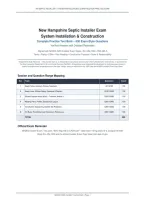
New Hampshire Septic Installer Exam
System Installation & Construction
Complete Practice Test Bank – 600 Exam-Style Questions
Verified Answers with Detailed Rationales
Aligned with NHDES ISDS Installer Exam Topics • Env-Wq 1000 • RSA 485-A
Tanks • Piping • EDAs • Plan Reading • Construction Practices • Rules & Responsibility
Independent Study Resource – This practice bank is an independent educational resource and is NOT affiliated with, endorsed by, or sponsored by
the New Hampshire Department of Environmental Services (NHDES). All questions were independently developed for study purposes based on
publicly available exam preparation topics and rules. Always study the official Env-Wq 1000 rules and NHDES Installer Exam Prep Sheet.
Section and Question Range Mapping
Sec Topic Questions Count
1 Septic Tanks, Access & Primary Treatment Q1-Q100 100
2 Sewer Lines, Effluent Piping, Cleanouts & Distribu... Q101-Q200 100
3 Effluent Disposal Areas (EDA) – Trenches, Beds & C... Q201-Q300 100
4 Reading Plans, Profiles, Elevations & Layout Q301-Q400 100
5 Construction Sequencing, Backfill, Site Protection... Q401-Q500 100
6 NH Rules, Permitting, Exam Structure & Professiona... Q501-Q600 100
TOTAL 600
Official Exam Reminder
NHDES Installer Exam: Two parts • 80% required on EACH part • Open book • Bring photo ID & acceptance letter
Study Env-Wq 1000 and the official Installer Exam Prep Sheet from des.nh.gov
NHDES ISDS Installer Practice Bank | Page 1
, NH SEPTIC INSTALLER – SYSTEM INSTALLATION & CONSTRUCTION PRACTICE EXAM
Section 1: Septic Tanks, Access & Primary Treatment
Q1: What is the primary function of a septic tank in an individual sewage disposal
system?
A. To fully treat wastewater to drinking water standards
B. To separate solids, allow settling and flotation, and provide primary treatment before
effluent reaches the disposal area [CORRECT]
C. To pump effluent uphill only
D. To eliminate the need for an effluent disposal area
Correct Answer: B
Rationale: The septic tank provides primary treatment by settling solids and retaining scum so clearer
effluent can flow to the EDA.
Q2: When an approved plan calls for a single large septic tank but site conditions
require two tanks in series, the first tank must generally be sized to meet minimum
requirements for:
A. Any size the installer prefers
B. The first tank meeting minimum capacity rules so that solids are adequately settled
before the second tank [CORRECT]
C. Only 50 gallons
D. No minimum applies
Correct Answer: B
Rationale: Rules typically require the first tank in series to provide adequate primary settling capacity.
NHDES ISDS Installer Practice Bank | Page 2
, NH SEPTIC INSTALLER – SYSTEM INSTALLATION & CONSTRUCTION PRACTICE EXAM
Q3: Septic tanks must be installed:
A. Above the seasonal high water table with no bedding
B. Level, on a suitable base, with proper inlet/outlet orientation and access for
maintenance as required by the approved plan and rules [CORRECT]
C. At any random slope
D. Without any risers or access
Correct Answer: B
Rationale: Proper installation requires a stable base, correct orientation, level setting, and required
access.
Q4: Access risers on septic tanks are important because they:
A. Are only decorative
B. Allow inspection and pumping without extensive excavation [CORRECT]
C. Replace the need for a tank
D. Are prohibited by rule
Correct Answer: B
Rationale: Risers provide access for maintenance and inspection.
Q5: Effluent filters, when required or installed, are typically located:
A. On the inlet only
B. On the outlet of the septic tank to reduce solids leaving the tank [CORRECT]
C. Only in the leach field
D. Only at the building sewer cleanout
Correct Answer: B
Rationale: Outlet filters help keep solids in the tank and protect the EDA.
NHDES ISDS Installer Practice Bank | Page 3
, NH SEPTIC INSTALLER – SYSTEM INSTALLATION & CONSTRUCTION PRACTICE EXAM
Q6: A septic tank that is not watertight can cause:
A. No problems
B. Infiltration of groundwater or exfiltration of sewage, both of which can impair system
performance and create environmental or health risks [CORRECT]
C. Only better treatment
D. Automatic approval
Correct Answer: B
Rationale: Leakage either direction undermines treatment and can contaminate groundwater or overload
the system.
Q7: When bedding a septic tank, the installer should:
A. Place it on large boulders only
B. Provide a stable, level base of suitable material as required so the tank does not settle
unevenly [CORRECT]
C. Leave voids under the tank
D. Set it on organic topsoil only
Correct Answer: B
Rationale: A proper base prevents differential settlement and structural stress.
Q8: The inlet baffle or tee in a septic tank is intended to:
A. Increase turbulence as much as possible
B. Direct flow downward and reduce disturbance of the scum and sludge layers
[CORRECT]
C. Block all flow
D. Replace the outlet
Correct Answer: B
Rationale: Inlet devices help protect the scum and sludge layers from disruption.
NHDES ISDS Installer Practice Bank | Page 4
New Hampshire Septic Installer Exam
System Installation & Construction
Complete Practice Test Bank – 600 Exam-Style Questions
Verified Answers with Detailed Rationales
Aligned with NHDES ISDS Installer Exam Topics • Env-Wq 1000 • RSA 485-A
Tanks • Piping • EDAs • Plan Reading • Construction Practices • Rules & Responsibility
Independent Study Resource – This practice bank is an independent educational resource and is NOT affiliated with, endorsed by, or sponsored by
the New Hampshire Department of Environmental Services (NHDES). All questions were independently developed for study purposes based on
publicly available exam preparation topics and rules. Always study the official Env-Wq 1000 rules and NHDES Installer Exam Prep Sheet.
Section and Question Range Mapping
Sec Topic Questions Count
1 Septic Tanks, Access & Primary Treatment Q1-Q100 100
2 Sewer Lines, Effluent Piping, Cleanouts & Distribu... Q101-Q200 100
3 Effluent Disposal Areas (EDA) – Trenches, Beds & C... Q201-Q300 100
4 Reading Plans, Profiles, Elevations & Layout Q301-Q400 100
5 Construction Sequencing, Backfill, Site Protection... Q401-Q500 100
6 NH Rules, Permitting, Exam Structure & Professiona... Q501-Q600 100
TOTAL 600
Official Exam Reminder
NHDES Installer Exam: Two parts • 80% required on EACH part • Open book • Bring photo ID & acceptance letter
Study Env-Wq 1000 and the official Installer Exam Prep Sheet from des.nh.gov
NHDES ISDS Installer Practice Bank | Page 1
, NH SEPTIC INSTALLER – SYSTEM INSTALLATION & CONSTRUCTION PRACTICE EXAM
Section 1: Septic Tanks, Access & Primary Treatment
Q1: What is the primary function of a septic tank in an individual sewage disposal
system?
A. To fully treat wastewater to drinking water standards
B. To separate solids, allow settling and flotation, and provide primary treatment before
effluent reaches the disposal area [CORRECT]
C. To pump effluent uphill only
D. To eliminate the need for an effluent disposal area
Correct Answer: B
Rationale: The septic tank provides primary treatment by settling solids and retaining scum so clearer
effluent can flow to the EDA.
Q2: When an approved plan calls for a single large septic tank but site conditions
require two tanks in series, the first tank must generally be sized to meet minimum
requirements for:
A. Any size the installer prefers
B. The first tank meeting minimum capacity rules so that solids are adequately settled
before the second tank [CORRECT]
C. Only 50 gallons
D. No minimum applies
Correct Answer: B
Rationale: Rules typically require the first tank in series to provide adequate primary settling capacity.
NHDES ISDS Installer Practice Bank | Page 2
, NH SEPTIC INSTALLER – SYSTEM INSTALLATION & CONSTRUCTION PRACTICE EXAM
Q3: Septic tanks must be installed:
A. Above the seasonal high water table with no bedding
B. Level, on a suitable base, with proper inlet/outlet orientation and access for
maintenance as required by the approved plan and rules [CORRECT]
C. At any random slope
D. Without any risers or access
Correct Answer: B
Rationale: Proper installation requires a stable base, correct orientation, level setting, and required
access.
Q4: Access risers on septic tanks are important because they:
A. Are only decorative
B. Allow inspection and pumping without extensive excavation [CORRECT]
C. Replace the need for a tank
D. Are prohibited by rule
Correct Answer: B
Rationale: Risers provide access for maintenance and inspection.
Q5: Effluent filters, when required or installed, are typically located:
A. On the inlet only
B. On the outlet of the septic tank to reduce solids leaving the tank [CORRECT]
C. Only in the leach field
D. Only at the building sewer cleanout
Correct Answer: B
Rationale: Outlet filters help keep solids in the tank and protect the EDA.
NHDES ISDS Installer Practice Bank | Page 3
, NH SEPTIC INSTALLER – SYSTEM INSTALLATION & CONSTRUCTION PRACTICE EXAM
Q6: A septic tank that is not watertight can cause:
A. No problems
B. Infiltration of groundwater or exfiltration of sewage, both of which can impair system
performance and create environmental or health risks [CORRECT]
C. Only better treatment
D. Automatic approval
Correct Answer: B
Rationale: Leakage either direction undermines treatment and can contaminate groundwater or overload
the system.
Q7: When bedding a septic tank, the installer should:
A. Place it on large boulders only
B. Provide a stable, level base of suitable material as required so the tank does not settle
unevenly [CORRECT]
C. Leave voids under the tank
D. Set it on organic topsoil only
Correct Answer: B
Rationale: A proper base prevents differential settlement and structural stress.
Q8: The inlet baffle or tee in a septic tank is intended to:
A. Increase turbulence as much as possible
B. Direct flow downward and reduce disturbance of the scum and sludge layers
[CORRECT]
C. Block all flow
D. Replace the outlet
Correct Answer: B
Rationale: Inlet devices help protect the scum and sludge layers from disruption.
NHDES ISDS Installer Practice Bank | Page 4


