
PMHNP Certification Exam 2026/2027 - 175 Verified Q&A - ANCC PMHNP-BC Prep 5 Core Domains | Instant Download
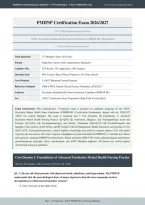
PMHNP Certification Exam 2026/2027
175 Verified Questions & Answers
ANCC Psychiatric-Mental Health Nurse Practitioner (PMHNP-BC) Preparation
5 Core Domains | Instant Download
Total Questions 175 Multiple Choice (Verified)
Format Single Best Answer with Comprehensive Rationales
Cognitive Mix 25% Recall | 55% Application | 20% Analysis
Question Style 80% Scenario-Based Clinical Vignettes | 20% Direct Recall
Core Domains 5 ANCC Blueprint Content Domains
Reference Standard DSM-5-TR & Current Clinical Practice Guidelines (2026/2027)
Audience Psychiatric-Mental Health Nurse Practitioner Candidates (PMHNP-BC)
Use ANCC Certification Exam Preparation | High-Yield Verified Q&A;
Exam Instructions: This comprehensive 175-question exam is designed for candidates preparing for the ANCC
Psychiatric-Mental Health Nurse Practitioner (PMHNP-BC) Certification Examination, aligned with the 2026/2027
ANCC test content blueprint. The exam is organized into 5 Core Domains: (1) Foundations of Advanced
Psychiatric-Mental Health Nursing Practice (Q1-Q30); (2) Assessment, Diagnosis, and Psychopathology Across the
Lifespan (Q31-Q65); (3) Psychopharmacology and Somatic Treatments (Q66-Q105); (4) Psychotherapeutic and
Integrative Interventions (Q106-Q140); and (5) Complex Clinical Management, Health Promotion, and Systems of Care
(Q141-Q175). Each question presents a clinical vignette or knowledge item with four response options (A-D). One option
represents the best answer; the correct response is highlighted in green and labeled [CORRECT]. A rationale box follows
each question containing PMHNP-level psychiatric clinical reasoning, DSM-5-TR criteria, pharmacological mechanisms,
psychotherapeutic principles, safety considerations, and ANCC blueprint alignment. All answers are verified against
current clinical practice guidelines.
Core Domain 1: Foundations of Advanced Psychiatric-Mental Health Nursing Practice
Theories, Neurobiology, Ethics, & Scope of Practice (Q1 - Q30)
Q1: A 28-year-old client presents with depressed mood, anhedonia, and hypersomnia. The PMHNP
understands that the neurobiological basis of major depressive disorder most commonly involves
dysregulation in which neurotransmitter systems?
A. Only serotonin, in the raphe nuclei
Page 1 | 175 Questions | ANCC PMHNP-BC Certification Blueprint
,PMHNP Certification Exam 2026/2027 - 175 Verified Q&A - ANCC PMHNP-BC Prep 5 Core Domains | Instant Download
B. Serotonin, norepinephrine, and dopamine, with additional roles for glutamate and GABA in
neuroplasticity [CORRECT]
C. Only acetylcholine, in the basal forebrain
D. Only histamine, in the tuberomammillary nucleus
Correct Answer: B — Serotonin, norepinephrine, and dopamine, with additional roles for ...
Rationale: MDD involves dysregulation of multiple monoamines (serotonin, norepinephrine, dopamine) and increasing evidence
supports roles for glutamate and GABA in neuroplasticity and the mechanism of rapid-acting agents like ketamine. (A), (C), and
(D) are incomplete; modern psychopharmacology recognizes MDD as a network disorder, not a single-neurotransmitter
deficiency. ANCC test-taking strategy: choose the most comprehensive, biologically plausible answer when asked about
psychiatric neurobiology.
Q2: A PMHNP is treating a client who presents with a positive symptom of schizophrenia. The client reports
hearing voices that comment on their behavior. The PMHNP recognizes that positive symptoms are most
associated with dysregulation in which dopaminergic pathway?
A. Mesocortical pathway
B. Mesolimbic pathway, with hyperactive dopamine transmission [CORRECT]
C. Nigrostriatal pathway
D. Tuberoinfundibular pathway
Correct Answer: B — Mesolimbic pathway, with hyperactive dopamine transmission
Rationale: Positive symptoms (hallucinations, delusions) are linked to hyperactive dopamine in the mesolimbic pathway. The
mesocortical pathway (A) is associated with negative and cognitive symptoms due to hypoactive dopamine. The nigrostriatal
pathway (C) is associated with motor side effects of antipsychotics (EPS). The tuberoinfundibular pathway (D) regulates
prolactin and is linked to antipsychotic-induced hyperprolactinemia.
Q3: A PMHNP applies Beck's cognitive triad in the assessment of a depressed adolescent. The cognitive triad
describes negative views about which three domains?
A. Self, world, and future [CORRECT]
B. Past, present, and dreams
C. Family, friends, and school only
D. Body, mind, and spirit
Correct Answer: A — Self, world, and future
Rationale: Beck's cognitive triad comprises negative views about the self ('I am worthless'), the world ('the world is unfair'), and
the future ('things will never improve'). This triad maintains depression and is the target of cognitive-behavioral therapy. The
other options do not reflect Beck's specific triad.
Q4: A client in therapy identifies automatic thoughts and works with the PMHNP to evaluate evidence for
and against these thoughts. This therapy is best described as:
A. Psychoanalytic psychotherapy
B. Cognitive behavioral therapy, targeting cognitive distortions through structured techniques
[CORRECT]
C. Dialectical behavior therapy
Page 2 | 175 Questions | ANCC PMHNP-BC Certification Blueprint
,PMHNP Certification Exam 2026/2027 - 175 Verified Q&A - ANCC PMHNP-BC Prep 5 Core Domains | Instant Download
D. Supportive psychotherapy
Correct Answer: B — Cognitive behavioral therapy, targeting cognitive distortions throu...
Rationale: Identifying and evaluating automatic thoughts is the core of CBT, which addresses cognitive distortions through
structured techniques like thought records and behavioral experiments. Psychoanalytic therapy (A) explores unconscious
processes and transference. DBT (C) integrates mindfulness, distress tolerance, and emotion regulation. Supportive therapy (D)
emphasizes empathy and ego support without structured cognitive restructuring.
Q5: A PMHNP works with a client who uses splitting, idealization, and devaluation. The PMHNP recognizes
these defense mechanisms as most characteristic of which personality structure?
A. Schizoid personality organization
B. Borderline personality organization [CORRECT]
C. Narcissistic personality organization only
D. Antisocial personality organization only
Correct Answer: B — Borderline personality organization
Rationale: Splitting, idealization, and devaluation are hallmark primitive defense mechanisms of borderline personality
organization as described by Kernberg, seen in borderline personality disorder and other Cluster B disorders. (A) is wrong;
schizoid organization uses intellectualization and detachment. (C) and (D) may use related defenses but splitting is most
characteristic of borderline organization.
Q6: According to Erikson's stages of psychosocial development, an adolescent (12-18 years) is primarily
negotiating which developmental task?
A. Trust vs. mistrust
B. Autonomy vs. shame and doubt
C. Identity vs. role confusion [CORRECT]
D. Intimacy vs. isolation
Correct Answer: C — Identity vs. role confusion
Rationale: Erikson's stage for adolescence is identity vs. role confusion, in which the adolescent develops a coherent sense of self
and values. (A) is infancy. (B) is toddlerhood. (D) is young adulthood. Correct stage identification is essential for
developmentally appropriate assessment and intervention.
Q7: A PMHNP receives a subpoena requesting records of a client in treatment for depression. The client has
not authorized release. The most appropriate action is to:
A. Immediately release the records because a subpoena is a court order
B. Refuse to release records, notify the client, and seek a court order or written authorization before
disclosure [CORRECT]
C. Release only the diagnostic information and withhold treatment notes
D. Discuss the records with the requesting attorney informally
Correct Answer: B — Refuse to release records, notify the client, and seek a court orde...
Page 3 | 175 Questions | ANCC PMHNP-BC Certification Blueprint
, PMHNP Certification Exam 2026/2027 - 175 Verified Q&A - ANCC PMHNP-BC Prep 5 Core Domains | Instant Download
Rationale: A subpoena is not equivalent to a court order compelling disclosure; under HIPAA and state confidentiality laws, the
PMHNP must obtain the client's authorization or a court order before releasing records. Notifying the client allows them to
object or quash the subpoena. (A) is wrong; mere compliance with a subpoena may violate confidentiality. (C) and (D) breach
confidentiality.
Q8: A client states during a session, 'When I leave here today, I'm going to kill my ex-boss.' The PMHNP
determines the threat is serious, specific, and directed at an identifiable victim. Under Tarasoff, the PMHNP
has a duty to:
A. Maintain strict confidentiality because the threat was made in therapy
B. Warn the identifiable victim, notify law enforcement, and take reasonable steps to prevent the harm
[CORRECT]
C. Only document the statement and continue treatment as usual
D. Only involuntary hospitalize the client without warning the victim
Correct Answer: B — Warn the identifiable victim, notify law enforcement, and take reas...
Rationale: Tarasoff v. Regents of University of California established a duty to warn and protect identifiable victims of serious
threats. The PMHNP must warn the victim, notify law enforcement, and take reasonable protective steps, including possible
hospitalization. (A) is wrong; confidentiality yields to the duty to protect. (C) is insufficient. (D) may be necessary but does not
satisfy the duty to warn the victim.
Q9: A PMHNP is considering initiating involuntary commitment for a client with severe, persistent mental
illness. In most jurisdictions, the criteria for involuntary commitment include all of the following EXCEPT:
A. Presence of a mental illness
B. Danger to self or others, or grave disability
C. Lack of capacity to make treatment decisions
D. Family preference alone, without meeting other criteria [CORRECT]
Correct Answer: D — Family preference alone, without meeting other criteria
Rationale: Involuntary commitment generally requires mental illness plus danger to self/others or grave disability, and often lack
of capacity. Family preference alone does not satisfy legal criteria. (A), (B), and (C) are common statutory elements.
Commitment standards vary by state but always require more than family preference.
Q10: A PMHNP prescribes a new medication to a client. For informed consent to be valid, the client must be
informed of all of the following EXCEPT:
A. The nature and purpose of the treatment
B. Risks, benefits, and alternatives, including no treatment
C. The provider's personal financial interests in the medication [CORRECT]
D. The right to refuse or withdraw consent at any time
Correct Answer: C — The provider's personal financial interests in the medication
Rationale: Informed consent requires disclosure of the nature, purpose, risks, benefits, and alternatives including no treatment,
and the right to refuse or withdraw. The provider's personal financial interests are not generally required, although conflicts may
be addressed under disclosure rules for research. (A), (B), and (D) are core elements of informed consent.
Page 4 | 175 Questions | ANCC PMHNP-BC Certification Blueprint
PMHNP Certification Exam 2026/2027
175 Verified Questions & Answers
ANCC Psychiatric-Mental Health Nurse Practitioner (PMHNP-BC) Preparation
5 Core Domains | Instant Download
Total Questions 175 Multiple Choice (Verified)
Format Single Best Answer with Comprehensive Rationales
Cognitive Mix 25% Recall | 55% Application | 20% Analysis
Question Style 80% Scenario-Based Clinical Vignettes | 20% Direct Recall
Core Domains 5 ANCC Blueprint Content Domains
Reference Standard DSM-5-TR & Current Clinical Practice Guidelines (2026/2027)
Audience Psychiatric-Mental Health Nurse Practitioner Candidates (PMHNP-BC)
Use ANCC Certification Exam Preparation | High-Yield Verified Q&A;
Exam Instructions: This comprehensive 175-question exam is designed for candidates preparing for the ANCC
Psychiatric-Mental Health Nurse Practitioner (PMHNP-BC) Certification Examination, aligned with the 2026/2027
ANCC test content blueprint. The exam is organized into 5 Core Domains: (1) Foundations of Advanced
Psychiatric-Mental Health Nursing Practice (Q1-Q30); (2) Assessment, Diagnosis, and Psychopathology Across the
Lifespan (Q31-Q65); (3) Psychopharmacology and Somatic Treatments (Q66-Q105); (4) Psychotherapeutic and
Integrative Interventions (Q106-Q140); and (5) Complex Clinical Management, Health Promotion, and Systems of Care
(Q141-Q175). Each question presents a clinical vignette or knowledge item with four response options (A-D). One option
represents the best answer; the correct response is highlighted in green and labeled [CORRECT]. A rationale box follows
each question containing PMHNP-level psychiatric clinical reasoning, DSM-5-TR criteria, pharmacological mechanisms,
psychotherapeutic principles, safety considerations, and ANCC blueprint alignment. All answers are verified against
current clinical practice guidelines.
Core Domain 1: Foundations of Advanced Psychiatric-Mental Health Nursing Practice
Theories, Neurobiology, Ethics, & Scope of Practice (Q1 - Q30)
Q1: A 28-year-old client presents with depressed mood, anhedonia, and hypersomnia. The PMHNP
understands that the neurobiological basis of major depressive disorder most commonly involves
dysregulation in which neurotransmitter systems?
A. Only serotonin, in the raphe nuclei
Page 1 | 175 Questions | ANCC PMHNP-BC Certification Blueprint
,PMHNP Certification Exam 2026/2027 - 175 Verified Q&A - ANCC PMHNP-BC Prep 5 Core Domains | Instant Download
B. Serotonin, norepinephrine, and dopamine, with additional roles for glutamate and GABA in
neuroplasticity [CORRECT]
C. Only acetylcholine, in the basal forebrain
D. Only histamine, in the tuberomammillary nucleus
Correct Answer: B — Serotonin, norepinephrine, and dopamine, with additional roles for ...
Rationale: MDD involves dysregulation of multiple monoamines (serotonin, norepinephrine, dopamine) and increasing evidence
supports roles for glutamate and GABA in neuroplasticity and the mechanism of rapid-acting agents like ketamine. (A), (C), and
(D) are incomplete; modern psychopharmacology recognizes MDD as a network disorder, not a single-neurotransmitter
deficiency. ANCC test-taking strategy: choose the most comprehensive, biologically plausible answer when asked about
psychiatric neurobiology.
Q2: A PMHNP is treating a client who presents with a positive symptom of schizophrenia. The client reports
hearing voices that comment on their behavior. The PMHNP recognizes that positive symptoms are most
associated with dysregulation in which dopaminergic pathway?
A. Mesocortical pathway
B. Mesolimbic pathway, with hyperactive dopamine transmission [CORRECT]
C. Nigrostriatal pathway
D. Tuberoinfundibular pathway
Correct Answer: B — Mesolimbic pathway, with hyperactive dopamine transmission
Rationale: Positive symptoms (hallucinations, delusions) are linked to hyperactive dopamine in the mesolimbic pathway. The
mesocortical pathway (A) is associated with negative and cognitive symptoms due to hypoactive dopamine. The nigrostriatal
pathway (C) is associated with motor side effects of antipsychotics (EPS). The tuberoinfundibular pathway (D) regulates
prolactin and is linked to antipsychotic-induced hyperprolactinemia.
Q3: A PMHNP applies Beck's cognitive triad in the assessment of a depressed adolescent. The cognitive triad
describes negative views about which three domains?
A. Self, world, and future [CORRECT]
B. Past, present, and dreams
C. Family, friends, and school only
D. Body, mind, and spirit
Correct Answer: A — Self, world, and future
Rationale: Beck's cognitive triad comprises negative views about the self ('I am worthless'), the world ('the world is unfair'), and
the future ('things will never improve'). This triad maintains depression and is the target of cognitive-behavioral therapy. The
other options do not reflect Beck's specific triad.
Q4: A client in therapy identifies automatic thoughts and works with the PMHNP to evaluate evidence for
and against these thoughts. This therapy is best described as:
A. Psychoanalytic psychotherapy
B. Cognitive behavioral therapy, targeting cognitive distortions through structured techniques
[CORRECT]
C. Dialectical behavior therapy
Page 2 | 175 Questions | ANCC PMHNP-BC Certification Blueprint
,PMHNP Certification Exam 2026/2027 - 175 Verified Q&A - ANCC PMHNP-BC Prep 5 Core Domains | Instant Download
D. Supportive psychotherapy
Correct Answer: B — Cognitive behavioral therapy, targeting cognitive distortions throu...
Rationale: Identifying and evaluating automatic thoughts is the core of CBT, which addresses cognitive distortions through
structured techniques like thought records and behavioral experiments. Psychoanalytic therapy (A) explores unconscious
processes and transference. DBT (C) integrates mindfulness, distress tolerance, and emotion regulation. Supportive therapy (D)
emphasizes empathy and ego support without structured cognitive restructuring.
Q5: A PMHNP works with a client who uses splitting, idealization, and devaluation. The PMHNP recognizes
these defense mechanisms as most characteristic of which personality structure?
A. Schizoid personality organization
B. Borderline personality organization [CORRECT]
C. Narcissistic personality organization only
D. Antisocial personality organization only
Correct Answer: B — Borderline personality organization
Rationale: Splitting, idealization, and devaluation are hallmark primitive defense mechanisms of borderline personality
organization as described by Kernberg, seen in borderline personality disorder and other Cluster B disorders. (A) is wrong;
schizoid organization uses intellectualization and detachment. (C) and (D) may use related defenses but splitting is most
characteristic of borderline organization.
Q6: According to Erikson's stages of psychosocial development, an adolescent (12-18 years) is primarily
negotiating which developmental task?
A. Trust vs. mistrust
B. Autonomy vs. shame and doubt
C. Identity vs. role confusion [CORRECT]
D. Intimacy vs. isolation
Correct Answer: C — Identity vs. role confusion
Rationale: Erikson's stage for adolescence is identity vs. role confusion, in which the adolescent develops a coherent sense of self
and values. (A) is infancy. (B) is toddlerhood. (D) is young adulthood. Correct stage identification is essential for
developmentally appropriate assessment and intervention.
Q7: A PMHNP receives a subpoena requesting records of a client in treatment for depression. The client has
not authorized release. The most appropriate action is to:
A. Immediately release the records because a subpoena is a court order
B. Refuse to release records, notify the client, and seek a court order or written authorization before
disclosure [CORRECT]
C. Release only the diagnostic information and withhold treatment notes
D. Discuss the records with the requesting attorney informally
Correct Answer: B — Refuse to release records, notify the client, and seek a court orde...
Page 3 | 175 Questions | ANCC PMHNP-BC Certification Blueprint
, PMHNP Certification Exam 2026/2027 - 175 Verified Q&A - ANCC PMHNP-BC Prep 5 Core Domains | Instant Download
Rationale: A subpoena is not equivalent to a court order compelling disclosure; under HIPAA and state confidentiality laws, the
PMHNP must obtain the client's authorization or a court order before releasing records. Notifying the client allows them to
object or quash the subpoena. (A) is wrong; mere compliance with a subpoena may violate confidentiality. (C) and (D) breach
confidentiality.
Q8: A client states during a session, 'When I leave here today, I'm going to kill my ex-boss.' The PMHNP
determines the threat is serious, specific, and directed at an identifiable victim. Under Tarasoff, the PMHNP
has a duty to:
A. Maintain strict confidentiality because the threat was made in therapy
B. Warn the identifiable victim, notify law enforcement, and take reasonable steps to prevent the harm
[CORRECT]
C. Only document the statement and continue treatment as usual
D. Only involuntary hospitalize the client without warning the victim
Correct Answer: B — Warn the identifiable victim, notify law enforcement, and take reas...
Rationale: Tarasoff v. Regents of University of California established a duty to warn and protect identifiable victims of serious
threats. The PMHNP must warn the victim, notify law enforcement, and take reasonable protective steps, including possible
hospitalization. (A) is wrong; confidentiality yields to the duty to protect. (C) is insufficient. (D) may be necessary but does not
satisfy the duty to warn the victim.
Q9: A PMHNP is considering initiating involuntary commitment for a client with severe, persistent mental
illness. In most jurisdictions, the criteria for involuntary commitment include all of the following EXCEPT:
A. Presence of a mental illness
B. Danger to self or others, or grave disability
C. Lack of capacity to make treatment decisions
D. Family preference alone, without meeting other criteria [CORRECT]
Correct Answer: D — Family preference alone, without meeting other criteria
Rationale: Involuntary commitment generally requires mental illness plus danger to self/others or grave disability, and often lack
of capacity. Family preference alone does not satisfy legal criteria. (A), (B), and (C) are common statutory elements.
Commitment standards vary by state but always require more than family preference.
Q10: A PMHNP prescribes a new medication to a client. For informed consent to be valid, the client must be
informed of all of the following EXCEPT:
A. The nature and purpose of the treatment
B. Risks, benefits, and alternatives, including no treatment
C. The provider's personal financial interests in the medication [CORRECT]
D. The right to refuse or withdraw consent at any time
Correct Answer: C — The provider's personal financial interests in the medication
Rationale: Informed consent requires disclosure of the nature, purpose, risks, benefits, and alternatives including no treatment,
and the right to refuse or withdraw. The provider's personal financial interests are not generally required, although conflicts may
be addressed under disclosure rules for research. (A), (B), and (D) are core elements of informed consent.
Page 4 | 175 Questions | ANCC PMHNP-BC Certification Blueprint


