
1
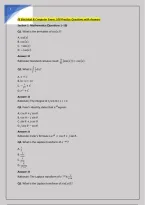
FE Electrical & Computer Exam: 100 Practice Questions with Answers
Section 1: Mathematics (Questions 1–10)
Q1. What is the derivative of sin(𝑥)?
A. sin(𝑥)
B. cos(𝑥)
C. −sin(𝑥)
D. −cos(𝑥)
Answer: B
𝑑
Rationale: Standard calculus result: 𝑑𝑥 [sin(𝑥)] = cos(𝑥).
1
Q2. What is ∫ 𝑥 𝑑𝑥?
A. 𝑥 + 𝐶
B. ln ∣ 𝑥 ∣ +𝐶
1
C. − 𝑥 2 + 𝐶
D. 𝑒 𝑥 + 𝐶
Answer: B
Rationale: The integral of 1/𝑥is ln ∣ 𝑥 ∣ +𝐶.
Q3. Euler's identity states that 𝑒 𝑗𝜃 equals:
A. cos 𝜃 + 𝑗 sin 𝜃
B. cos 𝜃 − 𝑗 sin 𝜃
C. sin 𝜃 + 𝑗 cos 𝜃
D. 𝑗 cos 𝜃 − sin 𝜃
Answer: A
Rationale: Euler's formula is 𝑒 𝑗𝜃 = cos 𝜃 + 𝑗 sin 𝜃.
Q4. What is the Laplace transform of 𝑒 −𝑎𝑡 ?
1
A.
𝑠
1
B. 𝑠+𝑎
1
C. 𝑠−𝑎
𝑎
D. 𝑠2 +𝑎2
Answer: B
1
Rationale: The Laplace transform of 𝑒 −𝑎𝑡 is 𝑠+𝑎.
Q5. What is the Laplace transform of sin(𝜔𝑡)?
,2
𝑠
A. 𝑠2 +𝜔2
𝜔
B. 𝑠2 +𝜔2
1
C. 𝑠2 +𝜔2
𝜔
D. 𝑠2 −𝜔2
Answer: B
𝜔
Rationale: The Laplace transform of sin(𝜔𝑡)is 𝑠2 +𝜔2.
𝑎 𝑏
Q6. For a 2×2 matrix 𝐴 = [ ], the determinant is:
𝑐 𝑑
A. 𝑎 + 𝑑 − 𝑏 − 𝑐
B. 𝑎𝑑 − 𝑏𝑐
C. 𝑎𝑐 − 𝑏𝑑
D. 𝑎𝑏 − 𝑐𝑑
Answer: B
Rationale: The determinant of a 2×2 matrix is 𝑎𝑑 − 𝑏𝑐.
Q7. Eigenvalues of a matrix 𝐴are found by solving:
A. det(𝐴) = 0
B. det(𝐴 − 𝜆𝐼) = 0
C. 𝐴𝜆 = 0
D. det(𝐴 + 𝜆𝐼) = 0
Answer: B
Rationale: Eigenvalues are found by solving det(𝐴 − 𝜆𝐼) = 0.
Q8. The dot product of two vectors 𝐴and 𝐵is:
A. ∣ 𝐴 ∣∣ 𝐵 ∣ sin 𝜃
B. ∣ 𝐴 ∣∣ 𝐵 ∣ cos 𝜃
C. ∣ 𝐴 ∣ +∣ 𝐵 ∣ cos 𝜃
D. ∣ 𝐴 ∣∣ 𝐵 ∣ tan 𝜃
Answer: B
Rationale: The dot product is ∣ 𝐴 ∣∣ 𝐵 ∣ cos 𝜃.
Q9. The initial value theorem states that lim𝑡→0 𝑓(𝑡)equals:
A. lim𝑠→0 𝑠𝐹(𝑠)
B. lim𝑠→∞ 𝑠𝐹(𝑠)
C. lim𝑠→0 𝐹(𝑠)
D. lim𝑠→∞ 𝐹(𝑠)
, 3
Answer: B
Rationale: The initial value theorem is lim𝑠→∞ 𝑠𝐹(𝑠).
Q10. The final value theorem states that lim𝑡→∞ 𝑓(𝑡)equals:
A. lim𝑠→∞ 𝑠𝐹(𝑠)
B. lim𝑠→0 𝑠𝐹(𝑠)
C. lim𝑠→∞ 𝐹(𝑠)
D. lim𝑠→0 𝐹(𝑠)
Answer: B
Rationale: The final value theorem is lim𝑠→0 𝑠𝐹(𝑠).
Section 2: Probability and Statistics (Questions 11–16)
Q11. The mean of a data set is calculated as:
A. ∑ 𝑥 /𝑛
B. 𝑛/ ∑ 𝑥
C. ∑ 𝑥 2 /𝑛
D. √∑ 𝑥 /𝑛
Answer: A
Rationale: The mean is ∑ 𝑥 /𝑛.
Q12. Variance is defined as:
A. 𝐸[𝑋]
B. 𝐸[𝑋 2 ] − (𝐸[𝑋])2
C. (𝐸[𝑋])2
D. 𝐸[𝑋 2 ] + (𝐸[𝑋])2
Answer: B
Rationale: Variance = 𝐸[𝑋 2 ] − (𝐸[𝑋])2 .
Q13. Standard deviation 𝜎is:
A. Variance squared
B. √Variance
C. Variance/𝑛
D. 𝑛 × Variance
Answer: B
Rationale: Standard deviation is the square root of variance .
Q14. For a binomial distribution, the mean is:
FE Electrical & Computer Exam: 100 Practice Questions with Answers
Section 1: Mathematics (Questions 1–10)
Q1. What is the derivative of sin(𝑥)?
A. sin(𝑥)
B. cos(𝑥)
C. −sin(𝑥)
D. −cos(𝑥)
Answer: B
𝑑
Rationale: Standard calculus result: 𝑑𝑥 [sin(𝑥)] = cos(𝑥).
1
Q2. What is ∫ 𝑥 𝑑𝑥?
A. 𝑥 + 𝐶
B. ln ∣ 𝑥 ∣ +𝐶
1
C. − 𝑥 2 + 𝐶
D. 𝑒 𝑥 + 𝐶
Answer: B
Rationale: The integral of 1/𝑥is ln ∣ 𝑥 ∣ +𝐶.
Q3. Euler's identity states that 𝑒 𝑗𝜃 equals:
A. cos 𝜃 + 𝑗 sin 𝜃
B. cos 𝜃 − 𝑗 sin 𝜃
C. sin 𝜃 + 𝑗 cos 𝜃
D. 𝑗 cos 𝜃 − sin 𝜃
Answer: A
Rationale: Euler's formula is 𝑒 𝑗𝜃 = cos 𝜃 + 𝑗 sin 𝜃.
Q4. What is the Laplace transform of 𝑒 −𝑎𝑡 ?
1
A.
𝑠
1
B. 𝑠+𝑎
1
C. 𝑠−𝑎
𝑎
D. 𝑠2 +𝑎2
Answer: B
1
Rationale: The Laplace transform of 𝑒 −𝑎𝑡 is 𝑠+𝑎.
Q5. What is the Laplace transform of sin(𝜔𝑡)?
,2
𝑠
A. 𝑠2 +𝜔2
𝜔
B. 𝑠2 +𝜔2
1
C. 𝑠2 +𝜔2
𝜔
D. 𝑠2 −𝜔2
Answer: B
𝜔
Rationale: The Laplace transform of sin(𝜔𝑡)is 𝑠2 +𝜔2.
𝑎 𝑏
Q6. For a 2×2 matrix 𝐴 = [ ], the determinant is:
𝑐 𝑑
A. 𝑎 + 𝑑 − 𝑏 − 𝑐
B. 𝑎𝑑 − 𝑏𝑐
C. 𝑎𝑐 − 𝑏𝑑
D. 𝑎𝑏 − 𝑐𝑑
Answer: B
Rationale: The determinant of a 2×2 matrix is 𝑎𝑑 − 𝑏𝑐.
Q7. Eigenvalues of a matrix 𝐴are found by solving:
A. det(𝐴) = 0
B. det(𝐴 − 𝜆𝐼) = 0
C. 𝐴𝜆 = 0
D. det(𝐴 + 𝜆𝐼) = 0
Answer: B
Rationale: Eigenvalues are found by solving det(𝐴 − 𝜆𝐼) = 0.
Q8. The dot product of two vectors 𝐴and 𝐵is:
A. ∣ 𝐴 ∣∣ 𝐵 ∣ sin 𝜃
B. ∣ 𝐴 ∣∣ 𝐵 ∣ cos 𝜃
C. ∣ 𝐴 ∣ +∣ 𝐵 ∣ cos 𝜃
D. ∣ 𝐴 ∣∣ 𝐵 ∣ tan 𝜃
Answer: B
Rationale: The dot product is ∣ 𝐴 ∣∣ 𝐵 ∣ cos 𝜃.
Q9. The initial value theorem states that lim𝑡→0 𝑓(𝑡)equals:
A. lim𝑠→0 𝑠𝐹(𝑠)
B. lim𝑠→∞ 𝑠𝐹(𝑠)
C. lim𝑠→0 𝐹(𝑠)
D. lim𝑠→∞ 𝐹(𝑠)
, 3
Answer: B
Rationale: The initial value theorem is lim𝑠→∞ 𝑠𝐹(𝑠).
Q10. The final value theorem states that lim𝑡→∞ 𝑓(𝑡)equals:
A. lim𝑠→∞ 𝑠𝐹(𝑠)
B. lim𝑠→0 𝑠𝐹(𝑠)
C. lim𝑠→∞ 𝐹(𝑠)
D. lim𝑠→0 𝐹(𝑠)
Answer: B
Rationale: The final value theorem is lim𝑠→0 𝑠𝐹(𝑠).
Section 2: Probability and Statistics (Questions 11–16)
Q11. The mean of a data set is calculated as:
A. ∑ 𝑥 /𝑛
B. 𝑛/ ∑ 𝑥
C. ∑ 𝑥 2 /𝑛
D. √∑ 𝑥 /𝑛
Answer: A
Rationale: The mean is ∑ 𝑥 /𝑛.
Q12. Variance is defined as:
A. 𝐸[𝑋]
B. 𝐸[𝑋 2 ] − (𝐸[𝑋])2
C. (𝐸[𝑋])2
D. 𝐸[𝑋 2 ] + (𝐸[𝑋])2
Answer: B
Rationale: Variance = 𝐸[𝑋 2 ] − (𝐸[𝑋])2 .
Q13. Standard deviation 𝜎is:
A. Variance squared
B. √Variance
C. Variance/𝑛
D. 𝑛 × Variance
Answer: B
Rationale: Standard deviation is the square root of variance .
Q14. For a binomial distribution, the mean is:


