
[STUDY GUIDE] • HIGH-YIELD PRACTICE & REVIEW EDITION
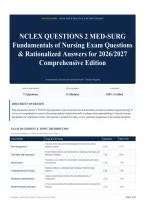
NCLEX QUESTIONS 2 MED-SURG
Fundamentals of Nursing Exam Questions
& Rationalized Answers for 2026/2027
Comprehensive Edition
Comprehensive Examination Question Bank • Concept Mapping
TOTAL QUESTIONS EXAM TOPICS ANSWERS
71 Questions 15 Modules 100% Verified
DOCUMENT OVERVIEW
This document contains 71 NCLEX-style questions with correct answers and rationales focused on medical-surgical nursing. It
serves as a comprehensive resource for nursing students and professionals to enhance their understanding of clinical concepts
and prepare for certification exams. The material is suitable for study, review, and exam preparation in the nursing discipline.
EXAM BLUEPRINT & TOPIC DISTRIBUTION
Systematic breakdown of subject domains and exam coverage.
Topic Module Scope & Core Focus Questions Share (%)
Focuses on the assessment and management of pain in various
Pain Management patient scenarios. 6 Qs 8.5%
Covers the procedures and implications of assessing vital signs and
Vital Signs and Assessment physical conditions. 7 Qs 9.9%
Examines issues related to skin integrity, including pressure ulcers
Skin Integrity and infection. 5 Qs 7.0%
Explores effective communication techniques within nursing
Communication in Nursing practice. 5 Qs 7.0%
Assesses knowledge related to the safe administration of
Medication Administration medications. 5 Qs 7.0%
Covers concepts related to health promotion and safety measures for
Health Promotion and Safety patients. 5 Qs 7.0%
Confidential • Student Study Edition • Practice & Review Guide Page 1 of 39
,STUDENT STUDY & MASTERY EDITION PRACTICE & REVIEW GUIDE
Nursing Process Evaluates the application of the nursing process in patient care. 5 Qs 7.0%
Nursing Ethics and Professionalism Focuses on ethical principles and professional standards in nursing. 4 Qs 5.6%
Examines the importance of educating patients on various health
Patient Education topics. 4 Qs 5.6%
Patient Care Assignments Explores roles and responsibilities within patient care assignments. 4 Qs 5.6%
Assesses the application of critical thinking skills in nursing
Critical Thinking in Nursing practice. 4 Qs 5.6%
Cultural Competence Examines the impact of cultural beliefs on patient care. 4 Qs 5.6%
Focuses on the importance of collaboration among healthcare team
Interdisciplinary Collaboration members. 4 Qs 5.6%
Covers the principles and practices of accurate patient
Documentation and Charting documentation. 4 Qs 5.6%
Addresses the critical aspects of ensuring patient safety in various
Patient Safety settings. 5 Qs 7.0%
Total Exam Coverage 15 Integrated Topic Modules 71 Qs 100.0%
TOPIC 1: PAIN MANAGEMENT
6 Questions • 8.5% of Exam • Focuses on the assessment and management of pain in various patient scenarios.
QUESTION 1
A 73-year-old patient who sustained a right hip fracture in a fall requests pain medication from
the
nurse. Based on his injury, which type of pain is this patient most likely experiencing?
1) Phantom
2) Visceral
3) Deep somatic
4) Referred
Answer: Answer:
3) Deep somatic.
Rationale: Deep somatic pain originates in ligaments, tendons, nerves, blood vessels, and bones. Therefore, a hip fracture causes deep
somatic pain. Phantom pain is pain that is perceived to originate from a part that was removed during surgery. Visceral pain is caused
by deep internal pain receptors and commonly occurs in the abdominal cavity, cranium, and thorax. Referred pain occurs in an area
that is distant to the original site.
Confidential • Student Study Edition • Practice & Review Guide Page 2 of 39
,STUDENT STUDY & MASTERY EDITION PRACTICE & REVIEW GUIDE
QUESTION 2
Which pain management task can the nurse safely delegate to nursing assistive personnel?
1) Asking about pain during vital signs
2) Evaluating the effectiveness of pain medication
3) Developing a plan of care involving nonpharmacologic interventions
4) Administering over-the-counter pain medications
Answer: Answer:
1) Asking about pain during vital signs.
Rationale: The nurse can delegate the task of asking about pain when nursing assistive personnel (NAP) obtain vital signs. The NAP
must be instructed to report findings to the nurse without delay. The nurse should evaluate the effectiveness of pain medications and
develop the plan of care.
Administering over-the-counter and prescription medications is the responsibility of the registered nurse or licensed practical nurse.
QUESTION 3
Which action should the nurse take before administering morphine 4.0 mg intravenously to a
patient complaining of incisional pain?
1) Assess the patient's incision.
2) Clarify the order with the prescriber.
3) Assess the patient's respiratory status.
4) Monitor the patient's heart rate.
Answer: Answer:
3) Assess the patient's respiratory status.
Rationale: Before administering an opioid analgesic, such as morphine, the nurse should assess the patient's respiratory status because
opioid analgesics can cause respiratory depression. It is not necessary to clarify the order with the physician because morphine 4 mg IV
is an appropriate dose. It is not necessary to monitor the patient's heart rate.
Confidential • Student Study Edition • Practice & Review Guide Page 3 of 39
, STUDENT STUDY & MASTERY EDITION PRACTICE & REVIEW GUIDE
QUESTION 4
Which action should the nurse take when preparing patient-controlled analgesia for a
postoperative patient?
1) Caution the patient to limit the number of times he presses the dosing button.
2) Ask another nurse to double-check the setup before patient use.
3) Instruct the patient to administer a dose only when experiencing pain.
4) Provide clear, simple instructions for dosing if the patient is cognitively impaired.
Answer: Answer:
2) Ask another nurse to double-check the setup before patient use.
Rationale: As a safeguard to reduce the risk for dosing errors, the nurse should request another nurse to double-check the setup before
patient use. The nurse should reassure the patient that the pump has a lockout feature that prevents him from overdosing even if he
continues to push the dose administration button. The nurse should also instruct the patient to administer a dose before potentially
painful activities, such as walking. Patient-controlled analgesia is contraindicated for those who are cognitively impaired.
QUESTION 5
The nurse administers codeine sulfate 30 mg orally to a patient who underwent craniotomy 3 days
ago for a brain tumor. How soon after administration should the nurse reassess the patient's
pain?
1) Immediately
2) In 10 minutes
3) In 15 minutes
4) In 60 minutes
Answer: Answer:
4) In 60 minutes.
Rationale: Codeine administered by the oral route reaches peak concentration in 60 minutes; therefore, the nurse should reassess the
patient's pain 60 minutes after administration. The nurse should reassess pain after 10 minutes when administering codeine by the
intramuscular or subcutaneous
routes. Drugs administered by the intravenous (IV) route are effective almost immediately; however, codeine is not recommended for IV
administration.
Confidential • Student Study Edition • Practice & Review Guide Page 4 of 39
NCLEX QUESTIONS 2 MED-SURG
Fundamentals of Nursing Exam Questions
& Rationalized Answers for 2026/2027
Comprehensive Edition
Comprehensive Examination Question Bank • Concept Mapping
TOTAL QUESTIONS EXAM TOPICS ANSWERS
71 Questions 15 Modules 100% Verified
DOCUMENT OVERVIEW
This document contains 71 NCLEX-style questions with correct answers and rationales focused on medical-surgical nursing. It
serves as a comprehensive resource for nursing students and professionals to enhance their understanding of clinical concepts
and prepare for certification exams. The material is suitable for study, review, and exam preparation in the nursing discipline.
EXAM BLUEPRINT & TOPIC DISTRIBUTION
Systematic breakdown of subject domains and exam coverage.
Topic Module Scope & Core Focus Questions Share (%)
Focuses on the assessment and management of pain in various
Pain Management patient scenarios. 6 Qs 8.5%
Covers the procedures and implications of assessing vital signs and
Vital Signs and Assessment physical conditions. 7 Qs 9.9%
Examines issues related to skin integrity, including pressure ulcers
Skin Integrity and infection. 5 Qs 7.0%
Explores effective communication techniques within nursing
Communication in Nursing practice. 5 Qs 7.0%
Assesses knowledge related to the safe administration of
Medication Administration medications. 5 Qs 7.0%
Covers concepts related to health promotion and safety measures for
Health Promotion and Safety patients. 5 Qs 7.0%
Confidential • Student Study Edition • Practice & Review Guide Page 1 of 39
,STUDENT STUDY & MASTERY EDITION PRACTICE & REVIEW GUIDE
Nursing Process Evaluates the application of the nursing process in patient care. 5 Qs 7.0%
Nursing Ethics and Professionalism Focuses on ethical principles and professional standards in nursing. 4 Qs 5.6%
Examines the importance of educating patients on various health
Patient Education topics. 4 Qs 5.6%
Patient Care Assignments Explores roles and responsibilities within patient care assignments. 4 Qs 5.6%
Assesses the application of critical thinking skills in nursing
Critical Thinking in Nursing practice. 4 Qs 5.6%
Cultural Competence Examines the impact of cultural beliefs on patient care. 4 Qs 5.6%
Focuses on the importance of collaboration among healthcare team
Interdisciplinary Collaboration members. 4 Qs 5.6%
Covers the principles and practices of accurate patient
Documentation and Charting documentation. 4 Qs 5.6%
Addresses the critical aspects of ensuring patient safety in various
Patient Safety settings. 5 Qs 7.0%
Total Exam Coverage 15 Integrated Topic Modules 71 Qs 100.0%
TOPIC 1: PAIN MANAGEMENT
6 Questions • 8.5% of Exam • Focuses on the assessment and management of pain in various patient scenarios.
QUESTION 1
A 73-year-old patient who sustained a right hip fracture in a fall requests pain medication from
the
nurse. Based on his injury, which type of pain is this patient most likely experiencing?
1) Phantom
2) Visceral
3) Deep somatic
4) Referred
Answer: Answer:
3) Deep somatic.
Rationale: Deep somatic pain originates in ligaments, tendons, nerves, blood vessels, and bones. Therefore, a hip fracture causes deep
somatic pain. Phantom pain is pain that is perceived to originate from a part that was removed during surgery. Visceral pain is caused
by deep internal pain receptors and commonly occurs in the abdominal cavity, cranium, and thorax. Referred pain occurs in an area
that is distant to the original site.
Confidential • Student Study Edition • Practice & Review Guide Page 2 of 39
,STUDENT STUDY & MASTERY EDITION PRACTICE & REVIEW GUIDE
QUESTION 2
Which pain management task can the nurse safely delegate to nursing assistive personnel?
1) Asking about pain during vital signs
2) Evaluating the effectiveness of pain medication
3) Developing a plan of care involving nonpharmacologic interventions
4) Administering over-the-counter pain medications
Answer: Answer:
1) Asking about pain during vital signs.
Rationale: The nurse can delegate the task of asking about pain when nursing assistive personnel (NAP) obtain vital signs. The NAP
must be instructed to report findings to the nurse without delay. The nurse should evaluate the effectiveness of pain medications and
develop the plan of care.
Administering over-the-counter and prescription medications is the responsibility of the registered nurse or licensed practical nurse.
QUESTION 3
Which action should the nurse take before administering morphine 4.0 mg intravenously to a
patient complaining of incisional pain?
1) Assess the patient's incision.
2) Clarify the order with the prescriber.
3) Assess the patient's respiratory status.
4) Monitor the patient's heart rate.
Answer: Answer:
3) Assess the patient's respiratory status.
Rationale: Before administering an opioid analgesic, such as morphine, the nurse should assess the patient's respiratory status because
opioid analgesics can cause respiratory depression. It is not necessary to clarify the order with the physician because morphine 4 mg IV
is an appropriate dose. It is not necessary to monitor the patient's heart rate.
Confidential • Student Study Edition • Practice & Review Guide Page 3 of 39
, STUDENT STUDY & MASTERY EDITION PRACTICE & REVIEW GUIDE
QUESTION 4
Which action should the nurse take when preparing patient-controlled analgesia for a
postoperative patient?
1) Caution the patient to limit the number of times he presses the dosing button.
2) Ask another nurse to double-check the setup before patient use.
3) Instruct the patient to administer a dose only when experiencing pain.
4) Provide clear, simple instructions for dosing if the patient is cognitively impaired.
Answer: Answer:
2) Ask another nurse to double-check the setup before patient use.
Rationale: As a safeguard to reduce the risk for dosing errors, the nurse should request another nurse to double-check the setup before
patient use. The nurse should reassure the patient that the pump has a lockout feature that prevents him from overdosing even if he
continues to push the dose administration button. The nurse should also instruct the patient to administer a dose before potentially
painful activities, such as walking. Patient-controlled analgesia is contraindicated for those who are cognitively impaired.
QUESTION 5
The nurse administers codeine sulfate 30 mg orally to a patient who underwent craniotomy 3 days
ago for a brain tumor. How soon after administration should the nurse reassess the patient's
pain?
1) Immediately
2) In 10 minutes
3) In 15 minutes
4) In 60 minutes
Answer: Answer:
4) In 60 minutes.
Rationale: Codeine administered by the oral route reaches peak concentration in 60 minutes; therefore, the nurse should reassess the
patient's pain 60 minutes after administration. The nurse should reassess pain after 10 minutes when administering codeine by the
intramuscular or subcutaneous
routes. Drugs administered by the intravenous (IV) route are effective almost immediately; however, codeine is not recommended for IV
administration.
Confidential • Student Study Edition • Practice & Review Guide Page 4 of 39


