
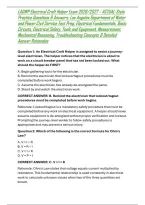
LADWP Electrical Craft Helper Exam 2026/2027 – ACTUAL-Style
Practice Questions & Answers, Los Angeles Department of Water
and Power Civil Service Test Prep, Electrical Fundamentals, Basic
Circuits, Electrical Safety, Tools and Equipment, Measurement,
Mechanical Reasoning, Troubleshooting Concepts & Detailed
Answer Rationales
Question 1: An Electrical Craft Helper is assigned to assist a journey-
level electrician. The helper notices that the electrician is about to
work on a circuit breaker panel that has not been locked out. What
should the helper do FIRST?
A. Begin gathering tools for the electrician.
B. Remind the electrician that lockout/tagout procedures must be
completed before work begins.
C. Assume the electrician has already de-energized the panel.
D. Stand by and watch the electrician work.
CORRECT ANSWER: B. Remind the electrician that lockout/tagout
procedures must be completed before work begins.
Rationale: Lockout/tagout is a mandatory safety procedure that must be
completed before any work on electrical equipment. A helper should never
assume equipment is de-energized without proper verification and lockout.
Prompting the journey-level worker to follow safety procedures is
appropriate and may prevent a serious injury.
Question 2: Which of the following is the correct formula for Ohm's
Law?
A. V = I ÷ R
B. V = R ÷ I
C. V = I × R
D. V = P × I
CORRECT ANSWER: C. V = I × R
Rationale: Ohm's Law states that voltage equals current multiplied by
resistance. This fundamental relationship is used constantly in electrical
work to calculate unknown values when two of the three quantities are
known.
,Question 3: What is the unit of measurement for electrical current?
A. Volt
B. Ohm
C. Watt
D. Ampere
CORRECT ANSWER: D. Ampere
Rationale: Current is measured in amperes (A), often called "amps."
Voltage is measured in volts, resistance in ohms, and power in watts.
Understanding these units is essential for reading meters and performing
calculations.
Question 4: A 120-volt circuit has a resistance of 24 ohms. What is the
current flow?
A. 0.2 amperes
B. 2 amperes
C. 5 amperes
D. 120 amperes
CORRECT ANSWER: C. 5 amperes
Rationale: Using Ohm's Law (I = V ÷ R), 120 volts divided by 24 ohms equals
5 amperes. This calculation is commonly performed when troubleshooting
circuits or verifying that current draw is within expected limits.
Question 5: Which hand tool is specifically designed for gripping,
twisting, and cutting electrical wire?
A. Ball-peen hammer
B. Lineman's pliers
C. Pipe wrench
D. Adjustable wrench
CORRECT ANSWER: B. Lineman's pliers
Rationale: Lineman's pliers are the primary gripping and cutting tool for
electrical workers. They feature a square nose for twisting wires and a
cutting edge for conductors, making them indispensable for electrical
tasks.
,Question 6: In a series circuit, what happens to the current through
each component?
A. It is different through each component.
B. It becomes zero after the first component.
C. It is the same through each component.
D. It is determined only by the largest resistor.
CORRECT ANSWER: C. It is the same through each component.
Rationale: A series circuit provides only one continuous path for current
flow. Therefore, the same current passes through every component in the
circuit, regardless of the individual resistance values.
Question 7: What is the primary purpose of a ground fault circuit
interrupter (GFCI)?
A. To protect equipment from voltage spikes
B. To prevent electrical fires caused by overloaded circuits
C. To protect people from electric shock by interrupting the circuit when a
fault is detected
D. To ensure stable voltage supply to sensitive electronics
CORRECT ANSWER: C. To protect people from electric shock by
interrupting the circuit when a fault is detected
Rationale: A GFCI monitors the current flowing on the hot and neutral
conductors. If it detects an imbalance indicating current is flowing to
ground through an unintended path (such as a person), it trips rapidly to
prevent electrocution.
Question 8: Which material is commonly used as an electrical
conductor because of its low resistance?
A. Glass
B. Rubber
C. Copper
D. PVC
CORRECT ANSWER: C. Copper
Rationale: Copper has high electrical conductivity and low resistance,
making it the standard material for electrical conductors. Glass, rubber,
and PVC are insulators, not conductors.
, Question 9: What should a worker do if an extension cord has exposed
conductors near the plug?
A. Wrap the damaged area with electrical tape and continue using it.
B. Remove the cord from service and report it immediately.
C. Use the cord only for low-voltage equipment.
D. Reduce the load connected to the cord.
CORRECT ANSWER: B. Remove the cord from service and report it
immediately.
Rationale: Exposed conductors create serious shock, short-circuit, and fire
hazards. Damaged electrical equipment must be removed from service
until properly repaired or replaced. Tape is not an acceptable repair for
exposed conductors.
Question 10: What is the primary purpose of a circuit breaker?
A. Increase circuit voltage
B. Store electrical energy
C. Interrupt a circuit when abnormal current conditions occur
D. Convert alternating current to direct current
CORRECT ANSWER: C. Interrupt a circuit when abnormal current
conditions occur
Rationale: A circuit breaker is an overcurrent protection device designed to
automatically open a circuit when current exceeds safe limits, protecting
conductors and equipment from damage and preventing fire hazards.
Question 11: The standard frequency of AC power supplied in the
United States is:
A. 25 Hz
B. 50 Hz
C. 60 Hz
D. 100 Hz
CORRECT ANSWER: C. 60 Hz
Rationale: The standard frequency for AC power in the United States is 60
hertz. This means the current reverses direction 60 times per second. Many
other countries use 50 Hz.
Practice Questions & Answers, Los Angeles Department of Water
and Power Civil Service Test Prep, Electrical Fundamentals, Basic
Circuits, Electrical Safety, Tools and Equipment, Measurement,
Mechanical Reasoning, Troubleshooting Concepts & Detailed
Answer Rationales
Question 1: An Electrical Craft Helper is assigned to assist a journey-
level electrician. The helper notices that the electrician is about to
work on a circuit breaker panel that has not been locked out. What
should the helper do FIRST?
A. Begin gathering tools for the electrician.
B. Remind the electrician that lockout/tagout procedures must be
completed before work begins.
C. Assume the electrician has already de-energized the panel.
D. Stand by and watch the electrician work.
CORRECT ANSWER: B. Remind the electrician that lockout/tagout
procedures must be completed before work begins.
Rationale: Lockout/tagout is a mandatory safety procedure that must be
completed before any work on electrical equipment. A helper should never
assume equipment is de-energized without proper verification and lockout.
Prompting the journey-level worker to follow safety procedures is
appropriate and may prevent a serious injury.
Question 2: Which of the following is the correct formula for Ohm's
Law?
A. V = I ÷ R
B. V = R ÷ I
C. V = I × R
D. V = P × I
CORRECT ANSWER: C. V = I × R
Rationale: Ohm's Law states that voltage equals current multiplied by
resistance. This fundamental relationship is used constantly in electrical
work to calculate unknown values when two of the three quantities are
known.
,Question 3: What is the unit of measurement for electrical current?
A. Volt
B. Ohm
C. Watt
D. Ampere
CORRECT ANSWER: D. Ampere
Rationale: Current is measured in amperes (A), often called "amps."
Voltage is measured in volts, resistance in ohms, and power in watts.
Understanding these units is essential for reading meters and performing
calculations.
Question 4: A 120-volt circuit has a resistance of 24 ohms. What is the
current flow?
A. 0.2 amperes
B. 2 amperes
C. 5 amperes
D. 120 amperes
CORRECT ANSWER: C. 5 amperes
Rationale: Using Ohm's Law (I = V ÷ R), 120 volts divided by 24 ohms equals
5 amperes. This calculation is commonly performed when troubleshooting
circuits or verifying that current draw is within expected limits.
Question 5: Which hand tool is specifically designed for gripping,
twisting, and cutting electrical wire?
A. Ball-peen hammer
B. Lineman's pliers
C. Pipe wrench
D. Adjustable wrench
CORRECT ANSWER: B. Lineman's pliers
Rationale: Lineman's pliers are the primary gripping and cutting tool for
electrical workers. They feature a square nose for twisting wires and a
cutting edge for conductors, making them indispensable for electrical
tasks.
,Question 6: In a series circuit, what happens to the current through
each component?
A. It is different through each component.
B. It becomes zero after the first component.
C. It is the same through each component.
D. It is determined only by the largest resistor.
CORRECT ANSWER: C. It is the same through each component.
Rationale: A series circuit provides only one continuous path for current
flow. Therefore, the same current passes through every component in the
circuit, regardless of the individual resistance values.
Question 7: What is the primary purpose of a ground fault circuit
interrupter (GFCI)?
A. To protect equipment from voltage spikes
B. To prevent electrical fires caused by overloaded circuits
C. To protect people from electric shock by interrupting the circuit when a
fault is detected
D. To ensure stable voltage supply to sensitive electronics
CORRECT ANSWER: C. To protect people from electric shock by
interrupting the circuit when a fault is detected
Rationale: A GFCI monitors the current flowing on the hot and neutral
conductors. If it detects an imbalance indicating current is flowing to
ground through an unintended path (such as a person), it trips rapidly to
prevent electrocution.
Question 8: Which material is commonly used as an electrical
conductor because of its low resistance?
A. Glass
B. Rubber
C. Copper
D. PVC
CORRECT ANSWER: C. Copper
Rationale: Copper has high electrical conductivity and low resistance,
making it the standard material for electrical conductors. Glass, rubber,
and PVC are insulators, not conductors.
, Question 9: What should a worker do if an extension cord has exposed
conductors near the plug?
A. Wrap the damaged area with electrical tape and continue using it.
B. Remove the cord from service and report it immediately.
C. Use the cord only for low-voltage equipment.
D. Reduce the load connected to the cord.
CORRECT ANSWER: B. Remove the cord from service and report it
immediately.
Rationale: Exposed conductors create serious shock, short-circuit, and fire
hazards. Damaged electrical equipment must be removed from service
until properly repaired or replaced. Tape is not an acceptable repair for
exposed conductors.
Question 10: What is the primary purpose of a circuit breaker?
A. Increase circuit voltage
B. Store electrical energy
C. Interrupt a circuit when abnormal current conditions occur
D. Convert alternating current to direct current
CORRECT ANSWER: C. Interrupt a circuit when abnormal current
conditions occur
Rationale: A circuit breaker is an overcurrent protection device designed to
automatically open a circuit when current exceeds safe limits, protecting
conductors and equipment from damage and preventing fire hazards.
Question 11: The standard frequency of AC power supplied in the
United States is:
A. 25 Hz
B. 50 Hz
C. 60 Hz
D. 100 Hz
CORRECT ANSWER: C. 60 Hz
Rationale: The standard frequency for AC power in the United States is 60
hertz. This means the current reverses direction 60 times per second. Many
other countries use 50 Hz.


