
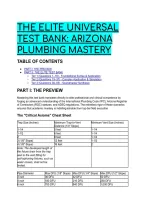
THE ELITE UNIVERSAL
TEST BANK: ARIZONA
PLUMBING MASTERY
TABLE OF CONTENTS
● PART I: THE PREVIEW
● PART II: THE ELITE TEST BANK
○ Tier 1 (Questions 1–18) - Foundational Syntax & Application
○ Tier 2 (Questions 19–37) - Complex Application & Simulation
○ Tier 3 (Questions 38–55) - Grandmaster Synthesis
PART I: THE PREVIEW
Mastering this test bank translates directly to elite professional and clinical competence by
forging an advanced understanding of the International Plumbing Code (IPC), Arizona Registrar
of Contractors (ROC) statutes, and ADEQ regulations. The relentless rigor of these scenarios
ensures that academic mastery is indistinguishable from top-tier field execution.
The "Critical Axioms" Cheat Sheet
Trap Size (Inches) Maximum Trap-to-Vent Minimum Vent Size (Inches)
Distance (1/4" Slope)
1-1/4 5 feet 1-1/4
1-1/2 6 feet 1-1/4
2 8 feet 1-1/4
3 (1/8" Slope) 12 feet 1-1/2
4 (1/8" Slope) 16 feet 2
Note: The developed length of
the fixture drain from the trap
weir to the vent fitting for
self-siphoning fixtures, such as
water closets, shall not be
limited.
Pipe Diameter Max DFU (1/8" Slope) Max DFU (1/4" Slope) Max DFU (1/2" Slope)
3 inch 36 DFU 42 DFU 50 DFU
4 inch 180 DFU 216 DFU 250 DFU
6 inch 700 DFU 840 DFU 1,000 DFU
,Pipe Diameter Max DFU (1/8" Slope) Max DFU (1/4" Slope) Max DFU (1/2" Slope)
Note: The minimum
size of any building
drain serving a water
closet shall be 3
inches, regardless of
the calculated DFU
load.
Device / Assembly Hazard Level Backpressure Typical Application
Protection
ASSE 1013 (RPZ) High Yes Chemical injection,
fertigation, mortuaries
ASSE 1015 (DC) Low Yes Fire sprinklers (no
chemicals), low-risk
containment
ASSE 1020 (PVB) High No Irrigation systems
without booster pumps
ASSE 1012 (IAV) Low Yes Residential/Light
commercial boilers
● Air Admittance Valves (AAV) (IPC 918): Must be installed a minimum of 4 inches above
the horizontal branch drain and 6 inches above attic insulation, retaining total accessibility.
● Arizona 811 (Blue Stake): Excavators must white-line the dig site, provide two full
working days' notice, and refresh marks after 15 working days.
● ADEQ Septic Setbacks: A minimum 100-foot setback is legally mandated between any
disposal works and a private water well.
PART II: THE ELITE TEST BANK
Tier 1 (Questions 1–18) - Foundational Syntax & Application
Q1: An Arizona commercial plumbing contractor is preparing to trench a sewer lateral.
According to Arizona 811 statutes, which action is the FIRST legally mandated step before
placing the locate request to the one-call center? A) Contacting the local municipality for a
right-of-way permit B) Calling 811 to establish the 15-day validity window C) Marking the
proposed excavation boundaries with white paint D) Potholing existing utilities to determine
precise depths
● Answer: C (Marking the proposed excavation boundaries with white paint)
● Distractor Analysis:
○ A is incorrect: While permits are necessary for compliance, the foundational
statutory step for utility locates is establishing the physical dig zone.
○ B is incorrect: Calling 811 initiates the two-day wait period, but the site must be
visually prepared prior to this call.
○ D is incorrect: Potholing is a non-invasive verification method executed after the
locators have marked the utilities based on the white-lined boundaries.
The Mentor's Analysis: Arizona law explicitly mandates white-lining the excavation area before
, the request enters the one-call system. When facing underground excavations, the immediate
priority is visual boundary establishment. By utilizing white-lining, you bypass the common trap
of vague, delayed, or rejected locate requests. Professional Intuition: Always white-line the
specific dig site before dialing 811; locators only mark within defined boundaries.
Q2: Based on the principles of IPC Table 909.1, what is the MAXIMUM permitted developed
length from a 2-inch fixture trap weir to its vent fitting at a 1/4-inch per foot slope? A) 5 feet B) 6
feet C) 8 feet D) 12 feet
● Answer: C (8 feet)
● Distractor Analysis:
○ A is incorrect: 5 feet is the strict maximum distance for a 1-1/4" trap arm.
○ B is incorrect: 6 feet applies to a 1-1/2" trap arm.
○ D is incorrect: 12 feet applies to a 3" trap arm installed at a 1/8-inch slope.
The Mentor's Analysis: Trap-to-vent distance is mathematically constrained by pipe diameter
and slope to prevent the drain's hydraulic gradient from dropping below the trap weir. When
facing trap arm sizing, the immediate priority is preserving the liquid seal. By utilizing IPC Table
909.1 limits, you bypass the common trap of induced siphonage caused by excessive fall.
Professional Intuition: A 2-inch trap arm allows exactly 8 feet of developed length before a
dedicated vent connection is mandatory.
Q3: According to ADEQ Title 18 Chapter 9 regulations for on-site wastewater treatment, what is
the MINIMUM required horizontal setback from a septic system disposal works to an existing
private water well? A) 50 feet B) 75 feet C) 100 feet D) 200 feet
● Answer: C (100 feet)
● Distractor Analysis:
○ A is incorrect: 50 feet is the standard setback to a property line or drainage
easement, not a potable water source.
○ B is incorrect: 75 feet is a legacy dimension used in outdated municipal codes but is
invalid under modern Arizona state mandates.
○ D is incorrect: 200 feet is an extended setback applicable to certain public water
systems, not standard private wells.
The Mentor's Analysis: Environmental regulations prioritize groundwater protection above all
other design variables. When facing septic site planning, the immediate priority is
cross-contamination prevention. By utilizing the 100-foot well setback rule, you bypass the
common trap of catastrophic potable aquifer contamination. Professional Intuition: Never
compromise the 100-foot isolation zone between septic effluent disposal and a potable
water well.
Q4: A high-hazard cross-connection is identified at a commercial boiler introducing conditioning
chemicals. Which backflow prevention assembly is the MOST APPROPRIATE to isolate this
potable water supply? A) ASSE 1012 Intermediate Atmospheric Vent B) ASSE 1013 Reduced
Pressure Zone (RPZ) Assembly C) ASSE 1020 Pressure Vacuum Breaker (PVB) D) ASSE 1024
Dual Check Valve
● Answer: B (ASSE 1013 Reduced Pressure Zone (RPZ) Assembly)
● Distractor Analysis:
○ A is incorrect: ASSE 1012 is strictly for low-hazard boilers without chemical
additives.
○ C is incorrect: PVBs cannot protect against backpressure, which a closed-loop
boiler inherently produces.
○ D is incorrect: Dual checks are low-hazard containment devices and offer no
atmospheric discharge for chemical protection.
TEST BANK: ARIZONA
PLUMBING MASTERY
TABLE OF CONTENTS
● PART I: THE PREVIEW
● PART II: THE ELITE TEST BANK
○ Tier 1 (Questions 1–18) - Foundational Syntax & Application
○ Tier 2 (Questions 19–37) - Complex Application & Simulation
○ Tier 3 (Questions 38–55) - Grandmaster Synthesis
PART I: THE PREVIEW
Mastering this test bank translates directly to elite professional and clinical competence by
forging an advanced understanding of the International Plumbing Code (IPC), Arizona Registrar
of Contractors (ROC) statutes, and ADEQ regulations. The relentless rigor of these scenarios
ensures that academic mastery is indistinguishable from top-tier field execution.
The "Critical Axioms" Cheat Sheet
Trap Size (Inches) Maximum Trap-to-Vent Minimum Vent Size (Inches)
Distance (1/4" Slope)
1-1/4 5 feet 1-1/4
1-1/2 6 feet 1-1/4
2 8 feet 1-1/4
3 (1/8" Slope) 12 feet 1-1/2
4 (1/8" Slope) 16 feet 2
Note: The developed length of
the fixture drain from the trap
weir to the vent fitting for
self-siphoning fixtures, such as
water closets, shall not be
limited.
Pipe Diameter Max DFU (1/8" Slope) Max DFU (1/4" Slope) Max DFU (1/2" Slope)
3 inch 36 DFU 42 DFU 50 DFU
4 inch 180 DFU 216 DFU 250 DFU
6 inch 700 DFU 840 DFU 1,000 DFU
,Pipe Diameter Max DFU (1/8" Slope) Max DFU (1/4" Slope) Max DFU (1/2" Slope)
Note: The minimum
size of any building
drain serving a water
closet shall be 3
inches, regardless of
the calculated DFU
load.
Device / Assembly Hazard Level Backpressure Typical Application
Protection
ASSE 1013 (RPZ) High Yes Chemical injection,
fertigation, mortuaries
ASSE 1015 (DC) Low Yes Fire sprinklers (no
chemicals), low-risk
containment
ASSE 1020 (PVB) High No Irrigation systems
without booster pumps
ASSE 1012 (IAV) Low Yes Residential/Light
commercial boilers
● Air Admittance Valves (AAV) (IPC 918): Must be installed a minimum of 4 inches above
the horizontal branch drain and 6 inches above attic insulation, retaining total accessibility.
● Arizona 811 (Blue Stake): Excavators must white-line the dig site, provide two full
working days' notice, and refresh marks after 15 working days.
● ADEQ Septic Setbacks: A minimum 100-foot setback is legally mandated between any
disposal works and a private water well.
PART II: THE ELITE TEST BANK
Tier 1 (Questions 1–18) - Foundational Syntax & Application
Q1: An Arizona commercial plumbing contractor is preparing to trench a sewer lateral.
According to Arizona 811 statutes, which action is the FIRST legally mandated step before
placing the locate request to the one-call center? A) Contacting the local municipality for a
right-of-way permit B) Calling 811 to establish the 15-day validity window C) Marking the
proposed excavation boundaries with white paint D) Potholing existing utilities to determine
precise depths
● Answer: C (Marking the proposed excavation boundaries with white paint)
● Distractor Analysis:
○ A is incorrect: While permits are necessary for compliance, the foundational
statutory step for utility locates is establishing the physical dig zone.
○ B is incorrect: Calling 811 initiates the two-day wait period, but the site must be
visually prepared prior to this call.
○ D is incorrect: Potholing is a non-invasive verification method executed after the
locators have marked the utilities based on the white-lined boundaries.
The Mentor's Analysis: Arizona law explicitly mandates white-lining the excavation area before
, the request enters the one-call system. When facing underground excavations, the immediate
priority is visual boundary establishment. By utilizing white-lining, you bypass the common trap
of vague, delayed, or rejected locate requests. Professional Intuition: Always white-line the
specific dig site before dialing 811; locators only mark within defined boundaries.
Q2: Based on the principles of IPC Table 909.1, what is the MAXIMUM permitted developed
length from a 2-inch fixture trap weir to its vent fitting at a 1/4-inch per foot slope? A) 5 feet B) 6
feet C) 8 feet D) 12 feet
● Answer: C (8 feet)
● Distractor Analysis:
○ A is incorrect: 5 feet is the strict maximum distance for a 1-1/4" trap arm.
○ B is incorrect: 6 feet applies to a 1-1/2" trap arm.
○ D is incorrect: 12 feet applies to a 3" trap arm installed at a 1/8-inch slope.
The Mentor's Analysis: Trap-to-vent distance is mathematically constrained by pipe diameter
and slope to prevent the drain's hydraulic gradient from dropping below the trap weir. When
facing trap arm sizing, the immediate priority is preserving the liquid seal. By utilizing IPC Table
909.1 limits, you bypass the common trap of induced siphonage caused by excessive fall.
Professional Intuition: A 2-inch trap arm allows exactly 8 feet of developed length before a
dedicated vent connection is mandatory.
Q3: According to ADEQ Title 18 Chapter 9 regulations for on-site wastewater treatment, what is
the MINIMUM required horizontal setback from a septic system disposal works to an existing
private water well? A) 50 feet B) 75 feet C) 100 feet D) 200 feet
● Answer: C (100 feet)
● Distractor Analysis:
○ A is incorrect: 50 feet is the standard setback to a property line or drainage
easement, not a potable water source.
○ B is incorrect: 75 feet is a legacy dimension used in outdated municipal codes but is
invalid under modern Arizona state mandates.
○ D is incorrect: 200 feet is an extended setback applicable to certain public water
systems, not standard private wells.
The Mentor's Analysis: Environmental regulations prioritize groundwater protection above all
other design variables. When facing septic site planning, the immediate priority is
cross-contamination prevention. By utilizing the 100-foot well setback rule, you bypass the
common trap of catastrophic potable aquifer contamination. Professional Intuition: Never
compromise the 100-foot isolation zone between septic effluent disposal and a potable
water well.
Q4: A high-hazard cross-connection is identified at a commercial boiler introducing conditioning
chemicals. Which backflow prevention assembly is the MOST APPROPRIATE to isolate this
potable water supply? A) ASSE 1012 Intermediate Atmospheric Vent B) ASSE 1013 Reduced
Pressure Zone (RPZ) Assembly C) ASSE 1020 Pressure Vacuum Breaker (PVB) D) ASSE 1024
Dual Check Valve
● Answer: B (ASSE 1013 Reduced Pressure Zone (RPZ) Assembly)
● Distractor Analysis:
○ A is incorrect: ASSE 1012 is strictly for low-hazard boilers without chemical
additives.
○ C is incorrect: PVBs cannot protect against backpressure, which a closed-loop
boiler inherently produces.
○ D is incorrect: Dual checks are low-hazard containment devices and offer no
atmospheric discharge for chemical protection.


