
STUVIA EXAM LIBRARY
EXAMINATION DOCUMENT • 2026/2027 A+
VERIFIED
ANCC FNP Exam Prep 2026/2027 –
Questions and Answers | Family Nurse
Practitioner | Board Readiness – Pass
Health Promotion, Assessment, Interventions, Acute/Chronic, Maternal-Child,
Guaranteed
Geriatric, Mental Health &– A+ Graded
Professional Role — Application/Analysis Level
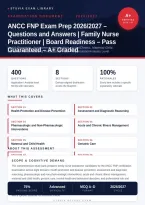
400 8 100%
QUESTIONS SECTIONS R AT I O N A L E S
Application / Analysis level Domain-aligned distribution Every item includes a specific
MCQs with rationales across the blueprint explanatory rationale
W H AT T H I S C O V E R S
SECTION 01 SECTION 02
Health Promotion and Disease Prevention Assessment and Diagnostic Reasoning
SECTION 03 SECTION 04
Pharmacologic and Non-Pharmacologic Acute and Chronic Illness Management
Interventions
SECTION 05 SECTION 06
Maternal and Child Health Geriatric Care
ABOUT THIS ASSESSMENT
SECTION 07 SECTION 08
Mental Health and Behavioral Disorders Professional Role and Policy
SCOPE & COGNITIVE DEMAND
This comprehensive study bank prepares family nurse practitioner candidates for the ANCC FNP certification
examination across eight domains: health promotion and disease prevention; assessment and diagnostic
reasoning; pharmacologic and non-pharmacologic interventions; acute and chronic illness management;
maternal and child health; geriatric care; mental health and behavioral disorders; and professional role and
policy. Items target application and analysis cognitive levels: prioritizing diagnostic workups, selecting
75%pharmacotherapy,Advanced
evidence-based interpreting lab and imagingMCQ A–D
findings, 2026/2027
managing acute presentations,
P A S S I Nlifespan-specific
addressing G SCORE D I F applying
care, and F I C U L T Yethical and regulatory
FORM AT
frameworks. C Y C is
Each question L Epaired
with a specific rationale for formative review.
S T U V I A A C T U A L E X A M
,ANCC FNP Exam Prep 400 Questions • Pass 75% • A+ Verified
ANCC FNP Exam Prep 2026/2027 – Questions and Answers | Family Nurse Practitioner | Board
Readiness – Pass Guaranteed – A+ Graded
Year Tag: 2026/2027 • Total Questions: 400 • Sections: 8 • Passing Score: 75% • Difficulty: Advanced • Bloom's: Application/Analysis
Section 1: Health Promotion and Disease Prevention
Screening, immunization, lifestyle counseling, and primary/secondary prevention across the lifespan. Items in this section: 50.
CONCEPT: USPSTF colorectal screening age
1. Per USPSTF, average-risk adults should begin colorectal cancer screening at:
A. 50
B. 60
C. 40
D. 45
Answer: D. Rationale: USPSTF lowered the starting age to 45 in 2021 due to rising early-onset colorectal cancer.
Options include annual FIT, colonoscopy every 10 years, or stool DNA every 1–3 years. Continue through age 75;
individualize 76–85; stop at 86.
CONCEPT: Mammography screening interval
2. A 52-year-old woman with average breast cancer risk asks about mammography. USPSTF
recommends:
A. Annual mammography starting at 40
B. MRI screening starting at 35
C. Biennial mammography from ages 50 to 74
D. Annual mammography from 40 to 75
Answer: C. Rationale: USPSTF recommends biennial mammography for average-risk women aged 50–74. Women
aged 40–49 should make an individualized decision. High-risk patients (BRCA, family history) may need earlier MRI
screening.
CONCEPT: Cervical cancer screening — 30–65
3. A 38-year-old woman with normal Pap history asks about screening. Recommended interval for
co-testing (Pap + HPV):
A. Every 5 years
B. Every 3 years
C. Annual
D. Every 10 years
Answer: A. Rationale: For women 30–65, USPSTF recommends Pap every 3 years, OR HPV alone every 5 years, OR
co-testing every 5 years. Cytology alone (B) is every 3 years. Stop at 65 with adequate prior screening and no
high-grade lesions in past 25 years.
CONCEPT: Hypertension screening adults
4. USPSTF recommends screening adults ≥18 years for hypertension:
A. At least annually; confirm with ambulatory or home measurement before diagnosis
B. Annually with office BP measurement
C. Only if symptomatic
D. Every 5 years
Page 1 STUVIA ACTUAL EXAM A+ Graded • Pass Guaranteed
,ANCC FNP Exam Prep 400 Questions • Pass 75% • A+ Verified
Answer: A. Rationale: USPSTF 2021: screen adults annually with office BP, but confirm elevated readings with ABPM
or home BP monitoring before labeling hypertension to avoid white-coat effects. Target <130/80 mmHg per ACC/AHA.
CONCEPT: Lipid screening — men
5. USPSTF recommends lipid screening for men:
A. Every 5 years starting at age 50
B. Starting at age 20 regardless of risk
C. Only when symptomatic
D. Starting at age 35 if no other risk factors
Answer: D. Rationale: USPSTF: screen men without risk factors starting at age 35; screen women without risk factors
starting at age 45. Adults with CV risk factors should be screened earlier (age 20+). Interval: every 5 years typically.
CONCEPT: HIV screening — adults
6. USPSTF recommends HIV screening for adults aged 15–65:
A. At least once, with repeat screening for high-risk individuals
B. Annually for all
C. Once only
D. Only when symptomatic
Answer: A. Rationale: USPSTF 2019 recommends one-time HIV screening for ages 15–65, with rescreening based on
risk (annually or more often for high-risk behaviors). Earlier screening for pregnant patients and younger adolescents
with risk factors.
CONCEPT: Hepatitis C screening
7. USPSTF recommends one-time HCV screening for adults aged:
A. 18–40
B. 50–75
C. 18–79
D. 65 and older only
Answer: C. Rationale: USPSTF 2020 expanded one-time HCV screening to all adults 18–79. Birth-cohort screening
(1945–1965) is now subsumed. Risk-based screening continues for ongoing risk (IVDU, dialysis, HIV-positive).
CONCEPT: Tobacco cessation — 5 A's
8. The recommended framework for tobacco cessation counseling is the 5 A's:
A. Ask, Anticipate, Assess, Advise, Assist
B. Advise, Ask, Anticipate, Assist, Arrange
C. Assess, Advise, Ask, Arrange, Acknowledge
D. Ask, Advise, Assess, Assist, Arrange
Answer: D. Rationale: 5 A's: Ask about tobacco; Advise to quit; Assess willingness; Assist with counseling and
pharmacotherapy (varenicline, bupropion, NRT); Arrange follow-up. Combining counseling + medication doubles quit
rates versus either alone.
CONCEPT: Adult immunization — influenza
9. Annual influenza vaccination is recommended for:
A. Only healthcare workers
B. Only pregnant women
C. Only adults ≥65
D. Everyone ≥6 months without contraindications
Page 2 STUVIA ACTUAL EXAM A+ Graded • Pass Guaranteed
, ANCC FNP Exam Prep 400 Questions • Pass 75% • A+ Verified
Answer: D. Rationale: CDC ACIP recommends annual influenza vaccination for everyone ≥6 months. High-dose or
adjuvanted vaccines are preferred for ≥65 years. Pregnant women should receive inactivated influenza vaccine any
trimester.
CONCEPT: Pneumococcal vaccination — ≥65
10. For immunocompetent adults ≥65 with no prior pneumococcal vaccination, ACIP recommends:
A. No vaccination if healthy
B. PCV13 alone
C. PPSV23 alone
D. PCV20 alone, or PCV15 followed by PPSV23 one year later
Answer: D. Rationale: ACIP (2022): give PCV20 alone, OR PCV15 then PPSV23 ≥1 year later. PCV20 simplifies the
schedule. Immunocompromised adults may need additional doses. Pneumococcal vaccination reduces invasive
pneumococcal disease.
CONCEPT: Shingrix schedule
11. A 70-year-old patient asks about shingles vaccination. The recommended regimen is:
A. Two doses of Shingrix (recombinant zoster vaccine) 2–6 months apart
B. One dose of Zostavax
C. Annual shingles vaccination
D. One dose of Shingrix
Answer: A. Rationale: ACIP: 2 doses of Shingrix (RZV) 2–6 months apart for immunocompetent adults ≥50. The live
Zostavax is no longer used in the US. Immunocompromised adults 19+ may also receive Shingrix.
CONCEPT: Tdap in pregnancy
12. A pregnant patient at 28 weeks asks about Tdap. Recommended timing:
A. Pre-pregnancy only
B. Single dose lifetime
C. Between 27 and 36 weeks of each pregnancy
D. Postpartum only
Answer: C. Rationale: ACIP: Tdap with each pregnancy between 27–36 weeks, regardless of prior Tdap history.
Maternal antibodies protect the newborn from pertussis during the first months of life before infant vaccination begins.
CONCEPT: HPV vaccination age
13. The HPV vaccine is routinely recommended for:
A. Infants at 2 months
B. All adolescents ages 11–12 (catch-up through 26)
C. Adults 27–45 only
D. Girls only, ages 11–12
Answer: B. Rationale: ACIP: routine HPV vaccination at 11–12 (can start at 9), 2-dose series if started before 15.
Catch-up through 26. Ages 27–45 may receive based on shared clinical decision-making. Vaccination prevents cervical,
oropharyngeal, anal, and genital cancers.
CONCEPT: Adult BMI counseling
14. USPSTF recommends referring adults with BMI ≥30 to intensive behavioral interventions delivering:
A. Annual weigh-ins only
B. Single brief counseling session
C. Pharmacotherapy alone
D. ≥12 sessions/year focused on diet, exercise, and behavior change
Page 3 STUVIA ACTUAL EXAM A+ Graded • Pass Guaranteed
EXAMINATION DOCUMENT • 2026/2027 A+
VERIFIED
ANCC FNP Exam Prep 2026/2027 –
Questions and Answers | Family Nurse
Practitioner | Board Readiness – Pass
Health Promotion, Assessment, Interventions, Acute/Chronic, Maternal-Child,
Guaranteed
Geriatric, Mental Health &– A+ Graded
Professional Role — Application/Analysis Level
400 8 100%
QUESTIONS SECTIONS R AT I O N A L E S
Application / Analysis level Domain-aligned distribution Every item includes a specific
MCQs with rationales across the blueprint explanatory rationale
W H AT T H I S C O V E R S
SECTION 01 SECTION 02
Health Promotion and Disease Prevention Assessment and Diagnostic Reasoning
SECTION 03 SECTION 04
Pharmacologic and Non-Pharmacologic Acute and Chronic Illness Management
Interventions
SECTION 05 SECTION 06
Maternal and Child Health Geriatric Care
ABOUT THIS ASSESSMENT
SECTION 07 SECTION 08
Mental Health and Behavioral Disorders Professional Role and Policy
SCOPE & COGNITIVE DEMAND
This comprehensive study bank prepares family nurse practitioner candidates for the ANCC FNP certification
examination across eight domains: health promotion and disease prevention; assessment and diagnostic
reasoning; pharmacologic and non-pharmacologic interventions; acute and chronic illness management;
maternal and child health; geriatric care; mental health and behavioral disorders; and professional role and
policy. Items target application and analysis cognitive levels: prioritizing diagnostic workups, selecting
75%pharmacotherapy,Advanced
evidence-based interpreting lab and imagingMCQ A–D
findings, 2026/2027
managing acute presentations,
P A S S I Nlifespan-specific
addressing G SCORE D I F applying
care, and F I C U L T Yethical and regulatory
FORM AT
frameworks. C Y C is
Each question L Epaired
with a specific rationale for formative review.
S T U V I A A C T U A L E X A M
,ANCC FNP Exam Prep 400 Questions • Pass 75% • A+ Verified
ANCC FNP Exam Prep 2026/2027 – Questions and Answers | Family Nurse Practitioner | Board
Readiness – Pass Guaranteed – A+ Graded
Year Tag: 2026/2027 • Total Questions: 400 • Sections: 8 • Passing Score: 75% • Difficulty: Advanced • Bloom's: Application/Analysis
Section 1: Health Promotion and Disease Prevention
Screening, immunization, lifestyle counseling, and primary/secondary prevention across the lifespan. Items in this section: 50.
CONCEPT: USPSTF colorectal screening age
1. Per USPSTF, average-risk adults should begin colorectal cancer screening at:
A. 50
B. 60
C. 40
D. 45
Answer: D. Rationale: USPSTF lowered the starting age to 45 in 2021 due to rising early-onset colorectal cancer.
Options include annual FIT, colonoscopy every 10 years, or stool DNA every 1–3 years. Continue through age 75;
individualize 76–85; stop at 86.
CONCEPT: Mammography screening interval
2. A 52-year-old woman with average breast cancer risk asks about mammography. USPSTF
recommends:
A. Annual mammography starting at 40
B. MRI screening starting at 35
C. Biennial mammography from ages 50 to 74
D. Annual mammography from 40 to 75
Answer: C. Rationale: USPSTF recommends biennial mammography for average-risk women aged 50–74. Women
aged 40–49 should make an individualized decision. High-risk patients (BRCA, family history) may need earlier MRI
screening.
CONCEPT: Cervical cancer screening — 30–65
3. A 38-year-old woman with normal Pap history asks about screening. Recommended interval for
co-testing (Pap + HPV):
A. Every 5 years
B. Every 3 years
C. Annual
D. Every 10 years
Answer: A. Rationale: For women 30–65, USPSTF recommends Pap every 3 years, OR HPV alone every 5 years, OR
co-testing every 5 years. Cytology alone (B) is every 3 years. Stop at 65 with adequate prior screening and no
high-grade lesions in past 25 years.
CONCEPT: Hypertension screening adults
4. USPSTF recommends screening adults ≥18 years for hypertension:
A. At least annually; confirm with ambulatory or home measurement before diagnosis
B. Annually with office BP measurement
C. Only if symptomatic
D. Every 5 years
Page 1 STUVIA ACTUAL EXAM A+ Graded • Pass Guaranteed
,ANCC FNP Exam Prep 400 Questions • Pass 75% • A+ Verified
Answer: A. Rationale: USPSTF 2021: screen adults annually with office BP, but confirm elevated readings with ABPM
or home BP monitoring before labeling hypertension to avoid white-coat effects. Target <130/80 mmHg per ACC/AHA.
CONCEPT: Lipid screening — men
5. USPSTF recommends lipid screening for men:
A. Every 5 years starting at age 50
B. Starting at age 20 regardless of risk
C. Only when symptomatic
D. Starting at age 35 if no other risk factors
Answer: D. Rationale: USPSTF: screen men without risk factors starting at age 35; screen women without risk factors
starting at age 45. Adults with CV risk factors should be screened earlier (age 20+). Interval: every 5 years typically.
CONCEPT: HIV screening — adults
6. USPSTF recommends HIV screening for adults aged 15–65:
A. At least once, with repeat screening for high-risk individuals
B. Annually for all
C. Once only
D. Only when symptomatic
Answer: A. Rationale: USPSTF 2019 recommends one-time HIV screening for ages 15–65, with rescreening based on
risk (annually or more often for high-risk behaviors). Earlier screening for pregnant patients and younger adolescents
with risk factors.
CONCEPT: Hepatitis C screening
7. USPSTF recommends one-time HCV screening for adults aged:
A. 18–40
B. 50–75
C. 18–79
D. 65 and older only
Answer: C. Rationale: USPSTF 2020 expanded one-time HCV screening to all adults 18–79. Birth-cohort screening
(1945–1965) is now subsumed. Risk-based screening continues for ongoing risk (IVDU, dialysis, HIV-positive).
CONCEPT: Tobacco cessation — 5 A's
8. The recommended framework for tobacco cessation counseling is the 5 A's:
A. Ask, Anticipate, Assess, Advise, Assist
B. Advise, Ask, Anticipate, Assist, Arrange
C. Assess, Advise, Ask, Arrange, Acknowledge
D. Ask, Advise, Assess, Assist, Arrange
Answer: D. Rationale: 5 A's: Ask about tobacco; Advise to quit; Assess willingness; Assist with counseling and
pharmacotherapy (varenicline, bupropion, NRT); Arrange follow-up. Combining counseling + medication doubles quit
rates versus either alone.
CONCEPT: Adult immunization — influenza
9. Annual influenza vaccination is recommended for:
A. Only healthcare workers
B. Only pregnant women
C. Only adults ≥65
D. Everyone ≥6 months without contraindications
Page 2 STUVIA ACTUAL EXAM A+ Graded • Pass Guaranteed
, ANCC FNP Exam Prep 400 Questions • Pass 75% • A+ Verified
Answer: D. Rationale: CDC ACIP recommends annual influenza vaccination for everyone ≥6 months. High-dose or
adjuvanted vaccines are preferred for ≥65 years. Pregnant women should receive inactivated influenza vaccine any
trimester.
CONCEPT: Pneumococcal vaccination — ≥65
10. For immunocompetent adults ≥65 with no prior pneumococcal vaccination, ACIP recommends:
A. No vaccination if healthy
B. PCV13 alone
C. PPSV23 alone
D. PCV20 alone, or PCV15 followed by PPSV23 one year later
Answer: D. Rationale: ACIP (2022): give PCV20 alone, OR PCV15 then PPSV23 ≥1 year later. PCV20 simplifies the
schedule. Immunocompromised adults may need additional doses. Pneumococcal vaccination reduces invasive
pneumococcal disease.
CONCEPT: Shingrix schedule
11. A 70-year-old patient asks about shingles vaccination. The recommended regimen is:
A. Two doses of Shingrix (recombinant zoster vaccine) 2–6 months apart
B. One dose of Zostavax
C. Annual shingles vaccination
D. One dose of Shingrix
Answer: A. Rationale: ACIP: 2 doses of Shingrix (RZV) 2–6 months apart for immunocompetent adults ≥50. The live
Zostavax is no longer used in the US. Immunocompromised adults 19+ may also receive Shingrix.
CONCEPT: Tdap in pregnancy
12. A pregnant patient at 28 weeks asks about Tdap. Recommended timing:
A. Pre-pregnancy only
B. Single dose lifetime
C. Between 27 and 36 weeks of each pregnancy
D. Postpartum only
Answer: C. Rationale: ACIP: Tdap with each pregnancy between 27–36 weeks, regardless of prior Tdap history.
Maternal antibodies protect the newborn from pertussis during the first months of life before infant vaccination begins.
CONCEPT: HPV vaccination age
13. The HPV vaccine is routinely recommended for:
A. Infants at 2 months
B. All adolescents ages 11–12 (catch-up through 26)
C. Adults 27–45 only
D. Girls only, ages 11–12
Answer: B. Rationale: ACIP: routine HPV vaccination at 11–12 (can start at 9), 2-dose series if started before 15.
Catch-up through 26. Ages 27–45 may receive based on shared clinical decision-making. Vaccination prevents cervical,
oropharyngeal, anal, and genital cancers.
CONCEPT: Adult BMI counseling
14. USPSTF recommends referring adults with BMI ≥30 to intensive behavioral interventions delivering:
A. Annual weigh-ins only
B. Single brief counseling session
C. Pharmacotherapy alone
D. ≥12 sessions/year focused on diet, exercise, and behavior change
Page 3 STUVIA ACTUAL EXAM A+ Graded • Pass Guaranteed


