
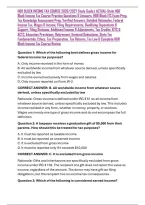
H&R BLOCK INCOME TAX COURSE 2026/2027 Study Guide | ACTUAL-Style H&R
Block Income Tax Course Practice Questions & Answers, H&R Block ITC Exam Prep,
Tax Knowledge Assessment Prep, Verified Answers, Detailed Rationales, Federal
Income Tax, Wages & Income, Filing Requirements, Qualifying Dependents &
Support, Filing Statuses, Additional Income & Adjustments, Tax Credits, EITC &
ACTC, Education Provisions, Retirement, Itemized Deductions, State Tax
Fundamentals, Ethics, Tax Preparation, Tax Returns, Tax Law & Complete H&R
Block Income Tax Course Review
Question 1: Which of the following best defines gross income for
federal income tax purposes?
A. Only income received in the form of money
B. All worldwide income from whatever source derived, unless specifically
excluded by law
C. Income earned exclusively from wages and salaries
D. Only income reported on Form W-2
CORRECT ANSWER: B. All worldwide income from whatever source
derived, unless specifically excluded by law
Rationale: Gross income is defined under IRC § 61 as all income from
whatever source derived, unless specifically excluded by law. This includes
income realized in any form, whether in money, property, or services.
Wages are merely one type of gross income and do not encompass the full
definition.
Question 2: A taxpayer receives a graduation gift of $5,000 from their
parents. How should this be treated for tax purposes?
A. It must be reported as taxable income
B. It must be reported as unearned income
C. It is excluded from gross income
D. It must be reported only if it exceeds $10,000
CORRECT ANSWER: C. It is excluded from gross income
Rationale: Gifts and inheritances are specifically excluded from gross
income under IRC § 102. The recipient of a gift does not report the value as
income, regardless of the amount. The donor may have gift tax filing
obligations, but the recipient has no income tax consequences.
Question 3: Which of the following is considered earned income?
,A. Dividends from corporate stock
B. Interest from a savings account
C. Self-employment income from a consulting business
D. Unemployment compensation
CORRECT ANSWER: C. Self-employment income from a consulting
business
Rationale: Earned income is income received for services performed. Self-
employment income results from personal services rendered and therefore
qualifies as earned income. Dividends and interest are unearned income
derived from capital. Unemployment compensation is taxable income but
is not earned income because it is not received for services performed.
Question 4: A taxpayer earned $95,000 in wages and $750 in interest
from a certificate of deposit. What is the taxpayer's gross income?
A. $95,000
B. $95,750
C. $750
D. $94,250
CORRECT ANSWER: B. $95,750
Rationale: Gross income includes both earned and unearned income from
all sources unless specifically excluded. Wages of $95,000 are taxable
compensation, and interest of $750 is taxable investment income. Both
amounts are included in gross income, resulting in $95,750.
Question 5: Which of the following types of income is NOT included in
gross income?
A. Interest income from a bank savings account
B. Dividend income from corporate stock
C. Income from a life insurance policy paid upon the death of the insured
D. Rental income from a property owned by the taxpayer
CORRECT ANSWER: C. Income from a life insurance policy paid upon
the death of the insured
Rationale: Life insurance proceeds paid upon the death of the insured are
generally excluded from gross income under IRC § 101(a). This is a
statutory exclusion and is not taxable to the beneficiary. Interest income
,from savings accounts, dividend income, and rental income are all taxable
and included in gross income.
Question 6: Which of the following is an example of unearned income?
A. Wages from part-time employment
B. Commissions from sales work
C. Royalties from a published book
D. Tips received at a restaurant
CORRECT ANSWER: C. Royalties from a published book
Rationale: Unearned income is taxable income that does not meet the
definition of earned income. It includes money received for the investment
of money or other property, such as interest, dividends, rents, and
royalties. Wages, commissions, and tips are all earned income because
they are received for services performed.
Question 7: A taxpayer who is 27 years old and has a gross income of
$13,050 filing as Head of Household with one dependent is required to
file a tax return. What primarily determines this filing requirement?
A. The taxpayer's age alone
B. The taxpayer's filing status and gross income level
C. The number of dependents claimed
D. The taxpayer's citizenship status
CORRECT ANSWER: B. The taxpayer's filing status and gross income
level
Rationale: Whether a taxpayer must file a federal return depends on factors
including filing status, age, and gross income. The IRS publishes filing
requirement thresholds that vary by filing status and age. For a Head of
Household under age 65, the threshold is typically reached at a gross
income level below $13,050. Filing status and gross income are the primary
determinants.
Question 8: What does "Due Diligence" refer to in tax preparation?
A. The amount of tax a taxpayer expects to owe
B. Standards and procedures tax professionals must follow when preparing
income tax returns to ensure accuracy and compliance
, C. Protection from being required to disclose confidential communications
D. Failure or refusal to comply with the tax code
CORRECT ANSWER: B. Standards and procedures tax professionals
must follow when preparing income tax returns to ensure accuracy and
compliance
Rationale: Due Diligence refers to the requirements that tax professionals
must follow when preparing income tax returns to ensure accuracy and
compliance. This includes verifying client information, asking appropriate
questions, and documenting the basis for tax positions taken on returns.
Question 9: What is Circular 230?
A. A tax form for reporting self-employment income
B. Regulations governing the practice of attorneys, certified public
accountants, enrolled agents, enrolled actuaries, and appraisers before
the IRS
C. A publication listing standard deduction amounts
D. An IRS form for requesting an extension of time to file
CORRECT ANSWER: B. Regulations governing the practice of attorneys,
certified public accountants, enrolled agents, enrolled actuaries, and
appraisers before the IRS
Rationale: Circular 230 establishes the ethical standards and rules of
conduct for tax professionals who practice before the IRS. It covers due
diligence, conflict of interest, and standards for written tax advice.
Violations can result in disciplinary action including suspension or
disbarment.
Question 10: What is "Estimated Tax"?
A. The amount of tax a taxpayer expects to owe for the year after
subtracting expected amounts withheld and certain refundable credits
B. A tax return filed after the original return has been filed
C. An increase by which income tax withholding on certain income is
reduced
D. The total amount of tax paid during the year
CORRECT ANSWER: A. The amount of tax a taxpayer expects to owe for
the year after subtracting expected amounts withheld and certain
refundable credits
Block Income Tax Course Practice Questions & Answers, H&R Block ITC Exam Prep,
Tax Knowledge Assessment Prep, Verified Answers, Detailed Rationales, Federal
Income Tax, Wages & Income, Filing Requirements, Qualifying Dependents &
Support, Filing Statuses, Additional Income & Adjustments, Tax Credits, EITC &
ACTC, Education Provisions, Retirement, Itemized Deductions, State Tax
Fundamentals, Ethics, Tax Preparation, Tax Returns, Tax Law & Complete H&R
Block Income Tax Course Review
Question 1: Which of the following best defines gross income for
federal income tax purposes?
A. Only income received in the form of money
B. All worldwide income from whatever source derived, unless specifically
excluded by law
C. Income earned exclusively from wages and salaries
D. Only income reported on Form W-2
CORRECT ANSWER: B. All worldwide income from whatever source
derived, unless specifically excluded by law
Rationale: Gross income is defined under IRC § 61 as all income from
whatever source derived, unless specifically excluded by law. This includes
income realized in any form, whether in money, property, or services.
Wages are merely one type of gross income and do not encompass the full
definition.
Question 2: A taxpayer receives a graduation gift of $5,000 from their
parents. How should this be treated for tax purposes?
A. It must be reported as taxable income
B. It must be reported as unearned income
C. It is excluded from gross income
D. It must be reported only if it exceeds $10,000
CORRECT ANSWER: C. It is excluded from gross income
Rationale: Gifts and inheritances are specifically excluded from gross
income under IRC § 102. The recipient of a gift does not report the value as
income, regardless of the amount. The donor may have gift tax filing
obligations, but the recipient has no income tax consequences.
Question 3: Which of the following is considered earned income?
,A. Dividends from corporate stock
B. Interest from a savings account
C. Self-employment income from a consulting business
D. Unemployment compensation
CORRECT ANSWER: C. Self-employment income from a consulting
business
Rationale: Earned income is income received for services performed. Self-
employment income results from personal services rendered and therefore
qualifies as earned income. Dividends and interest are unearned income
derived from capital. Unemployment compensation is taxable income but
is not earned income because it is not received for services performed.
Question 4: A taxpayer earned $95,000 in wages and $750 in interest
from a certificate of deposit. What is the taxpayer's gross income?
A. $95,000
B. $95,750
C. $750
D. $94,250
CORRECT ANSWER: B. $95,750
Rationale: Gross income includes both earned and unearned income from
all sources unless specifically excluded. Wages of $95,000 are taxable
compensation, and interest of $750 is taxable investment income. Both
amounts are included in gross income, resulting in $95,750.
Question 5: Which of the following types of income is NOT included in
gross income?
A. Interest income from a bank savings account
B. Dividend income from corporate stock
C. Income from a life insurance policy paid upon the death of the insured
D. Rental income from a property owned by the taxpayer
CORRECT ANSWER: C. Income from a life insurance policy paid upon
the death of the insured
Rationale: Life insurance proceeds paid upon the death of the insured are
generally excluded from gross income under IRC § 101(a). This is a
statutory exclusion and is not taxable to the beneficiary. Interest income
,from savings accounts, dividend income, and rental income are all taxable
and included in gross income.
Question 6: Which of the following is an example of unearned income?
A. Wages from part-time employment
B. Commissions from sales work
C. Royalties from a published book
D. Tips received at a restaurant
CORRECT ANSWER: C. Royalties from a published book
Rationale: Unearned income is taxable income that does not meet the
definition of earned income. It includes money received for the investment
of money or other property, such as interest, dividends, rents, and
royalties. Wages, commissions, and tips are all earned income because
they are received for services performed.
Question 7: A taxpayer who is 27 years old and has a gross income of
$13,050 filing as Head of Household with one dependent is required to
file a tax return. What primarily determines this filing requirement?
A. The taxpayer's age alone
B. The taxpayer's filing status and gross income level
C. The number of dependents claimed
D. The taxpayer's citizenship status
CORRECT ANSWER: B. The taxpayer's filing status and gross income
level
Rationale: Whether a taxpayer must file a federal return depends on factors
including filing status, age, and gross income. The IRS publishes filing
requirement thresholds that vary by filing status and age. For a Head of
Household under age 65, the threshold is typically reached at a gross
income level below $13,050. Filing status and gross income are the primary
determinants.
Question 8: What does "Due Diligence" refer to in tax preparation?
A. The amount of tax a taxpayer expects to owe
B. Standards and procedures tax professionals must follow when preparing
income tax returns to ensure accuracy and compliance
, C. Protection from being required to disclose confidential communications
D. Failure or refusal to comply with the tax code
CORRECT ANSWER: B. Standards and procedures tax professionals
must follow when preparing income tax returns to ensure accuracy and
compliance
Rationale: Due Diligence refers to the requirements that tax professionals
must follow when preparing income tax returns to ensure accuracy and
compliance. This includes verifying client information, asking appropriate
questions, and documenting the basis for tax positions taken on returns.
Question 9: What is Circular 230?
A. A tax form for reporting self-employment income
B. Regulations governing the practice of attorneys, certified public
accountants, enrolled agents, enrolled actuaries, and appraisers before
the IRS
C. A publication listing standard deduction amounts
D. An IRS form for requesting an extension of time to file
CORRECT ANSWER: B. Regulations governing the practice of attorneys,
certified public accountants, enrolled agents, enrolled actuaries, and
appraisers before the IRS
Rationale: Circular 230 establishes the ethical standards and rules of
conduct for tax professionals who practice before the IRS. It covers due
diligence, conflict of interest, and standards for written tax advice.
Violations can result in disciplinary action including suspension or
disbarment.
Question 10: What is "Estimated Tax"?
A. The amount of tax a taxpayer expects to owe for the year after
subtracting expected amounts withheld and certain refundable credits
B. A tax return filed after the original return has been filed
C. An increase by which income tax withholding on certain income is
reduced
D. The total amount of tax paid during the year
CORRECT ANSWER: A. The amount of tax a taxpayer expects to owe for
the year after subtracting expected amounts withheld and certain
refundable credits


