
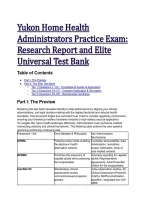
Yukon Home Health
Administrators Practice Exam:
Research Report and Elite
Universal Test Bank
Table of Contents
● Part I: The Preview
● Part II: The Elite Test Bank
○ Tier 1 (Questions 1–18) - Foundational Syntax & Application
○ Tier 2 (Questions 19–37) - Complex Application & Simulation
○ Tier 3 (Questions 38–55) - Grandmaster Synthesis
Part I: The Preview
Mastering this test bank translates directly to elite performance by aligning your clinical,
administrative, and legal decision-making with the highest territorial and national health
standards. This document forges true command over Yukon’s complex regulatory environment,
ensuring your theoretical mastery translates instantly to high-stakes practical application.
To navigate the Yukon health landscape effectively, administrators must synthesize multiple
intersecting statutory and clinical frameworks. The following table outlines the core systems
governing community continuing care.
Framework / Act Core Mandate & Philosophy Key Administrative
Mechanisms
HIPMA Protects privacy while enabling Custodian accountability, data
the electronic health minimization, mandatory
information network. breach notification, circle of
care implied consent.
APDMA Prioritizes the autonomy of Voluntary reporting for capable
capable adults while protecting adults, Representation
the incapacitated. Agreements, Adult Protection
Orders for the incapacitated.
interRAI HC Standardizes clinical 3-day observation window, 25
assessments across Clinical Assessment Protocols
community-based programs (CAPs), MAPLe prioritization
globally. algorithm, integrated into CIHI
IRRS.
,Framework / Act Core Mandate & Philosophy Key Administrative
Mechanisms
Accreditation Canada ROPs Enforces essential quality and Medication Reconciliation
safety protocols across health (MedRec) at all transitions,
organizations. Best Possible Medication
History (BPMH), formal patient
safety incident disclosure.
WSCB / OHS Mandates the occupational Formal "Working Alone"
health and safety of the policies, hazard assessments,
workforce above all else. strictly smoke-free
environments, mandatory
securing of pets.
● Critical Axioms (The Hard Deck):
○ HIPMA Custodianship: Under Yukon's Health Information Privacy and
Management Act, Custodians are legally accountable for the actions of their agents
(staff). Internal access is a "use," while external sharing is a "disclosure".
○ The Autonomy Imperative: The Adult Protection and Decision-Making Act
explicitly defends the "dignity of risk." You cannot force interventions on a capable
adult; emergency protections are strictly reserved for the incapacitated facing
severe harm.
○ The 3-Day interRAI Window: Unless explicitly specified, interRAI HC assessments
evaluate the client's objective performance strictly over the previous 3 days,
identifying triggers that inform localized care planning.
○ The MedRec Baseline: A Best Possible Medication History (BPMH) is the
foundation of Medication Reconciliation. It requires direct interviews to capture
actual consumption (including traditional herbs), not just passive reliance on
historical physician orders.
○ Safety Over Service: Occupational Health and Safety (OHS) hazards nullify the
duty to provide service. Unsecured pets, second-hand smoke, or physical violence
demand immediate worker extraction and hazard reporting.
Part II: The Elite Test Bank
Tier 1 (Questions 1–18) - Foundational Syntax & Application
Q1: A Yukon home care nurse accesses the Yukon Health Information Network (YHIN) to review
a patient's lab results prior to a home visit. Based on the principles of the Health Information
Privacy and Management Act (HIPMA), which classification MOST ACCURATELY describes
this action? A) An unauthorized collection of personal health information B) A disclosure of
personal health information C) An authorized use of personal health information D) A privacy
breach requiring immediate notification
● Answer: C (An authorized use of personal health information)
● Distractor Analysis:
○ A is incorrect: Accessing YHIN for direct patient care by an authorized agent is a
routine, legal action, not an unauthorized collection.
○ B is incorrect: Under HIPMA, authorized access to YHIN by an internal agent for
care is classified strictly as a "use," not a "disclosure," which involves sharing
, outside the Custodian's control.
○ D is incorrect: This is a legitimate workflow process, entirely unrelated to a breach.
The Mentor's Analysis: HIPMA distinctly categorizes accessing internal electronic health
networks (like YHIN) by authorized agents as a "use" of data. When facing data flow scenarios,
the immediate priority is distinguishing between internal use and external disclosure. By utilizing
accurate statutory definitions, you bypass the common trap of mislabeling routine network
access as a privacy-violating disclosure. Professional Intuition: Internal electronic network
access by an agent for direct care is always legally classified as a "use," not a
"disclosure."
Q2: A community social worker suspects a mentally capable 75-year-old Yukon resident is
being financially exploited by their nephew. Based on the Adult Protection and Decision-Making
Act (APDMA), which action is legally REQUIRED of the social worker? A) Immediately freezing
the resident's bank accounts for 30 days B) Filing a mandatory report with the Adult Protection
Office C) Respecting the adult's autonomy, as reporting is voluntary D) Applying for a
court-appointed guardianship order
● Answer: C (Respecting the adult's autonomy, as reporting is voluntary)
● Distractor Analysis:
○ A is incorrect: Social workers lack the unilateral authority to freeze accounts under
the APDMA; such actions require specific institutional or judicial triggers.
○ B is incorrect: In Yukon, reporting abuse of a community-dwelling adult is voluntary,
not mandatory, unless the adult is unable to seek help on their own.
○ D is incorrect: A capable adult retains the fundamental right to make their own
decisions; guardianship is highly restrictive and legally void here.
The Mentor's Analysis: The APDMA prioritizes the autonomy of capable adults, enshrining their
right to the "dignity of risk". When facing suspected abuse of a capable community dweller, the
immediate priority is offering support without violating their autonomy. By utilizing the principle of
voluntary reporting, you bypass the common trap of assuming all elder abuse mandates state
intervention. Professional Intuition: In Yukon, there is no public duty to report elder abuse
for community-dwelling, legally capable adults.
Q3: A home care nurse is initiating a comprehensive assessment for a newly admitted senior
using the interRAI HC tool. Based on the principles of interRAI HC methodology, what is the
STANDARD observation period for coding most items? A) The previous 24 hours B) The
previous 3 days C) The previous 7 days D) The previous 30 days
● Answer: B (The previous 3 days)
● Distractor Analysis:
○ A is incorrect: 24 hours is too narrow to capture fluctuating functional statuses in the
home environment.
○ C is incorrect: 7 days is used in some legacy long-term care MDS tools, but not the
standard interRAI HC.
○ D is incorrect: A 30-day window is utilized for specific historical look-backs (e.g.,
falls), but not as the general observational baseline.
The Mentor's Analysis: The interRAI HC relies on a specific retrospective window to ensure data
consistency across all global users and feed accurate data into the CIHI IRRS. When facing
coding dilemmas, the immediate priority is bounding the assessment to recent, verifiable
behaviors. By utilizing the 3-day observation period, you bypass the common trap of
over-reporting historical or isolated functional abilities. Professional Intuition: Unless explicitly
stated otherwise in the item definition, the interRAI HC observation window is exactly 3
days.
Administrators Practice Exam:
Research Report and Elite
Universal Test Bank
Table of Contents
● Part I: The Preview
● Part II: The Elite Test Bank
○ Tier 1 (Questions 1–18) - Foundational Syntax & Application
○ Tier 2 (Questions 19–37) - Complex Application & Simulation
○ Tier 3 (Questions 38–55) - Grandmaster Synthesis
Part I: The Preview
Mastering this test bank translates directly to elite performance by aligning your clinical,
administrative, and legal decision-making with the highest territorial and national health
standards. This document forges true command over Yukon’s complex regulatory environment,
ensuring your theoretical mastery translates instantly to high-stakes practical application.
To navigate the Yukon health landscape effectively, administrators must synthesize multiple
intersecting statutory and clinical frameworks. The following table outlines the core systems
governing community continuing care.
Framework / Act Core Mandate & Philosophy Key Administrative
Mechanisms
HIPMA Protects privacy while enabling Custodian accountability, data
the electronic health minimization, mandatory
information network. breach notification, circle of
care implied consent.
APDMA Prioritizes the autonomy of Voluntary reporting for capable
capable adults while protecting adults, Representation
the incapacitated. Agreements, Adult Protection
Orders for the incapacitated.
interRAI HC Standardizes clinical 3-day observation window, 25
assessments across Clinical Assessment Protocols
community-based programs (CAPs), MAPLe prioritization
globally. algorithm, integrated into CIHI
IRRS.
,Framework / Act Core Mandate & Philosophy Key Administrative
Mechanisms
Accreditation Canada ROPs Enforces essential quality and Medication Reconciliation
safety protocols across health (MedRec) at all transitions,
organizations. Best Possible Medication
History (BPMH), formal patient
safety incident disclosure.
WSCB / OHS Mandates the occupational Formal "Working Alone"
health and safety of the policies, hazard assessments,
workforce above all else. strictly smoke-free
environments, mandatory
securing of pets.
● Critical Axioms (The Hard Deck):
○ HIPMA Custodianship: Under Yukon's Health Information Privacy and
Management Act, Custodians are legally accountable for the actions of their agents
(staff). Internal access is a "use," while external sharing is a "disclosure".
○ The Autonomy Imperative: The Adult Protection and Decision-Making Act
explicitly defends the "dignity of risk." You cannot force interventions on a capable
adult; emergency protections are strictly reserved for the incapacitated facing
severe harm.
○ The 3-Day interRAI Window: Unless explicitly specified, interRAI HC assessments
evaluate the client's objective performance strictly over the previous 3 days,
identifying triggers that inform localized care planning.
○ The MedRec Baseline: A Best Possible Medication History (BPMH) is the
foundation of Medication Reconciliation. It requires direct interviews to capture
actual consumption (including traditional herbs), not just passive reliance on
historical physician orders.
○ Safety Over Service: Occupational Health and Safety (OHS) hazards nullify the
duty to provide service. Unsecured pets, second-hand smoke, or physical violence
demand immediate worker extraction and hazard reporting.
Part II: The Elite Test Bank
Tier 1 (Questions 1–18) - Foundational Syntax & Application
Q1: A Yukon home care nurse accesses the Yukon Health Information Network (YHIN) to review
a patient's lab results prior to a home visit. Based on the principles of the Health Information
Privacy and Management Act (HIPMA), which classification MOST ACCURATELY describes
this action? A) An unauthorized collection of personal health information B) A disclosure of
personal health information C) An authorized use of personal health information D) A privacy
breach requiring immediate notification
● Answer: C (An authorized use of personal health information)
● Distractor Analysis:
○ A is incorrect: Accessing YHIN for direct patient care by an authorized agent is a
routine, legal action, not an unauthorized collection.
○ B is incorrect: Under HIPMA, authorized access to YHIN by an internal agent for
care is classified strictly as a "use," not a "disclosure," which involves sharing
, outside the Custodian's control.
○ D is incorrect: This is a legitimate workflow process, entirely unrelated to a breach.
The Mentor's Analysis: HIPMA distinctly categorizes accessing internal electronic health
networks (like YHIN) by authorized agents as a "use" of data. When facing data flow scenarios,
the immediate priority is distinguishing between internal use and external disclosure. By utilizing
accurate statutory definitions, you bypass the common trap of mislabeling routine network
access as a privacy-violating disclosure. Professional Intuition: Internal electronic network
access by an agent for direct care is always legally classified as a "use," not a
"disclosure."
Q2: A community social worker suspects a mentally capable 75-year-old Yukon resident is
being financially exploited by their nephew. Based on the Adult Protection and Decision-Making
Act (APDMA), which action is legally REQUIRED of the social worker? A) Immediately freezing
the resident's bank accounts for 30 days B) Filing a mandatory report with the Adult Protection
Office C) Respecting the adult's autonomy, as reporting is voluntary D) Applying for a
court-appointed guardianship order
● Answer: C (Respecting the adult's autonomy, as reporting is voluntary)
● Distractor Analysis:
○ A is incorrect: Social workers lack the unilateral authority to freeze accounts under
the APDMA; such actions require specific institutional or judicial triggers.
○ B is incorrect: In Yukon, reporting abuse of a community-dwelling adult is voluntary,
not mandatory, unless the adult is unable to seek help on their own.
○ D is incorrect: A capable adult retains the fundamental right to make their own
decisions; guardianship is highly restrictive and legally void here.
The Mentor's Analysis: The APDMA prioritizes the autonomy of capable adults, enshrining their
right to the "dignity of risk". When facing suspected abuse of a capable community dweller, the
immediate priority is offering support without violating their autonomy. By utilizing the principle of
voluntary reporting, you bypass the common trap of assuming all elder abuse mandates state
intervention. Professional Intuition: In Yukon, there is no public duty to report elder abuse
for community-dwelling, legally capable adults.
Q3: A home care nurse is initiating a comprehensive assessment for a newly admitted senior
using the interRAI HC tool. Based on the principles of interRAI HC methodology, what is the
STANDARD observation period for coding most items? A) The previous 24 hours B) The
previous 3 days C) The previous 7 days D) The previous 30 days
● Answer: B (The previous 3 days)
● Distractor Analysis:
○ A is incorrect: 24 hours is too narrow to capture fluctuating functional statuses in the
home environment.
○ C is incorrect: 7 days is used in some legacy long-term care MDS tools, but not the
standard interRAI HC.
○ D is incorrect: A 30-day window is utilized for specific historical look-backs (e.g.,
falls), but not as the general observational baseline.
The Mentor's Analysis: The interRAI HC relies on a specific retrospective window to ensure data
consistency across all global users and feed accurate data into the CIHI IRRS. When facing
coding dilemmas, the immediate priority is bounding the assessment to recent, verifiable
behaviors. By utilizing the 3-day observation period, you bypass the common trap of
over-reporting historical or isolated functional abilities. Professional Intuition: Unless explicitly
stated otherwise in the item definition, the interRAI HC observation window is exactly 3
days.


