
Lewis Dot Diagrams: Covalent Compounds
How do you know if there will be a covalent bond between two elements?
You can identify a covalent bond by checking if both elements are non-metals. And if they
share electrons.
What happens to electrons in a covalent bond?
In a covalent bond, atoms achieve stability by sharing pairs of valence (outermost) electrons.
How is a covalent bond formed?
The electrons from one atom(non-metal) are attracted to the positive proton nucleus of
another atom(non-metal). When the two atoms get close enough, the attractive force keeps
them together, allowing both atoms to now have a full outer shell which mean they are now
stable.
Can electrons be shared unequally? What kind of bond is this then?
Yes, electrons can be shared unequally between atoms. This type of chemical bond is called
a polar covalent bond.
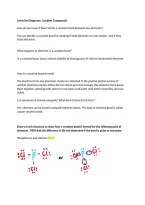
Draw a Lewis Structure to show how a covalent bond if formed for the following pairs of
elements. THEN find the difference in EN and determine if the bond is polar or non-polar.
Phosphorous and chlorine (PCl3)
How do you know if there will be a covalent bond between two elements?
You can identify a covalent bond by checking if both elements are non-metals. And if they
share electrons.
What happens to electrons in a covalent bond?
In a covalent bond, atoms achieve stability by sharing pairs of valence (outermost) electrons.
How is a covalent bond formed?
The electrons from one atom(non-metal) are attracted to the positive proton nucleus of
another atom(non-metal). When the two atoms get close enough, the attractive force keeps
them together, allowing both atoms to now have a full outer shell which mean they are now
stable.
Can electrons be shared unequally? What kind of bond is this then?
Yes, electrons can be shared unequally between atoms. This type of chemical bond is called
a polar covalent bond.
Draw a Lewis Structure to show how a covalent bond if formed for the following pairs of
elements. THEN find the difference in EN and determine if the bond is polar or non-polar.
Phosphorous and chlorine (PCl3)


