
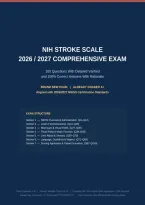
NIH STROKE SCALE
COMPREHENSIVE EXAM
100 Questions With Detailed Verified
and 100% Correct Answers With Rationale
BRAND NEW EXAM | ALREADY GRADED A+
Aligned with 2026/2027 NIHSS Certification Standards
EXAM STRUCTURE
Section 1 — NIHSS Overview & Administration (Q1–Q12)
Section 2 — Level of Consciousness (Q13–Q26)
Section 3 — Best Gaze & Visual Fields (Q27–Q38)
Section 4 — Facial Palsy & Motor Function (Q39–Q58)
Section 5 — Limb Ataxia & Sensory (Q59–Q70)
Section 6 — Language, Dysarthria & Neglect (Q71–Q86)
Section 7 — Scoring Application & Patient Scenarios (Q87–Q100)
Total Questions: 100 | Format: Multiple Choice (A–D) | Cognitive Mix: 30% Recall / 50% Application / 20% Analysis
Answer Key Convention: C. [Choice text] **[CORRECT]** · Each rationale cites official NIHSS scoring criteria
,NIH STROKE SCALE 2026/2027 — COMPREHENSIVE CERTIFICATION
Already Graded
EXAMA+ · 100% Correct With Rationale
NIH Stroke Scale 2026/2027 Comprehensive Certification
Exam
Already Graded A+ · Brand New Exam · 100% Correct Answers With
Rationale
This comprehensive examination contains 100 multiple-choice questions aligned with the current 2026/2027
NIHSS certification standards. It is structured in seven sections corresponding to the natural organization of
the scale: overview and administration, level of consciousness (Items 1a, 1b, 1c), gaze and visual fields (Items
2, 3), facial palsy and motor function (Items 4, 5a/5b, 6a/6b), limb ataxia and sensory (Items 7, 8), language
and neglect (Items 9, 10, 11), and full-scale scoring application with patient scenarios. Each question is
followed by four options (A–D) with one correct answer marked [CORRECT], the answer letter, and a 2–3
sentence rationale grounded in the official NIHSS scoring criteria.
Cognitive Mix & Difficulty
The exam follows the official cognitive-level distribution used in NIHSS certification testing: approximately
30% recall (direct scoring definitions and item rules), 50% application (patient scenario scoring requiring
item-by-item decision-making), and 20% analysis (differentiating subtle neurological findings — e.g., gaze
preference vs. partial gaze palsy, aphasia vs. dysarthria, ataxia vs. weakness, neglect vs. sensory loss).
Distractors represent commonly confused scoring errors (e.g., scoring drift 1 vs. 2, misclassifying ataxia as
weakness, incorrect visual field grading, failing to distinguish complete vs. partial facial paralysis).
NIHSS Total Score Reference Table
Total NIHSS Severity Category Clinical Interpretation
0 No deficit No measurable neurological deficit
1–4 Minor stroke Mild deficit; often good prognosis
5 – 15 Moderate stroke Moderate deficit; admission to stroke unit
16 – 20 Moderate-severe Significant deficit; ICU-level monitoring
21 – 42 Severe stroke Severe deficit; poor prognosis; high mortality
Item Quick-Reference Scoring
1a Alertness 0–3 · 1b Orientation 0–2 · 1c Commands 0–2 · 2 Gaze 0–2 · 3 Visual Fields 0–3 · 4 Facial Palsy
0–3 · 5a/5b Motor Arm 0–4 (UN=amputee/joint fusion) · 6a/6b Motor Leg 0–4 (UN=amputee/joint fusion) · 7
Limb Ataxia 0–2 · 8 Sensory 0–2 · 9 Best Language 0–3 · 10 Dysarthria 0–2 (UN=intubated) · 11
Extinction/Neglect 0–2. Maximum possible total: 42 (with no UN items).
Page 2 100 Questions · 7 Sections · 2026/2027 Edition
,NIH STROKE SCALE 2026/2027 — COMPREHENSIVE CERTIFICATION
Already Graded
EXAMA+ · 100% Correct With Rationale
Section 1: NIHSS Overview and Administration
Purpose, Certification, Administration Standards, and Documentation —
Q1–Q12
Q1. The NIHSS was originally developed from which prior neurological assessment tool, and what is its
primary clinical purpose in 2026/2027 stroke care?
A. Modified from the Glasgow Coma Scale; used exclusively to triage intracerebral hemorrhage.
B. Derived from the Toronto Stroke Scale and Oxbury Initial Severity Scale; used to objectively
quantify neurological deficits from cerebral infarction and standardize stroke severity
communication. [CORRECT]
C. Adapted from the Hunt and Hess Scale; used to predict aneurysmal rebleeding risk.
D. Built from the ABCD² score; used to stratify transient ischemic attack recurrence risk.
Correct Answer: B
Rationale: The NIHSS was derived by Brott, Adams, and colleagues at the NIH by combining elements of the
Toronto Stroke Scale, the Oxbury Initial Severity Scale, the Cincinnati Stroke Scale, and the Edinburgh-2 Coma
Scale to objectively quantify neurological deficits from cerebral infarction. Its primary 2026/2027 purpose remains
standardized, reproducible measurement of stroke severity to guide acute treatment decisions (e.g., tPA eligibility,
thrombectomy threshold) and to enable consistent communication across the stroke team. It is not a coma scale (1a
alone is, but the full NIHSS is broader), and it is not designed for hemorrhage triage, aneurysm grading, or TIA
recurrence prediction.
Q2. A stroke nurse certified on NIHSS in 2019 asks about current 2026/2027 recertification standards. Which
statement is correct?
A. NIHSS certification is valid for life once initially completed; no recertification is ever required.
B. Annual recertification is required for all clinicians who score the NIHSS on acute stroke patients,
and many institutions additionally require Group A, B, and C alternating patient-set recertification
every 6 to 12 months to maintain scorer reliability. [CORRECT]
C. Recertification is required only every 5 years and only for attending stroke neurologists.
D. Recertification is needed only after a documented scoring discrepancy; otherwise the original
certificate remains valid.
Correct Answer: B
Rationale: Current 2026/2027 NIHSS training standards require annual recertification for clinicians who score the
NIHSS on acute stroke patients, and the official certification program uses three rotating patient sets (Group A,
Group B, Group C) so that test-takers do not see the same patients on consecutive cycles; many stroke centers cycle
through these groups every 6–12 months to maintain inter-rater reliability. Options A, C, and D all contradict the
official annual + rotating-group requirement and would invalidate a stroke center's certification status.
Page 3 100 Questions · 7 Sections · 2026/2027 Edition
, NIH STROKE SCALE 2026/2027 — COMPREHENSIVE CERTIFICATION
Already Graded
EXAMA+ · 100% Correct With Rationale
Q3. Which sequence reflects the correct standard administration order of the 11 NIHSS items?
A. 1a→1b→1c→4→2→3→5a→5b→6a→6b→7→8→9→10→11 (motor items first, then cranial
nerves).
B. 1a→1b→1c→2→3→4→5a→5b→6a→6b→7→8→9→10→11 (cranial nerves, then motor, then
coordination, sensory, language, speech, neglect). [CORRECT]
C. 1a→1b→1c→9→10→11→2→3→4→5a→5b→6a→6b→7→8 (language and neglect first).
D. The order is examiner-dependent and is left to individual clinical judgment.
Correct Answer: B
Rationale: The official NIHSS administration order is 1a, 1b, 1c (level of consciousness), then Item 2 (best gaze),
Item 3 (visual fields), Item 4 (facial palsy), Items 5a/5b (motor arms), Items 6a/6b (motor legs), Item 7 (limb ataxia),
Item 8 (sensory), Item 9 (best language), Item 10 (dysarthria), and finally Item 11 (extinction and inattention). This
order proceeds rostral-to-caudal through cranial nerve functions, then motor, then coordination/sensory, then
language/speech/neglect — preserving both clinical logic and rater reproducibility. The order is fixed, not
examiner-dependent.
Q4. When administering Item 1b (orientation), a 67-year-old patient with severe aphasia is asked the month
and his age. He clearly attempts to respond but produces only non-verbal sounds and cannot produce a correct
answer in any modality. How should Item 1b be scored, and what is the underlying NIHSS rule?
A. Score 0 — credit the patient because aphasia does not affect orientation scoring.
B. Score 1 — credit one answer because the patient made an attempt.
C. Score 2 — aphasic or stuporous patients who cannot answer either question are scored 2
(answers neither correctly). [CORRECT]
D. Mark Item 1b 'UN' (untestable) — aphasic patients are excluded from orientation scoring.
Correct Answer: C
Rationale: Per official NIHSS instructions, only the patient's initial answer is scored; if the patient is aphasic or
stuporous and cannot answer either question, the score is 2 (answers neither correctly). The NIHSS does NOT have
an 'untestable' option for Item 1b — Item 1b is always scored 0, 1, or 2 even when aphasia precludes a verbal
response. This rule prevents falsely low total scores in aphasic patients while still documenting the deficit.
Q5. A patient is being evaluated with the NIHSS. Which of the following items permits an 'UN' (untestable)
designation in the official scale?
A. Item 1c (LOC commands).
B. Item 4 (facial palsy).
C. Item 5a/5b motor arm and Item 6a/6b motor leg when the limb is amputated or has a joint
fusion, and Item 10 (dysarthria) when the patient is intubated or has another physical barrier.
[CORRECT]
D. Item 9 (best language) when the patient is intubated.
Correct Answer: C
Rationale: Only three item categories allow 'UN' scoring on the official NIHSS: (1) Items 5a/5b (motor arm) and
6a/6b (motor leg) when the limb is amputated or has a joint fusion; (2) Item 10 (dysarthria) when the patient is
intubated or has another physical barrier to speech; and (3) aphasia does NOT convert Item 9 to UN — aphasic
patients are still scored 1, 2, or 3. Item 1c (LOC commands) does not use UN; if the patient cannot perform, score 2.
Page 4 100 Questions · 7 Sections · 2026/2027 Edition
COMPREHENSIVE EXAM
100 Questions With Detailed Verified
and 100% Correct Answers With Rationale
BRAND NEW EXAM | ALREADY GRADED A+
Aligned with 2026/2027 NIHSS Certification Standards
EXAM STRUCTURE
Section 1 — NIHSS Overview & Administration (Q1–Q12)
Section 2 — Level of Consciousness (Q13–Q26)
Section 3 — Best Gaze & Visual Fields (Q27–Q38)
Section 4 — Facial Palsy & Motor Function (Q39–Q58)
Section 5 — Limb Ataxia & Sensory (Q59–Q70)
Section 6 — Language, Dysarthria & Neglect (Q71–Q86)
Section 7 — Scoring Application & Patient Scenarios (Q87–Q100)
Total Questions: 100 | Format: Multiple Choice (A–D) | Cognitive Mix: 30% Recall / 50% Application / 20% Analysis
Answer Key Convention: C. [Choice text] **[CORRECT]** · Each rationale cites official NIHSS scoring criteria
,NIH STROKE SCALE 2026/2027 — COMPREHENSIVE CERTIFICATION
Already Graded
EXAMA+ · 100% Correct With Rationale
NIH Stroke Scale 2026/2027 Comprehensive Certification
Exam
Already Graded A+ · Brand New Exam · 100% Correct Answers With
Rationale
This comprehensive examination contains 100 multiple-choice questions aligned with the current 2026/2027
NIHSS certification standards. It is structured in seven sections corresponding to the natural organization of
the scale: overview and administration, level of consciousness (Items 1a, 1b, 1c), gaze and visual fields (Items
2, 3), facial palsy and motor function (Items 4, 5a/5b, 6a/6b), limb ataxia and sensory (Items 7, 8), language
and neglect (Items 9, 10, 11), and full-scale scoring application with patient scenarios. Each question is
followed by four options (A–D) with one correct answer marked [CORRECT], the answer letter, and a 2–3
sentence rationale grounded in the official NIHSS scoring criteria.
Cognitive Mix & Difficulty
The exam follows the official cognitive-level distribution used in NIHSS certification testing: approximately
30% recall (direct scoring definitions and item rules), 50% application (patient scenario scoring requiring
item-by-item decision-making), and 20% analysis (differentiating subtle neurological findings — e.g., gaze
preference vs. partial gaze palsy, aphasia vs. dysarthria, ataxia vs. weakness, neglect vs. sensory loss).
Distractors represent commonly confused scoring errors (e.g., scoring drift 1 vs. 2, misclassifying ataxia as
weakness, incorrect visual field grading, failing to distinguish complete vs. partial facial paralysis).
NIHSS Total Score Reference Table
Total NIHSS Severity Category Clinical Interpretation
0 No deficit No measurable neurological deficit
1–4 Minor stroke Mild deficit; often good prognosis
5 – 15 Moderate stroke Moderate deficit; admission to stroke unit
16 – 20 Moderate-severe Significant deficit; ICU-level monitoring
21 – 42 Severe stroke Severe deficit; poor prognosis; high mortality
Item Quick-Reference Scoring
1a Alertness 0–3 · 1b Orientation 0–2 · 1c Commands 0–2 · 2 Gaze 0–2 · 3 Visual Fields 0–3 · 4 Facial Palsy
0–3 · 5a/5b Motor Arm 0–4 (UN=amputee/joint fusion) · 6a/6b Motor Leg 0–4 (UN=amputee/joint fusion) · 7
Limb Ataxia 0–2 · 8 Sensory 0–2 · 9 Best Language 0–3 · 10 Dysarthria 0–2 (UN=intubated) · 11
Extinction/Neglect 0–2. Maximum possible total: 42 (with no UN items).
Page 2 100 Questions · 7 Sections · 2026/2027 Edition
,NIH STROKE SCALE 2026/2027 — COMPREHENSIVE CERTIFICATION
Already Graded
EXAMA+ · 100% Correct With Rationale
Section 1: NIHSS Overview and Administration
Purpose, Certification, Administration Standards, and Documentation —
Q1–Q12
Q1. The NIHSS was originally developed from which prior neurological assessment tool, and what is its
primary clinical purpose in 2026/2027 stroke care?
A. Modified from the Glasgow Coma Scale; used exclusively to triage intracerebral hemorrhage.
B. Derived from the Toronto Stroke Scale and Oxbury Initial Severity Scale; used to objectively
quantify neurological deficits from cerebral infarction and standardize stroke severity
communication. [CORRECT]
C. Adapted from the Hunt and Hess Scale; used to predict aneurysmal rebleeding risk.
D. Built from the ABCD² score; used to stratify transient ischemic attack recurrence risk.
Correct Answer: B
Rationale: The NIHSS was derived by Brott, Adams, and colleagues at the NIH by combining elements of the
Toronto Stroke Scale, the Oxbury Initial Severity Scale, the Cincinnati Stroke Scale, and the Edinburgh-2 Coma
Scale to objectively quantify neurological deficits from cerebral infarction. Its primary 2026/2027 purpose remains
standardized, reproducible measurement of stroke severity to guide acute treatment decisions (e.g., tPA eligibility,
thrombectomy threshold) and to enable consistent communication across the stroke team. It is not a coma scale (1a
alone is, but the full NIHSS is broader), and it is not designed for hemorrhage triage, aneurysm grading, or TIA
recurrence prediction.
Q2. A stroke nurse certified on NIHSS in 2019 asks about current 2026/2027 recertification standards. Which
statement is correct?
A. NIHSS certification is valid for life once initially completed; no recertification is ever required.
B. Annual recertification is required for all clinicians who score the NIHSS on acute stroke patients,
and many institutions additionally require Group A, B, and C alternating patient-set recertification
every 6 to 12 months to maintain scorer reliability. [CORRECT]
C. Recertification is required only every 5 years and only for attending stroke neurologists.
D. Recertification is needed only after a documented scoring discrepancy; otherwise the original
certificate remains valid.
Correct Answer: B
Rationale: Current 2026/2027 NIHSS training standards require annual recertification for clinicians who score the
NIHSS on acute stroke patients, and the official certification program uses three rotating patient sets (Group A,
Group B, Group C) so that test-takers do not see the same patients on consecutive cycles; many stroke centers cycle
through these groups every 6–12 months to maintain inter-rater reliability. Options A, C, and D all contradict the
official annual + rotating-group requirement and would invalidate a stroke center's certification status.
Page 3 100 Questions · 7 Sections · 2026/2027 Edition
, NIH STROKE SCALE 2026/2027 — COMPREHENSIVE CERTIFICATION
Already Graded
EXAMA+ · 100% Correct With Rationale
Q3. Which sequence reflects the correct standard administration order of the 11 NIHSS items?
A. 1a→1b→1c→4→2→3→5a→5b→6a→6b→7→8→9→10→11 (motor items first, then cranial
nerves).
B. 1a→1b→1c→2→3→4→5a→5b→6a→6b→7→8→9→10→11 (cranial nerves, then motor, then
coordination, sensory, language, speech, neglect). [CORRECT]
C. 1a→1b→1c→9→10→11→2→3→4→5a→5b→6a→6b→7→8 (language and neglect first).
D. The order is examiner-dependent and is left to individual clinical judgment.
Correct Answer: B
Rationale: The official NIHSS administration order is 1a, 1b, 1c (level of consciousness), then Item 2 (best gaze),
Item 3 (visual fields), Item 4 (facial palsy), Items 5a/5b (motor arms), Items 6a/6b (motor legs), Item 7 (limb ataxia),
Item 8 (sensory), Item 9 (best language), Item 10 (dysarthria), and finally Item 11 (extinction and inattention). This
order proceeds rostral-to-caudal through cranial nerve functions, then motor, then coordination/sensory, then
language/speech/neglect — preserving both clinical logic and rater reproducibility. The order is fixed, not
examiner-dependent.
Q4. When administering Item 1b (orientation), a 67-year-old patient with severe aphasia is asked the month
and his age. He clearly attempts to respond but produces only non-verbal sounds and cannot produce a correct
answer in any modality. How should Item 1b be scored, and what is the underlying NIHSS rule?
A. Score 0 — credit the patient because aphasia does not affect orientation scoring.
B. Score 1 — credit one answer because the patient made an attempt.
C. Score 2 — aphasic or stuporous patients who cannot answer either question are scored 2
(answers neither correctly). [CORRECT]
D. Mark Item 1b 'UN' (untestable) — aphasic patients are excluded from orientation scoring.
Correct Answer: C
Rationale: Per official NIHSS instructions, only the patient's initial answer is scored; if the patient is aphasic or
stuporous and cannot answer either question, the score is 2 (answers neither correctly). The NIHSS does NOT have
an 'untestable' option for Item 1b — Item 1b is always scored 0, 1, or 2 even when aphasia precludes a verbal
response. This rule prevents falsely low total scores in aphasic patients while still documenting the deficit.
Q5. A patient is being evaluated with the NIHSS. Which of the following items permits an 'UN' (untestable)
designation in the official scale?
A. Item 1c (LOC commands).
B. Item 4 (facial palsy).
C. Item 5a/5b motor arm and Item 6a/6b motor leg when the limb is amputated or has a joint
fusion, and Item 10 (dysarthria) when the patient is intubated or has another physical barrier.
[CORRECT]
D. Item 9 (best language) when the patient is intubated.
Correct Answer: C
Rationale: Only three item categories allow 'UN' scoring on the official NIHSS: (1) Items 5a/5b (motor arm) and
6a/6b (motor leg) when the limb is amputated or has a joint fusion; (2) Item 10 (dysarthria) when the patient is
intubated or has another physical barrier to speech; and (3) aphasia does NOT convert Item 9 to UN — aphasic
patients are still scored 1, 2, or 3. Item 1c (LOC commands) does not use UN; if the patient cannot perform, score 2.
Page 4 100 Questions · 7 Sections · 2026/2027 Edition


