
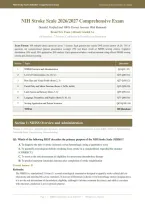
NIH Stroke Scale 2026/2027 Comprehensive Exam Certification & Recertification | A+ Graded
NIH Stroke Scale 2026/2027 Comprehensive Exam
Detailed Verified and 100% Correct Answers With Rationale
Brand New Exam | Already Graded A+
100 Questions | 7 Sections | Certification & Recertification Preparation
Exam Format: 100 multiple-choice questions across 7 sections. Each question has exactly ONE correct answer (A-D). 75% of
questions are scenario-based (patient presentation scoring); 25% test direct recall of NIHSS scoring criteria. Cognitive
distribution: 30% recall, 50% application, 20% analysis. Each question includes a verified rationale citing official NIHSS scoring
criteria and clinical reasoning.
Section Topic Questions
1 NIHSS Overview and Administration Q1-Q12 (12)
2 Level of Consciousness (1a, 1b, 1c) Q13-Q26 (14)
3 Best Gaze and Visual Fields (Items 2, 3) Q27-Q38 (12)
4 Facial Palsy and Motor Function (Items 4, 5a/5b, 6a/6b) Q39-Q58 (20)
5 Limb Ataxia and Sensory (Items 7, 8) Q59-Q70 (12)
6 Language, Dysarthria, and Neglect (Items 9, 10, 11) Q71-Q86 (16)
7 Scoring Application and Patient Scenarios Q87-Q100 (14)
TOTAL 100 Questions
Section 1: NIHSS Overview and Administration
Purpose, Certification, Administration Standards, and Documentation (Items: Overview, Group A/B/C, Order of Administration,
Untestable Items, Coma Scoring, Documentation).
Q1: Which of the following BEST describes the primary purpose of the NIH Stroke Scale (NIHSS)?
A. To diagnose the type of stroke (ischemic versus hemorrhagic) using a quantitative score
B. To quantify neurological deficits resulting from stroke in a standardized, reproducible manner
[CORRECT]
C. To serve as the sole determinant of eligibility for intravenous thrombolytic therapy
D. To predict long-term functional outcome after completion of stroke rehabilitation
Correct Answer: B
Rationale:
The NIHSS is a standardized 15-item (11 scored) neurological examination designed to quantify stroke-related deficits
objectively and reproducibly across examiners. It does not differentiate ischemic from hemorrhagic stroke (imaging does),
it is not the sole determinant of thrombolytic eligibility (although it informs treatment decisions), and while it correlates
with outcomes, prediction is not its primary purpose.
Page 1 | NIHSS Comprehensive Exam 2026/2027 | 100 Questions, 7 Sections
,NIH Stroke Scale 2026/2027 Comprehensive Exam Certification & Recertification | A+ Graded
Q2: The NIH Stroke Scale evaluates 11 categories of neurological function. Which statement BEST
describes the maximum achievable total score and the rationale?
A. The maximum score is 30, derived from summing the worst deficit per item
B. The maximum score is 42, derived from summing all 11 item scores including bilateral limb testing for
motor arms and legs [CORRECT]
C. The maximum score is 50, accounting for simultaneous scoring of right and left limbs at maximum deficit
D. The maximum score is 35, because bilateral limb ataxia cannot be scored simultaneously
Correct Answer: B
Rationale:
The maximum NIHSS total is 42, derived by summing all 11 scored categories. Items 5a/5b (motor arms) and 6a/6b (motor
legs) are scored separately for each side, and item 7 (ataxia) is capped at 2 even when multiple limbs are involved. A score
of 42 indicates profound neurological compromise with coma and bilateral deficits, typically seen with massive
hemispheric or brainstem infarction.
Q3: Per current 2026-2027 NIHSS certification standards, which training modality is required for
INITIAL certification?
A. Self-study of the NIHSS manual followed by a written institutional competency examination
B. Successful completion of the standardized NIHSS training program with video-based patient
assessments and a passing score on the assigned test group [CORRECT]
C. A single supervised bedside examination observed and signed off by a senior vascular neurologist
D. Completion of any accredited nursing neuroscience continuing education course equivalent
Correct Answer: B
Rationale:
Initial NIHSS certification requires successful completion of the standardized training program, which uses video-based
patient assessments across multiple test groups (Group A, B, and C). A passing score must be achieved on the assigned
group. Self-study, single bedside observation, or generic continuing education credits do not satisfy the standardized
certification standard required for credentialed examiners.
Q4: A neurology resident certified 12 months ago plans to renew their NIHSS credential. Per 2026-2027
recertification standards, which statement is MOST accurate?
A. Recertification is required every 2 years using the same patient group as initial certification
B. Recertification is required annually (every 12 months) using a different test group (Group A, B, or C)
than the one used for the most recent prior certification [CORRECT]
C. Recertification is required every 5 years by repeating the original certification group
D. Recertification is not required once initial certification has been achieved
Correct Answer: B
Rationale:
NIHSS recertification is required annually (every 12 months) to maintain active credentialing. The recertification
examination must use a different test group (Group A, B, or C) than the one used for the most recent prior certification to
prevent memorization and ensure ongoing scoring reliability. This annual cycle is a critical component of maintaining
examiner consistency across stroke centers and clinical trials.
Page 2 | NIHSS Comprehensive Exam 2026/2027 | 100 Questions, 7 Sections
,NIH Stroke Scale 2026/2027 Comprehensive Exam Certification & Recertification | A+ Graded
Q5: A physician is evaluating a stroke patient using the NIHSS. Which of the following reflects the
CORRECT standardized order of item administration?
A. Motor function, language, level of consciousness, visual fields, sensory
B. Level of consciousness (1a, 1b, 1c), gaze, visual fields, facial palsy, motor arms, motor legs, ataxia,
sensory, language, dysarthria, neglect [CORRECT]
C. Level of consciousness, motor, sensory, gaze, language, visual fields, facial palsy, dysarthria, ataxia, neglect
D. Facial palsy, gaze, motor, level of consciousness, visual fields, ataxia, sensory, language, dysarthria, neglect
Correct Answer: B
Rationale:
The NIHSS must be administered in the standardized order: Item 1 (LOC: alertness, orientation, commands), Item 2
(gaze), Item 3 (visual fields), Item 4 (facial palsy), Items 5a/5b (motor arms), Items 6a/6b (motor legs), Item 7 (limb
ataxia), Item 8 (sensory), Item 9 (language), Item 10 (dysarthria), and Item 11 (extinction/neglect). Administering items out
of order compromises scoring reliability, disrupts patient fatigue management, and impairs inter-examiner consistency.
Q6: When administering the NIHSS, which of the following is the BEST example of a patient whose item is
correctly documented as 'UN' (untestable)?
A. A patient with hemiparesis who cannot lift the right arm against gravity on item 5a
B. A patient with a right upper extremity amputation at the shoulder who cannot be tested on item 5a
[CORRECT]
C. A patient who is mute from global aphasia and cannot repeat phrases for item 10
D. A patient with severe visual loss from pre-existing cataracts on item 3
Correct Answer: B
Rationale:
'UN' (untestable) is reserved for items where physical limitations prevent any valid testing, such as amputation, joint
fusion, or limb cast. Item 5a cannot be tested on a patient without the limb. In contrast, hemiparesis is scored numerically
(4 for no movement), mutism from aphasia is scored under item 9 (=3) and item 10 is UN only when intubated or
anatomically unable to articulate, and pre-existing visual loss from cataracts does not automatically render item 3
untestable—the examiner documents what can be observed and tested.
Q7: A patient is brought to the emergency department unresponsive. On examination, there is no eye
opening, no verbal output, and no purposeful motor response to noxious stimulation. Only reflex motor
activity (decerebrate posturing) is present. Which item 1a score is MOST appropriate?
A. 2 - Not alert, requires repeated stimulation to attend
B. 3 - Responds only with reflex motor activity or is unresponsive [CORRECT]
C. 1 - Not alert but arousable by minor stimulation
D. 0 - Alert, since reflex posturing constitutes responsiveness
Correct Answer: B
Rationale:
Item 1a scoring: 0 = alert; 1 = not alert but arousable with minor stimulation, then attends; 2 = not alert, requires repeated
stimulation to attend; 3 = coma/unresponsive, responds only with reflex motor activity or is unresponsive. A patient
exhibiting only decerebrate or decorticate posturing to noxious stimulation is scored 3. This reflects profound impairment
of consciousness requiring emergent neurological intervention and is associated with grave prognosis.
Page 3 | NIHSS Comprehensive Exam 2026/2027 | 100 Questions, 7 Sections
, NIH Stroke Scale 2026/2027 Comprehensive Exam Certification & Recertification | A+ Graded
Q8: When documenting NIHSS findings in the medical record per 2026-2027 best-practice standards,
which approach is MOST appropriate?
A. Recording only the total numerical score in the patient chart for brevity
B. Documenting each item score individually along with the total, the time of assessment, and noting any
untestable items with rationale [CORRECT]
C. Recording narrative findings only, without numerical scoring, to preserve clinical nuance
D. Documenting only items scored as 0 to demonstrate absence of deficits
Correct Answer: B
Rationale:
Best-practice documentation requires recording the score for EACH of the 11 items, the total score, the exact time of
assessment, and noting any untestable items with brief rationale (e.g., '5a = UN, right upper extremity amputation'). A total
score alone obscures clinically important information about which deficits are present, which is critical for serial
assessment, treatment decisions, and inter-provider communication during stroke care.
Q9: Which NIHSS item can be PRIMARILY scored through observation rather than requiring active
patient participation or verbal command following?
A. Item 1c (LOC Commands)
B. Item 9 (Best Language)
C. Item 4 (Facial Palsy) - observing nasolabial fold symmetry and spontaneous facial movement
[CORRECT]
D. Item 7 (Limb Ataxia)
Correct Answer: C
Rationale:
Item 4 (Facial Palsy) can largely be scored by observing the patient's spontaneous facial movements, smile, and nasolabial
fold symmetry, although the examiner may ask the patient to show teeth or raise eyebrows to confirm. Items 1c, 9, and 7 all
require active patient participation (following commands, producing language, performing coordinated movements). This
distinction is critical in patients who are obtunded, severely aphasic, or intubated, where observation-only items can still
yield valid scoring information.
Q10: A comatose patient is being evaluated with the NIHSS. Which combination of items would MOST
predictably receive the maximum score (or be designated untestable) due to the patient's inability to
participate?
A. Items 1a, 1b, 1c, 9, and 10 (the latter often UN if intubated) [CORRECT]
B. Items 4, 5, and 6 only, because motor function cannot be tested in coma
C. Items 2, 3, and 7 only, because sensory and motor pathways are preserved
D. Items 8 and 11 only, because coma preserves language and motor function
Correct Answer: A
Rationale:
In coma, items 1a (3), 1b (2 - no responses), 1c (2 - no tasks performed), and 9 (3 - mute/global aphasia) receive maximum
scores. Item 10 (dysarthria) is often UN if the patient is intubated, or scored 2 if unintelligible sounds are produced. Motor
and sensory items may receive partial credit based on reflex response to pain. This pattern reflects the inability to
interactively participate in testing and contributes substantially to the high total NIHSS seen in comatose stroke patients.
Page 4 | NIHSS Comprehensive Exam 2026/2027 | 100 Questions, 7 Sections
NIH Stroke Scale 2026/2027 Comprehensive Exam
Detailed Verified and 100% Correct Answers With Rationale
Brand New Exam | Already Graded A+
100 Questions | 7 Sections | Certification & Recertification Preparation
Exam Format: 100 multiple-choice questions across 7 sections. Each question has exactly ONE correct answer (A-D). 75% of
questions are scenario-based (patient presentation scoring); 25% test direct recall of NIHSS scoring criteria. Cognitive
distribution: 30% recall, 50% application, 20% analysis. Each question includes a verified rationale citing official NIHSS scoring
criteria and clinical reasoning.
Section Topic Questions
1 NIHSS Overview and Administration Q1-Q12 (12)
2 Level of Consciousness (1a, 1b, 1c) Q13-Q26 (14)
3 Best Gaze and Visual Fields (Items 2, 3) Q27-Q38 (12)
4 Facial Palsy and Motor Function (Items 4, 5a/5b, 6a/6b) Q39-Q58 (20)
5 Limb Ataxia and Sensory (Items 7, 8) Q59-Q70 (12)
6 Language, Dysarthria, and Neglect (Items 9, 10, 11) Q71-Q86 (16)
7 Scoring Application and Patient Scenarios Q87-Q100 (14)
TOTAL 100 Questions
Section 1: NIHSS Overview and Administration
Purpose, Certification, Administration Standards, and Documentation (Items: Overview, Group A/B/C, Order of Administration,
Untestable Items, Coma Scoring, Documentation).
Q1: Which of the following BEST describes the primary purpose of the NIH Stroke Scale (NIHSS)?
A. To diagnose the type of stroke (ischemic versus hemorrhagic) using a quantitative score
B. To quantify neurological deficits resulting from stroke in a standardized, reproducible manner
[CORRECT]
C. To serve as the sole determinant of eligibility for intravenous thrombolytic therapy
D. To predict long-term functional outcome after completion of stroke rehabilitation
Correct Answer: B
Rationale:
The NIHSS is a standardized 15-item (11 scored) neurological examination designed to quantify stroke-related deficits
objectively and reproducibly across examiners. It does not differentiate ischemic from hemorrhagic stroke (imaging does),
it is not the sole determinant of thrombolytic eligibility (although it informs treatment decisions), and while it correlates
with outcomes, prediction is not its primary purpose.
Page 1 | NIHSS Comprehensive Exam 2026/2027 | 100 Questions, 7 Sections
,NIH Stroke Scale 2026/2027 Comprehensive Exam Certification & Recertification | A+ Graded
Q2: The NIH Stroke Scale evaluates 11 categories of neurological function. Which statement BEST
describes the maximum achievable total score and the rationale?
A. The maximum score is 30, derived from summing the worst deficit per item
B. The maximum score is 42, derived from summing all 11 item scores including bilateral limb testing for
motor arms and legs [CORRECT]
C. The maximum score is 50, accounting for simultaneous scoring of right and left limbs at maximum deficit
D. The maximum score is 35, because bilateral limb ataxia cannot be scored simultaneously
Correct Answer: B
Rationale:
The maximum NIHSS total is 42, derived by summing all 11 scored categories. Items 5a/5b (motor arms) and 6a/6b (motor
legs) are scored separately for each side, and item 7 (ataxia) is capped at 2 even when multiple limbs are involved. A score
of 42 indicates profound neurological compromise with coma and bilateral deficits, typically seen with massive
hemispheric or brainstem infarction.
Q3: Per current 2026-2027 NIHSS certification standards, which training modality is required for
INITIAL certification?
A. Self-study of the NIHSS manual followed by a written institutional competency examination
B. Successful completion of the standardized NIHSS training program with video-based patient
assessments and a passing score on the assigned test group [CORRECT]
C. A single supervised bedside examination observed and signed off by a senior vascular neurologist
D. Completion of any accredited nursing neuroscience continuing education course equivalent
Correct Answer: B
Rationale:
Initial NIHSS certification requires successful completion of the standardized training program, which uses video-based
patient assessments across multiple test groups (Group A, B, and C). A passing score must be achieved on the assigned
group. Self-study, single bedside observation, or generic continuing education credits do not satisfy the standardized
certification standard required for credentialed examiners.
Q4: A neurology resident certified 12 months ago plans to renew their NIHSS credential. Per 2026-2027
recertification standards, which statement is MOST accurate?
A. Recertification is required every 2 years using the same patient group as initial certification
B. Recertification is required annually (every 12 months) using a different test group (Group A, B, or C)
than the one used for the most recent prior certification [CORRECT]
C. Recertification is required every 5 years by repeating the original certification group
D. Recertification is not required once initial certification has been achieved
Correct Answer: B
Rationale:
NIHSS recertification is required annually (every 12 months) to maintain active credentialing. The recertification
examination must use a different test group (Group A, B, or C) than the one used for the most recent prior certification to
prevent memorization and ensure ongoing scoring reliability. This annual cycle is a critical component of maintaining
examiner consistency across stroke centers and clinical trials.
Page 2 | NIHSS Comprehensive Exam 2026/2027 | 100 Questions, 7 Sections
,NIH Stroke Scale 2026/2027 Comprehensive Exam Certification & Recertification | A+ Graded
Q5: A physician is evaluating a stroke patient using the NIHSS. Which of the following reflects the
CORRECT standardized order of item administration?
A. Motor function, language, level of consciousness, visual fields, sensory
B. Level of consciousness (1a, 1b, 1c), gaze, visual fields, facial palsy, motor arms, motor legs, ataxia,
sensory, language, dysarthria, neglect [CORRECT]
C. Level of consciousness, motor, sensory, gaze, language, visual fields, facial palsy, dysarthria, ataxia, neglect
D. Facial palsy, gaze, motor, level of consciousness, visual fields, ataxia, sensory, language, dysarthria, neglect
Correct Answer: B
Rationale:
The NIHSS must be administered in the standardized order: Item 1 (LOC: alertness, orientation, commands), Item 2
(gaze), Item 3 (visual fields), Item 4 (facial palsy), Items 5a/5b (motor arms), Items 6a/6b (motor legs), Item 7 (limb
ataxia), Item 8 (sensory), Item 9 (language), Item 10 (dysarthria), and Item 11 (extinction/neglect). Administering items out
of order compromises scoring reliability, disrupts patient fatigue management, and impairs inter-examiner consistency.
Q6: When administering the NIHSS, which of the following is the BEST example of a patient whose item is
correctly documented as 'UN' (untestable)?
A. A patient with hemiparesis who cannot lift the right arm against gravity on item 5a
B. A patient with a right upper extremity amputation at the shoulder who cannot be tested on item 5a
[CORRECT]
C. A patient who is mute from global aphasia and cannot repeat phrases for item 10
D. A patient with severe visual loss from pre-existing cataracts on item 3
Correct Answer: B
Rationale:
'UN' (untestable) is reserved for items where physical limitations prevent any valid testing, such as amputation, joint
fusion, or limb cast. Item 5a cannot be tested on a patient without the limb. In contrast, hemiparesis is scored numerically
(4 for no movement), mutism from aphasia is scored under item 9 (=3) and item 10 is UN only when intubated or
anatomically unable to articulate, and pre-existing visual loss from cataracts does not automatically render item 3
untestable—the examiner documents what can be observed and tested.
Q7: A patient is brought to the emergency department unresponsive. On examination, there is no eye
opening, no verbal output, and no purposeful motor response to noxious stimulation. Only reflex motor
activity (decerebrate posturing) is present. Which item 1a score is MOST appropriate?
A. 2 - Not alert, requires repeated stimulation to attend
B. 3 - Responds only with reflex motor activity or is unresponsive [CORRECT]
C. 1 - Not alert but arousable by minor stimulation
D. 0 - Alert, since reflex posturing constitutes responsiveness
Correct Answer: B
Rationale:
Item 1a scoring: 0 = alert; 1 = not alert but arousable with minor stimulation, then attends; 2 = not alert, requires repeated
stimulation to attend; 3 = coma/unresponsive, responds only with reflex motor activity or is unresponsive. A patient
exhibiting only decerebrate or decorticate posturing to noxious stimulation is scored 3. This reflects profound impairment
of consciousness requiring emergent neurological intervention and is associated with grave prognosis.
Page 3 | NIHSS Comprehensive Exam 2026/2027 | 100 Questions, 7 Sections
, NIH Stroke Scale 2026/2027 Comprehensive Exam Certification & Recertification | A+ Graded
Q8: When documenting NIHSS findings in the medical record per 2026-2027 best-practice standards,
which approach is MOST appropriate?
A. Recording only the total numerical score in the patient chart for brevity
B. Documenting each item score individually along with the total, the time of assessment, and noting any
untestable items with rationale [CORRECT]
C. Recording narrative findings only, without numerical scoring, to preserve clinical nuance
D. Documenting only items scored as 0 to demonstrate absence of deficits
Correct Answer: B
Rationale:
Best-practice documentation requires recording the score for EACH of the 11 items, the total score, the exact time of
assessment, and noting any untestable items with brief rationale (e.g., '5a = UN, right upper extremity amputation'). A total
score alone obscures clinically important information about which deficits are present, which is critical for serial
assessment, treatment decisions, and inter-provider communication during stroke care.
Q9: Which NIHSS item can be PRIMARILY scored through observation rather than requiring active
patient participation or verbal command following?
A. Item 1c (LOC Commands)
B. Item 9 (Best Language)
C. Item 4 (Facial Palsy) - observing nasolabial fold symmetry and spontaneous facial movement
[CORRECT]
D. Item 7 (Limb Ataxia)
Correct Answer: C
Rationale:
Item 4 (Facial Palsy) can largely be scored by observing the patient's spontaneous facial movements, smile, and nasolabial
fold symmetry, although the examiner may ask the patient to show teeth or raise eyebrows to confirm. Items 1c, 9, and 7 all
require active patient participation (following commands, producing language, performing coordinated movements). This
distinction is critical in patients who are obtunded, severely aphasic, or intubated, where observation-only items can still
yield valid scoring information.
Q10: A comatose patient is being evaluated with the NIHSS. Which combination of items would MOST
predictably receive the maximum score (or be designated untestable) due to the patient's inability to
participate?
A. Items 1a, 1b, 1c, 9, and 10 (the latter often UN if intubated) [CORRECT]
B. Items 4, 5, and 6 only, because motor function cannot be tested in coma
C. Items 2, 3, and 7 only, because sensory and motor pathways are preserved
D. Items 8 and 11 only, because coma preserves language and motor function
Correct Answer: A
Rationale:
In coma, items 1a (3), 1b (2 - no responses), 1c (2 - no tasks performed), and 9 (3 - mute/global aphasia) receive maximum
scores. Item 10 (dysarthria) is often UN if the patient is intubated, or scored 2 if unintelligible sounds are produced. Motor
and sensory items may receive partial credit based on reflex response to pain. This pattern reflects the inability to
interactively participate in testing and contributes substantially to the high total NIHSS seen in comatose stroke patients.
Page 4 | NIHSS Comprehensive Exam 2026/2027 | 100 Questions, 7 Sections


