
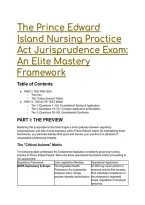
The Prince Edward
Island Nursing Practice
Act Jurisprudence Exam:
An Elite Mastery
Framework
Table of Contents
● PART I: THE PREVIEW
○ The Intro
○ The "Critical Axioms" Matrix
● PART II: THE ELITE TEST BANK
○ Tier 1 (Questions 1–18): Foundational Syntax & Application
○ Tier 2 (Questions 19–37): Complex Application & Simulation
○ Tier 3 (Questions 38–55): Grandmaster Synthesis
PART I: THE PREVIEW
Mastering this jurisprudence test bank forges a direct pathway between regulatory
comprehension and elite clinical autonomy within Prince Edward Island. By internalizing these
frameworks, you eliminate liability blind spots and elevate your practice to a standard of
unassailable professional integrity.
The "Critical Axioms" Matrix
The following table synthesizes the fundamental legislative constraints governing nursing
practice in Prince Edward Island. Memorize these operational boundaries before proceeding to
the assessment.
Regulatory Framework Core Legislative Mandate Operational Application
RHPA Supremacy & Scope The Regulated Health An RN may never perform a
Professions Act supersedes reserved activity that exceeds
employer policy. Scope their individual competence or
requires tripartite authorization. the profession's legislated
scope, regardless of employer
directives.
,Regulatory Framework Core Legislative Mandate Operational Application
Mandatory Reporting (Sec. Registrants possessing Failure to report a colleague's
27) reasonable grounds regarding violation is an independent act
misconduct, incompetence, or of professional misconduct.
incapacity must report to the Resignation does not nullify the
College. duty to report.
Child Protection (CYFSA) The mandatory duty to report In PEI, a "child" is defined as
suspected abuse or neglect any individual under the age of
applies to any "child". 18; the shield of protection
does not end at 16.
Consent & SDM Hierarchy Consent is capacity-based, not If a patient lacks capacity,
strictly age-based. Advance consent is obtained strictly via
directives can be established at the statutory SDM hierarchy:
age 16. Guardian, Attorney,
Representative,
Spouse/Partner, Child/Parent,
PGT.
RN Prescribing (RN(AP)) Authorized Prescribers operate An RN(AP) may never
under strict ethical and clinical prescribe for themselves or
parameters. immediate family members,
and cannot delegate their
prescribing accountability.
PART II: THE ELITE TEST BANK
Tier 1: Foundational Syntax & Application
Q1: An RN observes a physician colleague exhibiting slurred speech and an unsteady gait prior
to entering a surgical suite. Based on the principles of the Regulated Health Professions Act
(RHPA) Section 27, which action is the FIRST legal requirement? A) Confront the physician and
request they voluntarily step down. B) Notify the hospital's human resources department within
30 days. C) Immediately file a mandatory report regarding suspected incapacity. D) Document
the observation in the shift log and notify the charge nurse.
● Answer: C (Immediately file a mandatory report regarding suspected incapacity.)
● Distractor Analysis:
○ A is incorrect: Confrontation does not fulfill the legal obligation of mandatory
reporting to the regulatory college.
○ B is incorrect: Incapacity presenting an imminent risk to patient safety requires
immediate reporting, not a 30-day delay.
○ D is incorrect: Internal documentation does not satisfy the statutory mandate of
Section 27.
The Mentor's Analysis: Section 27 of the RHPA demands immediate reporting when an
individual's incapacity poses a direct threat to public safety. When facing suspected acute
impairment, the immediate priority is protecting the patient and notifying the regulator. By
utilizing the statutory reporting mandate, you bypass the common trap of deferring to internal
hospital politics. Professional Intuition: Never substitute internal employer protocols for
statutory mandatory reporting requirements.
Q2: A 17-year-old patient presents to the clinic requesting an assessment for a minor injury.
, They state they do not want their parents informed. Based on the principles of the PEI Consent
to Treatment and Health Care Directives Act, which conclusion is the MOST ACCURATE? A)
The patient requires parental consent because they are under the age of 18. B) The patient
requires parental consent because they are under the age of 19. C) The patient may consent if
they demonstrate the capacity to understand the treatment and its consequences. D) The
patient may only consent if a legally binding Personal Directive is already in place.
● Answer: C (The patient may consent if they demonstrate the capacity to understand the
treatment and its consequences.)
● Distractor Analysis:
○ A is incorrect: PEI utilizes a capacity-based model for consent, not a strict
chronological age cutoff of 18 for medical treatment.
○ B is incorrect: Age 19 is the age of majority in other jurisdictions, but irrelevant to
capacity in PEI.
○ D is incorrect: A personal directive is not required for a capable 17-year-old to
provide concurrent consent.
The Mentor's Analysis: Consent in PEI is governed by the assessment of capacity, not purely by
chronological age. When facing a minor seeking independent care, the immediate priority is
assessing their ability to comprehend risks and benefits. By utilizing capacity assessment, you
bypass the common trap of unlawfully denying care based on chronological assumptions.
Professional Intuition: Capacity dictates consent; age is merely a secondary data point in
the assessment.
Q3: A school nurse suspects a 17-year-old student is being physically abused at home. Based
on the PEI Child, Youth and Family Services Act, which action is the MANDATORY response?
A) No report is legally required because the youth is over 16. B) Recommend family counseling
to the student before taking further action. C) Report the suspicion immediately to Child
Protection Services. D) Wait for the student to explicitly disclose the abuse before reporting.
● Answer: C (Report the suspicion immediately to Child Protection Services.)
● Distractor Analysis:
○ A is incorrect: The PEI Act defines a child as anyone under 18; the duty to report
applies.
○ B is incorrect: Counseling is a therapeutic intervention, not a substitute for legal
reporting.
○ D is incorrect: "Reasonable grounds to suspect" triggers the mandate; waiting for
explicit disclosure is a failure to report.
The Mentor's Analysis: In PEI, the duty to report child abuse applies to all individuals under 18.
When facing suspected harm to a minor, the immediate priority is notifying the Director of Child
Protection. By utilizing the statutory definition of a child, you bypass the common trap of
applying outdated 16-year-old age thresholds from other provinces. Professional Intuition: In
PEI, the shield of child protection extends entirely to the 18th birthday.
Q4: An RN applying for registration renewal with the College of Registered Nurses and
Midwives of PEI (PEICNM) is auditing their practice hours. Based on the Continuing
Competence Program, what is the MINIMUM number of hours required in the preceding three
years? A) 1,125 hours B) 1,000 hours C) 450 hours D) 600 hours
● Answer: C (450 hours)
● Distractor Analysis:
○ A is incorrect: 1,125 hours is an outdated or cross-jurisdictional metric.
○ B is incorrect: 1,000 hours applies to specific other professions, not PEI RNs.
○ D is incorrect: 600 hours is an arbitrary distractor.
Island Nursing Practice
Act Jurisprudence Exam:
An Elite Mastery
Framework
Table of Contents
● PART I: THE PREVIEW
○ The Intro
○ The "Critical Axioms" Matrix
● PART II: THE ELITE TEST BANK
○ Tier 1 (Questions 1–18): Foundational Syntax & Application
○ Tier 2 (Questions 19–37): Complex Application & Simulation
○ Tier 3 (Questions 38–55): Grandmaster Synthesis
PART I: THE PREVIEW
Mastering this jurisprudence test bank forges a direct pathway between regulatory
comprehension and elite clinical autonomy within Prince Edward Island. By internalizing these
frameworks, you eliminate liability blind spots and elevate your practice to a standard of
unassailable professional integrity.
The "Critical Axioms" Matrix
The following table synthesizes the fundamental legislative constraints governing nursing
practice in Prince Edward Island. Memorize these operational boundaries before proceeding to
the assessment.
Regulatory Framework Core Legislative Mandate Operational Application
RHPA Supremacy & Scope The Regulated Health An RN may never perform a
Professions Act supersedes reserved activity that exceeds
employer policy. Scope their individual competence or
requires tripartite authorization. the profession's legislated
scope, regardless of employer
directives.
,Regulatory Framework Core Legislative Mandate Operational Application
Mandatory Reporting (Sec. Registrants possessing Failure to report a colleague's
27) reasonable grounds regarding violation is an independent act
misconduct, incompetence, or of professional misconduct.
incapacity must report to the Resignation does not nullify the
College. duty to report.
Child Protection (CYFSA) The mandatory duty to report In PEI, a "child" is defined as
suspected abuse or neglect any individual under the age of
applies to any "child". 18; the shield of protection
does not end at 16.
Consent & SDM Hierarchy Consent is capacity-based, not If a patient lacks capacity,
strictly age-based. Advance consent is obtained strictly via
directives can be established at the statutory SDM hierarchy:
age 16. Guardian, Attorney,
Representative,
Spouse/Partner, Child/Parent,
PGT.
RN Prescribing (RN(AP)) Authorized Prescribers operate An RN(AP) may never
under strict ethical and clinical prescribe for themselves or
parameters. immediate family members,
and cannot delegate their
prescribing accountability.
PART II: THE ELITE TEST BANK
Tier 1: Foundational Syntax & Application
Q1: An RN observes a physician colleague exhibiting slurred speech and an unsteady gait prior
to entering a surgical suite. Based on the principles of the Regulated Health Professions Act
(RHPA) Section 27, which action is the FIRST legal requirement? A) Confront the physician and
request they voluntarily step down. B) Notify the hospital's human resources department within
30 days. C) Immediately file a mandatory report regarding suspected incapacity. D) Document
the observation in the shift log and notify the charge nurse.
● Answer: C (Immediately file a mandatory report regarding suspected incapacity.)
● Distractor Analysis:
○ A is incorrect: Confrontation does not fulfill the legal obligation of mandatory
reporting to the regulatory college.
○ B is incorrect: Incapacity presenting an imminent risk to patient safety requires
immediate reporting, not a 30-day delay.
○ D is incorrect: Internal documentation does not satisfy the statutory mandate of
Section 27.
The Mentor's Analysis: Section 27 of the RHPA demands immediate reporting when an
individual's incapacity poses a direct threat to public safety. When facing suspected acute
impairment, the immediate priority is protecting the patient and notifying the regulator. By
utilizing the statutory reporting mandate, you bypass the common trap of deferring to internal
hospital politics. Professional Intuition: Never substitute internal employer protocols for
statutory mandatory reporting requirements.
Q2: A 17-year-old patient presents to the clinic requesting an assessment for a minor injury.
, They state they do not want their parents informed. Based on the principles of the PEI Consent
to Treatment and Health Care Directives Act, which conclusion is the MOST ACCURATE? A)
The patient requires parental consent because they are under the age of 18. B) The patient
requires parental consent because they are under the age of 19. C) The patient may consent if
they demonstrate the capacity to understand the treatment and its consequences. D) The
patient may only consent if a legally binding Personal Directive is already in place.
● Answer: C (The patient may consent if they demonstrate the capacity to understand the
treatment and its consequences.)
● Distractor Analysis:
○ A is incorrect: PEI utilizes a capacity-based model for consent, not a strict
chronological age cutoff of 18 for medical treatment.
○ B is incorrect: Age 19 is the age of majority in other jurisdictions, but irrelevant to
capacity in PEI.
○ D is incorrect: A personal directive is not required for a capable 17-year-old to
provide concurrent consent.
The Mentor's Analysis: Consent in PEI is governed by the assessment of capacity, not purely by
chronological age. When facing a minor seeking independent care, the immediate priority is
assessing their ability to comprehend risks and benefits. By utilizing capacity assessment, you
bypass the common trap of unlawfully denying care based on chronological assumptions.
Professional Intuition: Capacity dictates consent; age is merely a secondary data point in
the assessment.
Q3: A school nurse suspects a 17-year-old student is being physically abused at home. Based
on the PEI Child, Youth and Family Services Act, which action is the MANDATORY response?
A) No report is legally required because the youth is over 16. B) Recommend family counseling
to the student before taking further action. C) Report the suspicion immediately to Child
Protection Services. D) Wait for the student to explicitly disclose the abuse before reporting.
● Answer: C (Report the suspicion immediately to Child Protection Services.)
● Distractor Analysis:
○ A is incorrect: The PEI Act defines a child as anyone under 18; the duty to report
applies.
○ B is incorrect: Counseling is a therapeutic intervention, not a substitute for legal
reporting.
○ D is incorrect: "Reasonable grounds to suspect" triggers the mandate; waiting for
explicit disclosure is a failure to report.
The Mentor's Analysis: In PEI, the duty to report child abuse applies to all individuals under 18.
When facing suspected harm to a minor, the immediate priority is notifying the Director of Child
Protection. By utilizing the statutory definition of a child, you bypass the common trap of
applying outdated 16-year-old age thresholds from other provinces. Professional Intuition: In
PEI, the shield of child protection extends entirely to the 18th birthday.
Q4: An RN applying for registration renewal with the College of Registered Nurses and
Midwives of PEI (PEICNM) is auditing their practice hours. Based on the Continuing
Competence Program, what is the MINIMUM number of hours required in the preceding three
years? A) 1,125 hours B) 1,000 hours C) 450 hours D) 600 hours
● Answer: C (450 hours)
● Distractor Analysis:
○ A is incorrect: 1,125 hours is an outdated or cross-jurisdictional metric.
○ B is incorrect: 1,000 hours applies to specific other professions, not PEI RNs.
○ D is incorrect: 600 hours is an arbitrary distractor.


