
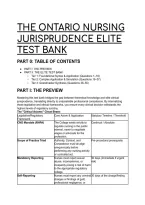
THE ONTARIO NURSING
JURISPRUDENCE ELITE
TEST BANK
PART 0: TABLE OF CONTENTS
● PART I: THE PREVIEW
● PART II: THE ELITE TEST BANK
○ Tier 1: Foundational Syntax & Application (Questions 1–18)
○ Tier 2: Complex Application & Simulation (Questions 19–37)
○ Tier 3: Grandmaster Synthesis (Questions 38–55)
PART I: THE PREVIEW
Mastering this test bank bridges the gap between theoretical knowledge and elite clinical
jurisprudence, translating directly to unassailable professional competence. By internalizing
these legislative and ethical frameworks, you ensure every clinical decision withstands the
highest levels of regulatory scrutiny.
The "Critical Axioms" Cheat Sheet:
Legislative/Regulatory Core Axiom & Application Statutory Timeline / Threshold
Framework
CNO Mandate (RHPA) The College exists strictly to Continual / Absolute
regulate nursing in the public
interest, never to negotiate
wages or advocate for the
profession.
Scope of Practice Triad Authority, Context, and Pre-procedural prerequisite
Competence must all align
unequivocally before
performing any nursing activity
or controlled act.
Mandatory Reporting Nurses must report sexual 30 days (Immediate if urgent
abuse, incompetence, or risk)
incapacity posing a risk of harm
to the appropriate regulatory
college.
Self-Reporting Nurses must report any criminal 30 days of the charge/finding
charges or findings of guilt,
professional negligence, or
,Legislative/Regulatory Core Axiom & Application Statutory Timeline / Threshold
Framework
out-of-jurisdiction misconduct to
the CNO.
Mental Health Act (Form 1) Authorizes psychiatric Maximum 72 hours
assessment and detention for
severe risk of harm. It does not
authorize forced treatment
without consent.
Refusal of Work / Discontinuing care is Prior to severing the
Abandonment professional misconduct unless relationship
alternative services are
arranged or the client explicitly
requests discontinuation.
PART II: THE ELITE TEST BANK
Tier 1: Foundational Syntax & Application
Q1: The Regulated Health Professions Act (RHPA) and the Nursing Act (1991) establish the
legislative framework for nursing in Ontario. Based on the principles of the CNO Mandate, which
action represents the PRIMARY purpose of the College of Nurses of Ontario? A) To advocate
for equitable compensation and optimal working conditions for registered nurses. B) To protect
the public right to quality nursing services by providing leadership to the nursing profession. C)
To regulate the practice of nursing to protect the public interest. D) To operate hospitals and
community clinics in compliance with provincial health policies.
● Answer: C (To regulate the practice of nursing to protect the public interest.)
● Distractor Analysis:
○ A is incorrect: Advocating for wages and working conditions is the role of
professional unions (e.g., ONA), not the regulatory college.
○ B is incorrect: While providing leadership occurs, the core statutory mandate is
strictly public protection, not merely providing professional leadership.
○ D is incorrect: The CNO regulates individual practitioners; it does not operate
facilities or hospitals.
The Mentor's Analysis: The absolute bedrock of nursing jurisprudence is distinguishing the
regulator from the union or association. The CNO's statutory mandate under the RHPA is strictly
public protection. When facing a conflict between professional comfort and public safety, the
priority is public protection. By utilizing the regulatory mandate, you bypass the common trap of
confusing advocacy with regulation. Professional Intuition: Always separate regulatory
accountability (public protection) from professional advocacy (union/association).
Q2: An applicant is preparing to write the CNO Jurisprudence Examination. Based on the
principles of CNO Examination Frameworks, what is the MAXIMUM validity period for a
successful jurisprudence examination result? A) 1 year B) 3 years C) 5 years D) Indefinitely,
provided continuous registration is maintained
● Answer: C (5 years)
● Distractor Analysis:
○ A is incorrect: One year is a common timeframe for some clinical certificates (e.g.,
CPR), but not the CNO jurisprudence result.
, ○ B is incorrect: Three years is an arbitrary legacy timeframe not supported by current
CNO regulations.
○ D is incorrect: Even with continuous registration, if an RPN seeks RN registration
(or vice versa) and their exam was written over 5 years ago, they must rewrite it.
The Mentor's Analysis: Examination results are valid for exactly five years. When facing an
application upgrade or re-entry, the immediate priority is verifying the date of your last
jurisprudence exam. By utilizing the 5-year validity rule, you bypass the common trap of
assuming permanent legislative clearance. Professional Intuition: Jurisprudence mastery has
a 5-year half-life; legislative fluency must be continually renewed.
Q3: Under the Nursing Act, 1991, the practice of nursing involves the promotion of health and
treatment of health conditions. Based on the principles of the Controlled Acts Model, which of
the following is an authorized controlled act specifically granted to Registered Nurses (RNs)? A)
Communicating a diagnosis identifying a disease or disorder as the cause of symptoms. B)
Performing a procedure on tissue below the dermis. C) Applying a prescribed form of energy. D)
Prescribing a drug without a physician's order under all circumstances.
● Answer: B (Performing a procedure on tissue below the dermis.)
● Distractor Analysis:
○ A is incorrect: Communicating a diagnosis is a controlled act authorized to Nurse
Practitioners (NPs), not general class RNs or RPNs.
○ C is incorrect: Applying energy (e.g., defibrillation) requires a direct order or
directive; it is not an independently authorized controlled act for nursing initiation.
○ D is incorrect: RN prescribing is highly restricted to specific medications and
requires specific education; it is not a blanket authorization.
The Mentor's Analysis: The RHPA outlines 14 controlled acts, with specific subsets authorized
to nursing. When facing a clinical procedure, the immediate priority is confirming it falls within
your specific class scope. By utilizing the controlled acts authorization list, you bypass the
common trap of confusing RN scope with NP scope. Professional Intuition: Never confuse
nursing scope with advanced practice authority; NPs diagnose, RNs/RPNs perform below
the dermis.
Q4: A nurse is reflecting on their daily practice to complete their mandatory CNO Quality
Assurance (QA) requirements. Based on the principles of the CNO Quality Assurance Program,
which action is the FIRST step in developing an annual learning plan? A) Selecting a practice
standard to review. B) Identifying learning needs through practice reflection. C) Engaging in
specific learning activities. D) Requesting formal peer assessment of clinical skills.
● Answer: B (Identifying learning needs through practice reflection.)
● Distractor Analysis:
○ A is incorrect: Selecting a practice standard occurs later to support the learning
goals, not as the first step.
○ C is incorrect: Learning activities are planned only after goals have been
established based on identified needs.
○ D is incorrect: While peer input is valuable, self-directed practice reflection is the
foundational first step of QA Every Day.
The Mentor's Analysis: The QA program is a continuous cycle that must organically begin with
self-reflection. When facing annual QA requirements, the immediate priority is identifying current
environmental changes or personal knowledge gaps. By utilizing practice reflection, you bypass
the common trap of creating arbitrary, irrelevant goals. Professional Intuition: Reflection always
precedes action; you cannot chart a learning path without first identifying your origin
point.
JURISPRUDENCE ELITE
TEST BANK
PART 0: TABLE OF CONTENTS
● PART I: THE PREVIEW
● PART II: THE ELITE TEST BANK
○ Tier 1: Foundational Syntax & Application (Questions 1–18)
○ Tier 2: Complex Application & Simulation (Questions 19–37)
○ Tier 3: Grandmaster Synthesis (Questions 38–55)
PART I: THE PREVIEW
Mastering this test bank bridges the gap between theoretical knowledge and elite clinical
jurisprudence, translating directly to unassailable professional competence. By internalizing
these legislative and ethical frameworks, you ensure every clinical decision withstands the
highest levels of regulatory scrutiny.
The "Critical Axioms" Cheat Sheet:
Legislative/Regulatory Core Axiom & Application Statutory Timeline / Threshold
Framework
CNO Mandate (RHPA) The College exists strictly to Continual / Absolute
regulate nursing in the public
interest, never to negotiate
wages or advocate for the
profession.
Scope of Practice Triad Authority, Context, and Pre-procedural prerequisite
Competence must all align
unequivocally before
performing any nursing activity
or controlled act.
Mandatory Reporting Nurses must report sexual 30 days (Immediate if urgent
abuse, incompetence, or risk)
incapacity posing a risk of harm
to the appropriate regulatory
college.
Self-Reporting Nurses must report any criminal 30 days of the charge/finding
charges or findings of guilt,
professional negligence, or
,Legislative/Regulatory Core Axiom & Application Statutory Timeline / Threshold
Framework
out-of-jurisdiction misconduct to
the CNO.
Mental Health Act (Form 1) Authorizes psychiatric Maximum 72 hours
assessment and detention for
severe risk of harm. It does not
authorize forced treatment
without consent.
Refusal of Work / Discontinuing care is Prior to severing the
Abandonment professional misconduct unless relationship
alternative services are
arranged or the client explicitly
requests discontinuation.
PART II: THE ELITE TEST BANK
Tier 1: Foundational Syntax & Application
Q1: The Regulated Health Professions Act (RHPA) and the Nursing Act (1991) establish the
legislative framework for nursing in Ontario. Based on the principles of the CNO Mandate, which
action represents the PRIMARY purpose of the College of Nurses of Ontario? A) To advocate
for equitable compensation and optimal working conditions for registered nurses. B) To protect
the public right to quality nursing services by providing leadership to the nursing profession. C)
To regulate the practice of nursing to protect the public interest. D) To operate hospitals and
community clinics in compliance with provincial health policies.
● Answer: C (To regulate the practice of nursing to protect the public interest.)
● Distractor Analysis:
○ A is incorrect: Advocating for wages and working conditions is the role of
professional unions (e.g., ONA), not the regulatory college.
○ B is incorrect: While providing leadership occurs, the core statutory mandate is
strictly public protection, not merely providing professional leadership.
○ D is incorrect: The CNO regulates individual practitioners; it does not operate
facilities or hospitals.
The Mentor's Analysis: The absolute bedrock of nursing jurisprudence is distinguishing the
regulator from the union or association. The CNO's statutory mandate under the RHPA is strictly
public protection. When facing a conflict between professional comfort and public safety, the
priority is public protection. By utilizing the regulatory mandate, you bypass the common trap of
confusing advocacy with regulation. Professional Intuition: Always separate regulatory
accountability (public protection) from professional advocacy (union/association).
Q2: An applicant is preparing to write the CNO Jurisprudence Examination. Based on the
principles of CNO Examination Frameworks, what is the MAXIMUM validity period for a
successful jurisprudence examination result? A) 1 year B) 3 years C) 5 years D) Indefinitely,
provided continuous registration is maintained
● Answer: C (5 years)
● Distractor Analysis:
○ A is incorrect: One year is a common timeframe for some clinical certificates (e.g.,
CPR), but not the CNO jurisprudence result.
, ○ B is incorrect: Three years is an arbitrary legacy timeframe not supported by current
CNO regulations.
○ D is incorrect: Even with continuous registration, if an RPN seeks RN registration
(or vice versa) and their exam was written over 5 years ago, they must rewrite it.
The Mentor's Analysis: Examination results are valid for exactly five years. When facing an
application upgrade or re-entry, the immediate priority is verifying the date of your last
jurisprudence exam. By utilizing the 5-year validity rule, you bypass the common trap of
assuming permanent legislative clearance. Professional Intuition: Jurisprudence mastery has
a 5-year half-life; legislative fluency must be continually renewed.
Q3: Under the Nursing Act, 1991, the practice of nursing involves the promotion of health and
treatment of health conditions. Based on the principles of the Controlled Acts Model, which of
the following is an authorized controlled act specifically granted to Registered Nurses (RNs)? A)
Communicating a diagnosis identifying a disease or disorder as the cause of symptoms. B)
Performing a procedure on tissue below the dermis. C) Applying a prescribed form of energy. D)
Prescribing a drug without a physician's order under all circumstances.
● Answer: B (Performing a procedure on tissue below the dermis.)
● Distractor Analysis:
○ A is incorrect: Communicating a diagnosis is a controlled act authorized to Nurse
Practitioners (NPs), not general class RNs or RPNs.
○ C is incorrect: Applying energy (e.g., defibrillation) requires a direct order or
directive; it is not an independently authorized controlled act for nursing initiation.
○ D is incorrect: RN prescribing is highly restricted to specific medications and
requires specific education; it is not a blanket authorization.
The Mentor's Analysis: The RHPA outlines 14 controlled acts, with specific subsets authorized
to nursing. When facing a clinical procedure, the immediate priority is confirming it falls within
your specific class scope. By utilizing the controlled acts authorization list, you bypass the
common trap of confusing RN scope with NP scope. Professional Intuition: Never confuse
nursing scope with advanced practice authority; NPs diagnose, RNs/RPNs perform below
the dermis.
Q4: A nurse is reflecting on their daily practice to complete their mandatory CNO Quality
Assurance (QA) requirements. Based on the principles of the CNO Quality Assurance Program,
which action is the FIRST step in developing an annual learning plan? A) Selecting a practice
standard to review. B) Identifying learning needs through practice reflection. C) Engaging in
specific learning activities. D) Requesting formal peer assessment of clinical skills.
● Answer: B (Identifying learning needs through practice reflection.)
● Distractor Analysis:
○ A is incorrect: Selecting a practice standard occurs later to support the learning
goals, not as the first step.
○ C is incorrect: Learning activities are planned only after goals have been
established based on identified needs.
○ D is incorrect: While peer input is valuable, self-directed practice reflection is the
foundational first step of QA Every Day.
The Mentor's Analysis: The QA program is a continuous cycle that must organically begin with
self-reflection. When facing annual QA requirements, the immediate priority is identifying current
environmental changes or personal knowledge gaps. By utilizing practice reflection, you bypass
the common trap of creating arbitrary, irrelevant goals. Professional Intuition: Reflection always
precedes action; you cannot chart a learning path without first identifying your origin
point.


