
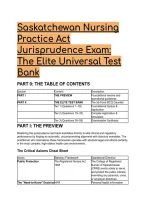
Saskatchewan Nursing
Practice Act
Jurisprudence Exam:
The Elite Universal Test
Bank
PART 0: THE TABLE OF CONTENTS
Section Content Description
PART I THE PREVIEW Foundational axioms and
operational guidelines
PART II THE ELITE TEST BANK The 55-Point MCQ Gauntlet
Tier 1 (Questions 1–18) Foundational Syntax &
Application
Tier 2 (Questions 19–37) Complex Application &
Simulation
Tier 3 (Questions 38–55) Grandmaster Synthesis
PART I: THE PREVIEW
Mastering this jurisprudence test bank translates directly to elite clinical and regulatory
performance by forging an automatic, uncompromising alignment with statutory mandates. The
practitioner who internalizes these frameworks operates with absolute legal and ethical certainty
in the most complex, high-stakes health care environments.
The Critical Axioms Cheat Sheet
Axiom Statutory Framework Operational Directive
Public Protection The Registered Nurses Act, The College of Registered
1988 Nurses of Saskatchewan
(CRNS) exists solely to serve
and protect the public interest,
overriding any personal, union,
or employer directives.
The "Need-to-Know" Doctrine HIPA Personal health information
,Axiom Statutory Framework Operational Directive
(PHI) is collected, used, and
disclosed strictly on a
need-to-know basis;
unauthorized access
constitutes a severe breach.
Mandatory Duty to Report The Registered Nurses Act, Any practice meeting the
1988 threshold of incompetence or
misconduct triggers a
mandatory duty to report to the
CRNS, irrespective of internal
employer processes.
Off-Duty Accountability Common Law (Strom v. SRNA) Professional misconduct
applies to off-duty behavior
(including social media) if a
sufficient nexus exists that
harms the standing of the
profession.
Continuing Competence CRNS Bylaws Annual participation in the
Continuing Competence
Program (CCP) is a
non-negotiable statutory
requirement for licensure.
PART II: THE ELITE TEST BANK
Tier 1 - Foundational Syntax & Application
Q1: A registered nurse is employed in a primary care facility where management introduces a
policy prioritizing operational speed over comprehensive client assessments. Based on the
principles of The Registered Nurses Act, 1988, which conclusion is the MOST ACCURATE
regarding the nurse's primary obligation? A) The nurse must align their practice with the
employer's strategic policy to maintain employment standards. B) The nurse's primary obligation
is governed by the facility's collective bargaining agreement. C) The nurse must serve and
protect the public interest above both employer directives and personal interests. D) The nurse
should request a mandate review from the Canadian Nurses Protective Society (CNPS).
● Answer: C (The nurse must serve and protect the public interest above both employer
directives and personal interests)
● Distractor Analysis:
○ A is incorrect: Employer policies cannot override the statutory mandate of public
protection outlined in the Act.
○ B is incorrect: Union agreements govern labor relations, not the statutory regulatory
duty to the public.
○ D is incorrect: CNPS provides professional liability protection, not regulatory
mandate reviews.
The Mentor's Analysis: The absolute foundation of professional self-regulation is the mandate to
protect the public. When facing organizational conflicts, the immediate priority is statutory
compliance. By utilizing the regulatory hierarchy, you bypass the common trap of prioritizing
, employer directives over legislative mandates. Professional Intuition: Statutory public
protection permanently supersedes organizational policy.
Q2: A nurse inadvertently provides a lethal dose of medication due to a profound lack of
pharmacological knowledge, resulting in severe patient harm. Based on the definitions in The
Registered Nurses Act, 1988, which classification BEST describes this event? A) Professional
misconduct, as the nurse acted carelessly. B) A standard clinical error exempt from regulatory
discipline. C) Professional incompetence, demonstrating a lack of knowledge, skill, or judgment.
D) An employer-liability incident requiring only internal remediation.
● Answer: C (Professional incompetence, demonstrating a lack of knowledge, skill, or
judgment)
● Distractor Analysis:
○ A is incorrect: Misconduct involves willful, unethical, or disgraceful conduct,
whereas this scenario specifically highlights a deficit in knowledge.
○ B is incorrect: Lethal harm resulting from knowledge deficits is not exempt from
regulatory scrutiny.
○ D is incorrect: While employers share vicarious liability, the regulatory body
maintains jurisdiction over the nurse's professional competence.
The Mentor's Analysis: Regulatory definitions distinguish between intent and capability. When
facing severe knowledge deficits, the immediate priority is recognizing the threshold of
professional incompetence. By utilizing the precise statutory definitions (Section 25), you
bypass the common trap of confusing misconduct with incompetence. Professional Intuition:
Incompetence is a deficit of skill; misconduct is a deficit of ethics or conduct.
Q3: An individual requests to revoke their consent for the use of their personal health
information (PHI) currently stored by a regional health authority. Based on the principles of the
Health Information Protection Act (HIPA), which action is the REQUIRED trustee response? A)
The trustee must erase all past historical records retroactively. B) The trustee must refuse the
request, as PHI belongs exclusively to the health authority. C) The trustee must honor the
revocation, but the revocation has no retroactive effect. D) The trustee must forward the
revocation to the Information and Privacy Commissioner for approval.
● Answer: C (The trustee must honor the revocation, but the revocation has no retroactive
effect)
● Distractor Analysis:
○ A is incorrect: HIPA explicitly states that consent revocation does not apply
retroactively to information already used or disclosed.
○ B is incorrect: Individuals possess inherent rights to control their PHI; trustees only
hold it in trust.
○ D is incorrect: The Privacy Commissioner oversees compliance but does not need
to approve individual consent revocations.
The Mentor's Analysis: Patient autonomy extends to data control, but operational reality dictates
limits. When facing consent revocation, the immediate priority is halting future unauthorized use.
By utilizing the non-retroactive clause of HIPA, you bypass the common trap of attempting
impossible data purges of historical records. Professional Intuition: Consent revocation is an
absolute right, but it only dictates future actions, not past disclosures.
Q4: A registered nurse is completing their annual licensure renewal and must fulfill the
Continuing Competence Program (CCP) requirements. Based on the principles of the CRNS
CCP framework, which component is a MANDATORY annual requirement? A) Submitting a
portfolio of 50 continuing education credits directly to the CRNS. B) Completing a
self-assessment, developing a learning plan, and evaluating the impact of the learning on
Practice Act
Jurisprudence Exam:
The Elite Universal Test
Bank
PART 0: THE TABLE OF CONTENTS
Section Content Description
PART I THE PREVIEW Foundational axioms and
operational guidelines
PART II THE ELITE TEST BANK The 55-Point MCQ Gauntlet
Tier 1 (Questions 1–18) Foundational Syntax &
Application
Tier 2 (Questions 19–37) Complex Application &
Simulation
Tier 3 (Questions 38–55) Grandmaster Synthesis
PART I: THE PREVIEW
Mastering this jurisprudence test bank translates directly to elite clinical and regulatory
performance by forging an automatic, uncompromising alignment with statutory mandates. The
practitioner who internalizes these frameworks operates with absolute legal and ethical certainty
in the most complex, high-stakes health care environments.
The Critical Axioms Cheat Sheet
Axiom Statutory Framework Operational Directive
Public Protection The Registered Nurses Act, The College of Registered
1988 Nurses of Saskatchewan
(CRNS) exists solely to serve
and protect the public interest,
overriding any personal, union,
or employer directives.
The "Need-to-Know" Doctrine HIPA Personal health information
,Axiom Statutory Framework Operational Directive
(PHI) is collected, used, and
disclosed strictly on a
need-to-know basis;
unauthorized access
constitutes a severe breach.
Mandatory Duty to Report The Registered Nurses Act, Any practice meeting the
1988 threshold of incompetence or
misconduct triggers a
mandatory duty to report to the
CRNS, irrespective of internal
employer processes.
Off-Duty Accountability Common Law (Strom v. SRNA) Professional misconduct
applies to off-duty behavior
(including social media) if a
sufficient nexus exists that
harms the standing of the
profession.
Continuing Competence CRNS Bylaws Annual participation in the
Continuing Competence
Program (CCP) is a
non-negotiable statutory
requirement for licensure.
PART II: THE ELITE TEST BANK
Tier 1 - Foundational Syntax & Application
Q1: A registered nurse is employed in a primary care facility where management introduces a
policy prioritizing operational speed over comprehensive client assessments. Based on the
principles of The Registered Nurses Act, 1988, which conclusion is the MOST ACCURATE
regarding the nurse's primary obligation? A) The nurse must align their practice with the
employer's strategic policy to maintain employment standards. B) The nurse's primary obligation
is governed by the facility's collective bargaining agreement. C) The nurse must serve and
protect the public interest above both employer directives and personal interests. D) The nurse
should request a mandate review from the Canadian Nurses Protective Society (CNPS).
● Answer: C (The nurse must serve and protect the public interest above both employer
directives and personal interests)
● Distractor Analysis:
○ A is incorrect: Employer policies cannot override the statutory mandate of public
protection outlined in the Act.
○ B is incorrect: Union agreements govern labor relations, not the statutory regulatory
duty to the public.
○ D is incorrect: CNPS provides professional liability protection, not regulatory
mandate reviews.
The Mentor's Analysis: The absolute foundation of professional self-regulation is the mandate to
protect the public. When facing organizational conflicts, the immediate priority is statutory
compliance. By utilizing the regulatory hierarchy, you bypass the common trap of prioritizing
, employer directives over legislative mandates. Professional Intuition: Statutory public
protection permanently supersedes organizational policy.
Q2: A nurse inadvertently provides a lethal dose of medication due to a profound lack of
pharmacological knowledge, resulting in severe patient harm. Based on the definitions in The
Registered Nurses Act, 1988, which classification BEST describes this event? A) Professional
misconduct, as the nurse acted carelessly. B) A standard clinical error exempt from regulatory
discipline. C) Professional incompetence, demonstrating a lack of knowledge, skill, or judgment.
D) An employer-liability incident requiring only internal remediation.
● Answer: C (Professional incompetence, demonstrating a lack of knowledge, skill, or
judgment)
● Distractor Analysis:
○ A is incorrect: Misconduct involves willful, unethical, or disgraceful conduct,
whereas this scenario specifically highlights a deficit in knowledge.
○ B is incorrect: Lethal harm resulting from knowledge deficits is not exempt from
regulatory scrutiny.
○ D is incorrect: While employers share vicarious liability, the regulatory body
maintains jurisdiction over the nurse's professional competence.
The Mentor's Analysis: Regulatory definitions distinguish between intent and capability. When
facing severe knowledge deficits, the immediate priority is recognizing the threshold of
professional incompetence. By utilizing the precise statutory definitions (Section 25), you
bypass the common trap of confusing misconduct with incompetence. Professional Intuition:
Incompetence is a deficit of skill; misconduct is a deficit of ethics or conduct.
Q3: An individual requests to revoke their consent for the use of their personal health
information (PHI) currently stored by a regional health authority. Based on the principles of the
Health Information Protection Act (HIPA), which action is the REQUIRED trustee response? A)
The trustee must erase all past historical records retroactively. B) The trustee must refuse the
request, as PHI belongs exclusively to the health authority. C) The trustee must honor the
revocation, but the revocation has no retroactive effect. D) The trustee must forward the
revocation to the Information and Privacy Commissioner for approval.
● Answer: C (The trustee must honor the revocation, but the revocation has no retroactive
effect)
● Distractor Analysis:
○ A is incorrect: HIPA explicitly states that consent revocation does not apply
retroactively to information already used or disclosed.
○ B is incorrect: Individuals possess inherent rights to control their PHI; trustees only
hold it in trust.
○ D is incorrect: The Privacy Commissioner oversees compliance but does not need
to approve individual consent revocations.
The Mentor's Analysis: Patient autonomy extends to data control, but operational reality dictates
limits. When facing consent revocation, the immediate priority is halting future unauthorized use.
By utilizing the non-retroactive clause of HIPA, you bypass the common trap of attempting
impossible data purges of historical records. Professional Intuition: Consent revocation is an
absolute right, but it only dictates future actions, not past disclosures.
Q4: A registered nurse is completing their annual licensure renewal and must fulfill the
Continuing Competence Program (CCP) requirements. Based on the principles of the CRNS
CCP framework, which component is a MANDATORY annual requirement? A) Submitting a
portfolio of 50 continuing education credits directly to the CRNS. B) Completing a
self-assessment, developing a learning plan, and evaluating the impact of the learning on


