
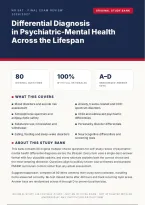
N R 547 · FIN AL EXAM REVIEW · OR I GI NAL S TU DY BANK
2026/2027
Differential Diagnosis
in Psychiatric-Mental Health
Across the Lifespan
80 100% A–D
O RIGIN AL Q UE STIO N S W ITH F ULL RATIO N ALE S RAN DO MIZE D AN SW E R
KE YS
WHAT THIS COVERS
Mood disorders and suicide risk Anxiety, trauma-related and OCD-
assessment spectrum disorders
Schizophrenia spectrum and Child and adolescent psychiatric
antipsychotic safety differentials
Substance use, intoxication and Personality disorder differentials
withdrawal
Eating, feeding and sleep-wake disorders Neurocognitive differentials and
screening tools
ABOUT THIS STUDY BANK
This bank contains 80 original multiple-choice questions for self-study review of psychiatric-
mental health differential diagnosis across the lifespan. Every item uses a single-best-answer
format with four plausible options, and every rationale explains both the correct choice and
the most tempting distractor. Questions align to publicly known course themes and standard
PMHNP curriculum content rather than any actual assessment.
Suggested approach: complete all 80 items untimed, then study every rationale, including
items answered correctly. Re-test missed items after 48 hours and track recurring topic areas.
Answer keys are randomized across A through D to prevent position bias.
O RI GI N A L STUD Y A I D F O R SE LF - STUD Y · N O T A N O F F I CI A L E X A M · N O T A F F I LI ATE D WI TH O R
E N D O RSE D BY A N Y I N STI TUTI O N O R P LATF O RM
,NR 547 · FINAL EXAM REVIEW — ORIGINAL STUDY QUESTION BANK
QUESTION 1 · Persistent Depressive Disorder
A 44-year-old woman reports depressed mood most days for the past 3 years, with poor appetite,
low self-esteem, and difficulty making decisions. She has never been without these symptoms for
more than 2 months and denies discrete severe episodes, hospitalization, or suicidal ideation.
Which diagnosis is most consistent with this presentation?
A. Adjustment disorder with depressed mood
B. Cyclothymic disorder
C. Major depressive disorder, recurrent
D. Persistent depressive disorder
Correct Answer: C — Persistent depressive disorder
Rationale: Depressed mood lasting at least 2 years without more than 2 months of remission, accompanied
by appetite disturbance, low self-esteem, and indecisiveness, defines persistent depressive disorder.
Recurrent major depressive disorder requires discrete full-criteria episodes with symptom-free intervals,
which she denies. Cyclothymic disorder involves fluctuating hypomanic and depressive symptoms rather
than persistent unipolar depression.
QUESTION 2 · Adjustment Disorder
A 30-year-old man was laid off from his job 6 weeks ago. Since then he feels sad most of the day,
sleeps poorly, and has stopped exercising. He still enjoys weekend games with friends, denies
hopelessness and suicidal thoughts, and his symptoms began within a month of the layoff. Which
diagnosis best explains this presentation?
A. Major depressive disorder, single episode
B. Persistent depressive disorder
C. Posttraumatic stress disorder
D. Adjustment disorder with depressed mood
Correct Answer: D — Adjustment disorder with depressed mood
Rationale: Depressed mood developing within 3 months of an identifiable stressor, in excess of what would
normally be expected, without meeting full criteria for another disorder defines adjustment disorder with
depressed mood. He retains the capacity for pleasure, denies hopelessness, and lacks the pervasive symptom
count of a major depressive episode. Posttraumatic stress disorder requires exposure to events involving
death, serious injury, or sexual violence, not job loss.
Original study aid for self-study use 1
,NR 547 · FINAL EXAM REVIEW — ORIGINAL STUDY QUESTION BANK
QUESTION 3 · Bipolar I Disorder
A 35-year-old woman presents with 5 weeks of depressed mood, hypersomnia, and feelings of
worthlessness. Two years ago she had a 2-week period of decreased need for sleep, grandiosity,
pressured speech, and impulsive spending that led to hospitalization. She has used antidepressants
in the past with limited response. Which diagnosis is most appropriate?
A. Bipolar I disorder, current episode depressed
B. Major depressive disorder, severe
C. Bipolar II disorder
D. Cyclothymic disorder
Correct Answer: A — Bipolar I disorder, current episode depressed
Rationale: A past manic episode, defined by elevated mood with grandiosity, impulsivity, and marked
impairment requiring hospitalization, establishes bipolar I disorder regardless of the current depressive
presentation. Bipolar II disorder requires hypomanic episodes without any manic episode or hospitalization.
Antidepressant monotherapy in such a patient risks precipitating mania, so the mood history must be
clarified before treatment.
QUESTION 4 · Bipolar II Disorder
A 26-year-old man reports repeated 4- to 5-day periods of elevated, irritable mood with less need
for sleep, rapid speech, and increased social activity that friends noticed but that caused no major
impairment or hospitalization. Between these periods he has 2-week episodes of depressed mood
and anhedonia. Which diagnosis is most consistent?
A. Bipolar I disorder
B. Major depressive disorder with anxious distress
C. Cyclothymic disorder
D. Bipolar II disorder
Correct Answer: A — Bipolar II disorder
Rationale: Hypomanic episodes lasting at least 4 consecutive days without psychosis, hospitalization, or
marked impairment, combined with major depressive episodes, define bipolar II disorder. Bipolar I disorder
requires at least one full manic episode lasting 7 days or requiring hospitalization. Cyclothymic disorder
requires 2 years of fluctuating symptoms that never meet full criteria for either type of episode.
Original study aid for self-study use 2
, NR 547 · FINAL EXAM REVIEW — ORIGINAL STUDY QUESTION BANK
QUESTION 5 · Cyclothymic Disorder
A 24-year-old woman describes 3 years of mood swings, with several-day stretches of unusual
energy and reduced need for sleep alternating with low energy and pessimism. No period has met
full criteria for a hypomanic, manic, or major depressive episode or required hospitalization. She
has been symptom-free for less than 2 months at a time. Which diagnosis fits best?
A. Cyclothymic disorder
B. Borderline personality disorder
C. Bipolar I disorder
D. Bipolar II disorder
Correct Answer: D — Cyclothymic disorder
Rationale: At least 2 years of numerous hypomanic and depressive periods that never meet full episode
criteria, with no more than 2 symptom-free months, defines cyclothymic disorder. Bipolar II disorder
requires full hypomanic and major depressive episodes, and bipolar I disorder requires mania. Borderline
personality disorder involves pervasive instability of relationships and self-image rather than episodic
changes in energy and sleep.
QUESTION 6 · Peripartum Depression
A 32-year-old woman at 28 weeks of gestation reports 6 weeks of depressed mood and loss of
interest in activities she previously enjoyed. She has insomnia despite fatigue, feels guilty that she
is 'failing the baby,' and has trouble concentrating at work. She denies thoughts of harming herself
or the fetus. Which condition is most consistent with this presentation?
A. Postpartum blues
B. Postpartum psychosis
C. Adjustment disorder with anxious mood
D. Depressive disorder with peripartum onset
Correct Answer: A — Depressive disorder with peripartum onset
Rationale: The peripartum onset specifier applies to depressive episodes beginning during pregnancy or
within 4 weeks of delivery, so antenatal symptoms meeting criteria for a depressive episode qualify.
Postpartum blues cannot begin before delivery and would not cause pervasive anhedonia and guilt lasting 6
weeks. Postpartum psychosis requires delusions, hallucinations, or thoughts of harm, which are absent.
Original study aid for self-study use 3
2026/2027
Differential Diagnosis
in Psychiatric-Mental Health
Across the Lifespan
80 100% A–D
O RIGIN AL Q UE STIO N S W ITH F ULL RATIO N ALE S RAN DO MIZE D AN SW E R
KE YS
WHAT THIS COVERS
Mood disorders and suicide risk Anxiety, trauma-related and OCD-
assessment spectrum disorders
Schizophrenia spectrum and Child and adolescent psychiatric
antipsychotic safety differentials
Substance use, intoxication and Personality disorder differentials
withdrawal
Eating, feeding and sleep-wake disorders Neurocognitive differentials and
screening tools
ABOUT THIS STUDY BANK
This bank contains 80 original multiple-choice questions for self-study review of psychiatric-
mental health differential diagnosis across the lifespan. Every item uses a single-best-answer
format with four plausible options, and every rationale explains both the correct choice and
the most tempting distractor. Questions align to publicly known course themes and standard
PMHNP curriculum content rather than any actual assessment.
Suggested approach: complete all 80 items untimed, then study every rationale, including
items answered correctly. Re-test missed items after 48 hours and track recurring topic areas.
Answer keys are randomized across A through D to prevent position bias.
O RI GI N A L STUD Y A I D F O R SE LF - STUD Y · N O T A N O F F I CI A L E X A M · N O T A F F I LI ATE D WI TH O R
E N D O RSE D BY A N Y I N STI TUTI O N O R P LATF O RM
,NR 547 · FINAL EXAM REVIEW — ORIGINAL STUDY QUESTION BANK
QUESTION 1 · Persistent Depressive Disorder
A 44-year-old woman reports depressed mood most days for the past 3 years, with poor appetite,
low self-esteem, and difficulty making decisions. She has never been without these symptoms for
more than 2 months and denies discrete severe episodes, hospitalization, or suicidal ideation.
Which diagnosis is most consistent with this presentation?
A. Adjustment disorder with depressed mood
B. Cyclothymic disorder
C. Major depressive disorder, recurrent
D. Persistent depressive disorder
Correct Answer: C — Persistent depressive disorder
Rationale: Depressed mood lasting at least 2 years without more than 2 months of remission, accompanied
by appetite disturbance, low self-esteem, and indecisiveness, defines persistent depressive disorder.
Recurrent major depressive disorder requires discrete full-criteria episodes with symptom-free intervals,
which she denies. Cyclothymic disorder involves fluctuating hypomanic and depressive symptoms rather
than persistent unipolar depression.
QUESTION 2 · Adjustment Disorder
A 30-year-old man was laid off from his job 6 weeks ago. Since then he feels sad most of the day,
sleeps poorly, and has stopped exercising. He still enjoys weekend games with friends, denies
hopelessness and suicidal thoughts, and his symptoms began within a month of the layoff. Which
diagnosis best explains this presentation?
A. Major depressive disorder, single episode
B. Persistent depressive disorder
C. Posttraumatic stress disorder
D. Adjustment disorder with depressed mood
Correct Answer: D — Adjustment disorder with depressed mood
Rationale: Depressed mood developing within 3 months of an identifiable stressor, in excess of what would
normally be expected, without meeting full criteria for another disorder defines adjustment disorder with
depressed mood. He retains the capacity for pleasure, denies hopelessness, and lacks the pervasive symptom
count of a major depressive episode. Posttraumatic stress disorder requires exposure to events involving
death, serious injury, or sexual violence, not job loss.
Original study aid for self-study use 1
,NR 547 · FINAL EXAM REVIEW — ORIGINAL STUDY QUESTION BANK
QUESTION 3 · Bipolar I Disorder
A 35-year-old woman presents with 5 weeks of depressed mood, hypersomnia, and feelings of
worthlessness. Two years ago she had a 2-week period of decreased need for sleep, grandiosity,
pressured speech, and impulsive spending that led to hospitalization. She has used antidepressants
in the past with limited response. Which diagnosis is most appropriate?
A. Bipolar I disorder, current episode depressed
B. Major depressive disorder, severe
C. Bipolar II disorder
D. Cyclothymic disorder
Correct Answer: A — Bipolar I disorder, current episode depressed
Rationale: A past manic episode, defined by elevated mood with grandiosity, impulsivity, and marked
impairment requiring hospitalization, establishes bipolar I disorder regardless of the current depressive
presentation. Bipolar II disorder requires hypomanic episodes without any manic episode or hospitalization.
Antidepressant monotherapy in such a patient risks precipitating mania, so the mood history must be
clarified before treatment.
QUESTION 4 · Bipolar II Disorder
A 26-year-old man reports repeated 4- to 5-day periods of elevated, irritable mood with less need
for sleep, rapid speech, and increased social activity that friends noticed but that caused no major
impairment or hospitalization. Between these periods he has 2-week episodes of depressed mood
and anhedonia. Which diagnosis is most consistent?
A. Bipolar I disorder
B. Major depressive disorder with anxious distress
C. Cyclothymic disorder
D. Bipolar II disorder
Correct Answer: A — Bipolar II disorder
Rationale: Hypomanic episodes lasting at least 4 consecutive days without psychosis, hospitalization, or
marked impairment, combined with major depressive episodes, define bipolar II disorder. Bipolar I disorder
requires at least one full manic episode lasting 7 days or requiring hospitalization. Cyclothymic disorder
requires 2 years of fluctuating symptoms that never meet full criteria for either type of episode.
Original study aid for self-study use 2
, NR 547 · FINAL EXAM REVIEW — ORIGINAL STUDY QUESTION BANK
QUESTION 5 · Cyclothymic Disorder
A 24-year-old woman describes 3 years of mood swings, with several-day stretches of unusual
energy and reduced need for sleep alternating with low energy and pessimism. No period has met
full criteria for a hypomanic, manic, or major depressive episode or required hospitalization. She
has been symptom-free for less than 2 months at a time. Which diagnosis fits best?
A. Cyclothymic disorder
B. Borderline personality disorder
C. Bipolar I disorder
D. Bipolar II disorder
Correct Answer: D — Cyclothymic disorder
Rationale: At least 2 years of numerous hypomanic and depressive periods that never meet full episode
criteria, with no more than 2 symptom-free months, defines cyclothymic disorder. Bipolar II disorder
requires full hypomanic and major depressive episodes, and bipolar I disorder requires mania. Borderline
personality disorder involves pervasive instability of relationships and self-image rather than episodic
changes in energy and sleep.
QUESTION 6 · Peripartum Depression
A 32-year-old woman at 28 weeks of gestation reports 6 weeks of depressed mood and loss of
interest in activities she previously enjoyed. She has insomnia despite fatigue, feels guilty that she
is 'failing the baby,' and has trouble concentrating at work. She denies thoughts of harming herself
or the fetus. Which condition is most consistent with this presentation?
A. Postpartum blues
B. Postpartum psychosis
C. Adjustment disorder with anxious mood
D. Depressive disorder with peripartum onset
Correct Answer: A — Depressive disorder with peripartum onset
Rationale: The peripartum onset specifier applies to depressive episodes beginning during pregnancy or
within 4 weeks of delivery, so antenatal symptoms meeting criteria for a depressive episode qualify.
Postpartum blues cannot begin before delivery and would not cause pervasive anhedonia and guilt lasting 6
weeks. Postpartum psychosis requires delusions, hallucinations, or thoughts of harm, which are absent.
Original study aid for self-study use 3


