
ATI RN Nursing Leadership & Management | Edition 9.0 Test Bank | A+ Graded 2026 ATI Curriculum Standards
ATI RN NURSING LEADERSHIP AND MANAGEMENT
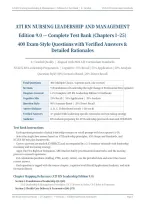
Edition 9.0 — Complete Test Bank (Chapters 1–25)
400 Exam-Style Questions with Verified Answers &
Detailed Rationales
A+ Graded Quality | Aligned with 2026 ATI Curriculum Standards
NCLEX-RN Leadership Preparation | Cognitive: 25% Recall | 55% Application | 20% Analysis
Question Style: 80% Scenario-Based | 20% Direct Recall
Total Questions 400 (Multiple Choice, 4 options each, one correct)
Sections 9 (Foundations of Leadership through Change & Professional Development)
Chapters Covered 1-25 (Complete ATI RN Leadership Edition 9.0 textbook)
Cognitive Mix 25% Recall | 55% Application | 20% Analysis
Question Style 80% Scenario-Based | 20% Direct Recall
Answer Balance A, B, C, D distributed evenly (~100 each)
Verified Answers A+ graded with leadership-specific rationales and test-taking strategy
Audience RN students preparing for ATI Leadership proctored exam and NCLEX-RN
Test Bank Instructions
• Each question presents a clinical leadership scenario or recall prompt with four options (A–D).
• Select the single best answer based on ATI Leadership principles, ANA Scope and Standards, and
NCLEX-RN test plan frameworks.
• Correct answers are marked [CORRECT] and accompanied by a 2–3 sentence rationale with leadership
reasoning and test-taking strategy.
• Apply the Five Rights of Delegation, ABC/Maslow/Safety prioritization frameworks, and the nursing
process to scenario questions.
• For calculation questions (staffing, FTEs, acuity, ratios), use the provided data and select the closest
correct answer.
• Each question is tagged with the source chapter, cognitive level (Recall/Application/Analysis), and style
(Scenario/Direct).
Chapter Mapping Reference (ATI RN Leadership Edition 9.0)
Section 1: Foundations of Leadership (Q1-Q40)
Ch 1 Leadership & Management Principles; Ch 2 Theories & Styles; Ch 3 Roles & Functions
Section 2: Health Care Delivery & Economics (Q41-Q75)
400 Exam-Style Questions | 25 Chapters | 9 Sections | Verified Answers & Rationales Page 1
,ATI RN Nursing Leadership & Management | Edition 9.0 Test Bank | A+ Graded 2026 ATI Curriculum Standards
Ch 4 Health Care Delivery Systems; Ch 5 Economics & Reimbursement; Ch 6 Resource Management
Section 3: Legal & Ethical Issues (Q76-Q110)
Ch 7 Legal Accountability; Ch 8 Ethics & Advocacy; Ch 9 Professional Liability
Section 4: Delegation, Supervision, Assignment (Q111-Q155)
Ch 10 Delegation Principles; Ch 11 Five Rights of Delegation; Ch 12 Scope of Practice; Ch 13 Supervision
Section 5: Prioritization & Time Management (Q156-Q200)
Ch 14 Prioritization Frameworks; Ch 15 Time Management; Ch 16 Workflow & Multitasking
Section 6: Communication, Collaboration, Conflict (Q201-Q240)
Ch 17 Communication; Ch 18 Collaboration & Teams; Ch 19 Conflict Resolution
Section 7: QI, Safety, Risk Management (Q241-Q285)
Ch 20 Quality Improvement; Ch 21 Patient Safety; Ch 22 Risk Management & Sentinel Events
Section 8: Staffing, Scheduling, HR (Q286-Q340)
Ch 23 Staffing & Scheduling; Ch 24 Human Resource Management; Ch 25 Performance Evaluation
Section 9: Change, Informatics, Professional Dev (Q341-Q400)
Ch 20-25 cross-cutting: Change theories, EBP, Informatics, Career Development, Magnet & Shared
Governance
Begin Test Bank
400 Exam-Style Questions | 25 Chapters | 9 Sections | Verified Answers & Rationales Page 2
,ATI RN Nursing Leadership & Management | Edition 9.0 Test Bank | A+ Graded 2026 ATI Curriculum Standards
Section 1: Foundations of Leadership and Management
Leadership Styles, Management Functions, and Theories — Questions Q1 through Q40
[Ch 1 | Recall | Direct]
Q1: Which statement best distinguishes leadership from management in nursing?
A. Leadership focuses on influencing others toward a goal, while management focuses on
coordinating resources and processes. [CORRECT]
B. Management focuses on inspiring a shared vision, while leadership focuses on coordinating
resources.
C. Leadership and management are identical functions performed by the same role.
D. Management is informal, while leadership requires formal authority.
Correct Answer: A
Rationale: Leadership is the process of influencing others to achieve a shared goal, while management is the
coordination of resources (people, time, supplies, processes) to accomplish organizational objectives. A nurse can
be a leader without being a manager (e.g., informal influence), and a manager without being an effective leader
(e.g., focuses only on tasks). Test-taking tip: think influence = leadership, coordination = management.
[Ch 1 | Application | Scenario]
Q2: A nurse manager notices her unit has high turnover and low morale. She holds a staff
meeting, asks for input on scheduling changes, and implements the team's preferred option.
Which leadership style is she demonstrating?
A. Democratic — involving staff in decision-making [CORRECT]
B. Autocratic — making decisions alone
C. Laissez-faire — letting staff do as they please
D. Transformational — inspiring a shared vision
Correct Answer: A
Rationale: Democratic (participative) leadership involves staff in decision-making, which builds engagement and
is appropriate for morale/turnaround scenarios. Autocratic centralizes decisions (faster but lower morale),
laissez-faire abdicates decision-making (risky in patient care), and transformational inspires through vision and
charisma. The key clue is 'asks for input and implements the team's preference' = democratic.
[Ch 2 | Recall | Direct]
Q3: Which leadership style is most effective in a crisis such as a Code Blue or mass casualty event?
A. Democratic — consults team before acting
B. Laissez-faire — lets the team self-organize
C. Autocratic — makes rapid, directive decisions [CORRECT]
D. Servant — focuses on team member needs first
Correct Answer: C
Rationale: Autocratic leadership is most effective in emergencies requiring rapid, decisive action with no time
for group input. The leader gives clear, directive orders and expects immediate compliance. Democratic and
laissez-faire styles are too slow for crises; servant leadership focuses on long-term team development, not acute
response. Test-taking tip: 'crisis, code, emergency' = autocratic.
[Ch 2 | Application | Scenario]
Q4: A charge nurse models integrity, mentors new graduates, and removes barriers so staff can
focus on patient care. Staff describe her as someone who serves the team. Which leadership style
is this?
A. Servant leadership [CORRECT]
B. Transformational leadership
C. Autocratic leadership
D. Situational leadership
400 Exam-Style Questions | 25 Chapters | 9 Sections | Verified Answers & Rationales Page 3
, ATI RN Nursing Leadership & Management | Edition 9.0 Test Bank | A+ Graded 2026 ATI Curriculum Standards
Correct Answer: A
Rationale: Servant leadership is characterized by focusing on the needs of team members, removing barriers to
their success, mentoring, and modeling integrity. The leader 'serves' the team so they can serve patients.
Transformational inspires through vision and charisma; autocratic is directive; situational adapts to maturity.
Key phrase: 'serves the team, removes barriers, mentors' = servant.
[Ch 2 | Application | Scenario]
Q5: A nurse leader articulates a compelling vision of the unit as a Magnet-recognized,
evidence-based center of excellence, inspires staff to embrace EBP, and recognizes individual
contributions. Which style is this?
A. Transformational leadership [CORRECT]
B. Transactional leadership
C. Laissez-faire leadership
D. Autocratic leadership
Correct Answer: A
Rationale: Transformational leadership inspires followers through a compelling vision, role modeling,
intellectual stimulation (EBP), and individualized recognition. The leader changes the team's mindset, not just
their tasks. Transactional uses rewards/punishments; laissez-faire abdicates; autocratic directs. Clues:
'compelling vision, inspires, recognizes individual contributions' = transformational.
[Ch 1 | Recall | Direct]
Q6: Which of the following is one of the five classic management functions described by Luther
Gulick and others?
A. Planning, Organizing, Staffing, Directing, Controlling (POSDC) [CORRECT]
B. Assessing, Diagnosing, Planning, Implementing, Evaluating (ADPIE)
C. Leading, Communicating, Deciding, Budgeting, Hiring
D. Visioning, Mentoring, Coaching, Evaluating, Rewarding
Correct Answer: A
Rationale: The five classic management functions are Planning (setting goals), Organizing (structuring), Staffing
(recruiting/retaining), Directing (leading/supervising), and Controlling (evaluating and correcting). ADPIE is the
nursing process, not management functions. Test-taking tip: POSDC = management; ADPIE = nursing process.
[Ch 1 | Application | Scenario]
Q7: A nurse manager sets a goal to reduce falls by 20% in 6 months, develops an action plan,
allocates resources, and tracks progress monthly. Which management function is primarily
demonstrated?
A. Planning — setting goals and strategies
B. Organizing — structuring work
C. Staffing — hiring and scheduling
D. Controlling — measuring and correcting performance [CORRECT]
Correct Answer: D
Rationale: Tracking monthly progress and comparing actual to goal (20% reduction) is the Controlling function,
which measures performance and takes corrective action. Planning set the goal; organizing structured the work;
staffing assigned people. But measuring progress against goals = controlling. Clues: 'sets goal, tracks progress
monthly' = planning + controlling; the active verb here is 'tracks progress monthly' = controlling.
[Ch 2 | Analysis | Scenario]
400 Exam-Style Questions | 25 Chapters | 9 Sections | Verified Answers & Rationales Page 4
ATI RN NURSING LEADERSHIP AND MANAGEMENT
Edition 9.0 — Complete Test Bank (Chapters 1–25)
400 Exam-Style Questions with Verified Answers &
Detailed Rationales
A+ Graded Quality | Aligned with 2026 ATI Curriculum Standards
NCLEX-RN Leadership Preparation | Cognitive: 25% Recall | 55% Application | 20% Analysis
Question Style: 80% Scenario-Based | 20% Direct Recall
Total Questions 400 (Multiple Choice, 4 options each, one correct)
Sections 9 (Foundations of Leadership through Change & Professional Development)
Chapters Covered 1-25 (Complete ATI RN Leadership Edition 9.0 textbook)
Cognitive Mix 25% Recall | 55% Application | 20% Analysis
Question Style 80% Scenario-Based | 20% Direct Recall
Answer Balance A, B, C, D distributed evenly (~100 each)
Verified Answers A+ graded with leadership-specific rationales and test-taking strategy
Audience RN students preparing for ATI Leadership proctored exam and NCLEX-RN
Test Bank Instructions
• Each question presents a clinical leadership scenario or recall prompt with four options (A–D).
• Select the single best answer based on ATI Leadership principles, ANA Scope and Standards, and
NCLEX-RN test plan frameworks.
• Correct answers are marked [CORRECT] and accompanied by a 2–3 sentence rationale with leadership
reasoning and test-taking strategy.
• Apply the Five Rights of Delegation, ABC/Maslow/Safety prioritization frameworks, and the nursing
process to scenario questions.
• For calculation questions (staffing, FTEs, acuity, ratios), use the provided data and select the closest
correct answer.
• Each question is tagged with the source chapter, cognitive level (Recall/Application/Analysis), and style
(Scenario/Direct).
Chapter Mapping Reference (ATI RN Leadership Edition 9.0)
Section 1: Foundations of Leadership (Q1-Q40)
Ch 1 Leadership & Management Principles; Ch 2 Theories & Styles; Ch 3 Roles & Functions
Section 2: Health Care Delivery & Economics (Q41-Q75)
400 Exam-Style Questions | 25 Chapters | 9 Sections | Verified Answers & Rationales Page 1
,ATI RN Nursing Leadership & Management | Edition 9.0 Test Bank | A+ Graded 2026 ATI Curriculum Standards
Ch 4 Health Care Delivery Systems; Ch 5 Economics & Reimbursement; Ch 6 Resource Management
Section 3: Legal & Ethical Issues (Q76-Q110)
Ch 7 Legal Accountability; Ch 8 Ethics & Advocacy; Ch 9 Professional Liability
Section 4: Delegation, Supervision, Assignment (Q111-Q155)
Ch 10 Delegation Principles; Ch 11 Five Rights of Delegation; Ch 12 Scope of Practice; Ch 13 Supervision
Section 5: Prioritization & Time Management (Q156-Q200)
Ch 14 Prioritization Frameworks; Ch 15 Time Management; Ch 16 Workflow & Multitasking
Section 6: Communication, Collaboration, Conflict (Q201-Q240)
Ch 17 Communication; Ch 18 Collaboration & Teams; Ch 19 Conflict Resolution
Section 7: QI, Safety, Risk Management (Q241-Q285)
Ch 20 Quality Improvement; Ch 21 Patient Safety; Ch 22 Risk Management & Sentinel Events
Section 8: Staffing, Scheduling, HR (Q286-Q340)
Ch 23 Staffing & Scheduling; Ch 24 Human Resource Management; Ch 25 Performance Evaluation
Section 9: Change, Informatics, Professional Dev (Q341-Q400)
Ch 20-25 cross-cutting: Change theories, EBP, Informatics, Career Development, Magnet & Shared
Governance
Begin Test Bank
400 Exam-Style Questions | 25 Chapters | 9 Sections | Verified Answers & Rationales Page 2
,ATI RN Nursing Leadership & Management | Edition 9.0 Test Bank | A+ Graded 2026 ATI Curriculum Standards
Section 1: Foundations of Leadership and Management
Leadership Styles, Management Functions, and Theories — Questions Q1 through Q40
[Ch 1 | Recall | Direct]
Q1: Which statement best distinguishes leadership from management in nursing?
A. Leadership focuses on influencing others toward a goal, while management focuses on
coordinating resources and processes. [CORRECT]
B. Management focuses on inspiring a shared vision, while leadership focuses on coordinating
resources.
C. Leadership and management are identical functions performed by the same role.
D. Management is informal, while leadership requires formal authority.
Correct Answer: A
Rationale: Leadership is the process of influencing others to achieve a shared goal, while management is the
coordination of resources (people, time, supplies, processes) to accomplish organizational objectives. A nurse can
be a leader without being a manager (e.g., informal influence), and a manager without being an effective leader
(e.g., focuses only on tasks). Test-taking tip: think influence = leadership, coordination = management.
[Ch 1 | Application | Scenario]
Q2: A nurse manager notices her unit has high turnover and low morale. She holds a staff
meeting, asks for input on scheduling changes, and implements the team's preferred option.
Which leadership style is she demonstrating?
A. Democratic — involving staff in decision-making [CORRECT]
B. Autocratic — making decisions alone
C. Laissez-faire — letting staff do as they please
D. Transformational — inspiring a shared vision
Correct Answer: A
Rationale: Democratic (participative) leadership involves staff in decision-making, which builds engagement and
is appropriate for morale/turnaround scenarios. Autocratic centralizes decisions (faster but lower morale),
laissez-faire abdicates decision-making (risky in patient care), and transformational inspires through vision and
charisma. The key clue is 'asks for input and implements the team's preference' = democratic.
[Ch 2 | Recall | Direct]
Q3: Which leadership style is most effective in a crisis such as a Code Blue or mass casualty event?
A. Democratic — consults team before acting
B. Laissez-faire — lets the team self-organize
C. Autocratic — makes rapid, directive decisions [CORRECT]
D. Servant — focuses on team member needs first
Correct Answer: C
Rationale: Autocratic leadership is most effective in emergencies requiring rapid, decisive action with no time
for group input. The leader gives clear, directive orders and expects immediate compliance. Democratic and
laissez-faire styles are too slow for crises; servant leadership focuses on long-term team development, not acute
response. Test-taking tip: 'crisis, code, emergency' = autocratic.
[Ch 2 | Application | Scenario]
Q4: A charge nurse models integrity, mentors new graduates, and removes barriers so staff can
focus on patient care. Staff describe her as someone who serves the team. Which leadership style
is this?
A. Servant leadership [CORRECT]
B. Transformational leadership
C. Autocratic leadership
D. Situational leadership
400 Exam-Style Questions | 25 Chapters | 9 Sections | Verified Answers & Rationales Page 3
, ATI RN Nursing Leadership & Management | Edition 9.0 Test Bank | A+ Graded 2026 ATI Curriculum Standards
Correct Answer: A
Rationale: Servant leadership is characterized by focusing on the needs of team members, removing barriers to
their success, mentoring, and modeling integrity. The leader 'serves' the team so they can serve patients.
Transformational inspires through vision and charisma; autocratic is directive; situational adapts to maturity.
Key phrase: 'serves the team, removes barriers, mentors' = servant.
[Ch 2 | Application | Scenario]
Q5: A nurse leader articulates a compelling vision of the unit as a Magnet-recognized,
evidence-based center of excellence, inspires staff to embrace EBP, and recognizes individual
contributions. Which style is this?
A. Transformational leadership [CORRECT]
B. Transactional leadership
C. Laissez-faire leadership
D. Autocratic leadership
Correct Answer: A
Rationale: Transformational leadership inspires followers through a compelling vision, role modeling,
intellectual stimulation (EBP), and individualized recognition. The leader changes the team's mindset, not just
their tasks. Transactional uses rewards/punishments; laissez-faire abdicates; autocratic directs. Clues:
'compelling vision, inspires, recognizes individual contributions' = transformational.
[Ch 1 | Recall | Direct]
Q6: Which of the following is one of the five classic management functions described by Luther
Gulick and others?
A. Planning, Organizing, Staffing, Directing, Controlling (POSDC) [CORRECT]
B. Assessing, Diagnosing, Planning, Implementing, Evaluating (ADPIE)
C. Leading, Communicating, Deciding, Budgeting, Hiring
D. Visioning, Mentoring, Coaching, Evaluating, Rewarding
Correct Answer: A
Rationale: The five classic management functions are Planning (setting goals), Organizing (structuring), Staffing
(recruiting/retaining), Directing (leading/supervising), and Controlling (evaluating and correcting). ADPIE is the
nursing process, not management functions. Test-taking tip: POSDC = management; ADPIE = nursing process.
[Ch 1 | Application | Scenario]
Q7: A nurse manager sets a goal to reduce falls by 20% in 6 months, develops an action plan,
allocates resources, and tracks progress monthly. Which management function is primarily
demonstrated?
A. Planning — setting goals and strategies
B. Organizing — structuring work
C. Staffing — hiring and scheduling
D. Controlling — measuring and correcting performance [CORRECT]
Correct Answer: D
Rationale: Tracking monthly progress and comparing actual to goal (20% reduction) is the Controlling function,
which measures performance and takes corrective action. Planning set the goal; organizing structured the work;
staffing assigned people. But measuring progress against goals = controlling. Clues: 'sets goal, tracks progress
monthly' = planning + controlling; the active verb here is 'tracks progress monthly' = controlling.
[Ch 2 | Analysis | Scenario]
400 Exam-Style Questions | 25 Chapters | 9 Sections | Verified Answers & Rationales Page 4


