
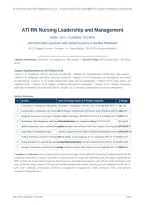
ATI RN Nursing Leadership & Management Ed. 10.0 - Complete Test Bank (400 Questions)
2026 ATI Curriculum Standards | A+ Graded Quality
ATI RN Nursing Leadership and Management
Edition 10.0 — Complete Test Bank
400 Exam-Style Questions with Verified Answers & Detailed Rationales
All 25 Chapters Covered · 9 Sections · A+ Graded Quality · 2026 ATI Curriculum Standards
Cognitive Distribution: 25% Recall · 55% Application · 20% Analysis | Question Design: 80% Scenario-Based · 20% Direct
Recall
Chapter Mapping Reference (ATI Edition 10.0)
Chapters 1-3: Foundations, theories, and styles of leadership · Chapters 4-6: Communication, collaboration, and teamwork ·
Chapters 7-9: Delegation, supervision, and scope of practice · Chapters 10-12: Prioritization, time management, and clinical
decision-making · Chapters 13-15: Quality improvement, safety, and risk management · Chapters 16-18: Legal, ethical, and
regulatory issues · Chapters 19-20: Staffing, scheduling, and resource management · Chapters 21-23: Change management,
leadership development, and professional growth · Chapters 24-25: Emergency preparedness and disaster management.
Section Overview
# Section Topic Coverage & ATI Chapter Mapping Q Range
1 Foundations of Leadership and Management Leadership vs. Management, Theories, Styles, & Nursing Roles (ATI Ch. 1-3)
Q1–Q45
2 Communication, Collaboration, and Teamwork
SBAR, Handoff, Interprofessional Teams, & Conflict Resolution (ATI Ch. 4-6)
Q46–Q90
3 Delegation, Supervision, and Scope of Practice
Five Rights of Delegation, RN/LPN/UAP Roles, & Accountability (ATI Ch.Q91–Q140
7-9)
4 Prioritization, Time Management, and ClinicalABCs,
Decision-Making
Maslow, Safety, & Assignment Making (ATI Ch. 10-12) Q141–Q190
5 Quality Improvement, Safety, and Risk Management
QI Methodologies, Sentinel Events, Root Cause Analysis, & Just Culture (ATI
Q191–Q240
Ch. 13-15)
6 Legal, Ethical, and Regulatory Issues Advocacy, Informed Consent, HIPAA, Mandatory Reporting, & LicensureQ241–Q285
(ATI Ch. 16-18)
7 Staffing, Scheduling, and Resource Management
Staffing Models, Acuity, Budgeting, & Cost Containment (ATI Ch. 19-20)Q286–Q325
8 Change Management, Leadership Development,
Change
and Professional
Theories, Mentoring,
Growth & Evidence-Based Practice (ATI Ch. 21-23)Q326–Q365
9 Emergency Preparedness and Disaster Management
Triage, Incident Command, Mass Casualty, & Crisis Leadership (ATI Ch. Q366–Q400
24-25)
Compliance Verification: This test bank has been developed to align with the 2026 ATI Curriculum Standards and NCLEX-RN
Leadership competencies. Cognitive distribution is maintained at 25% recall, 55% application, and 20% analysis. Eighty percent
(80%) of items are scenario-based requiring clinical reasoning and leadership judgment, while 20% are direct mechanism recall
items. Distractors target common ATI Leadership and Management exam pitfalls including incorrect delegation to UAP, RN vs.
LPN scope confusion, prioritization framework misapplication, inappropriate conflict resolution styles, and improper
assignment-making decisions.
NCLEX-RN Leadership Preparation Page 1
,ATI RN Nursing Leadership & Management Ed. 10.0 - Complete Test Bank (400 Questions)
2026 ATI Curriculum Standards | A+ Graded Quality
Section 1: Foundations of Leadership and Management
Leadership vs. Management, Theories, Styles, & Nursing Roles (ATI Ch. 1-3)
Q1: A nurse manager is implementing a new evidence-based fall-prevention protocol. Although the policy has
been officially adopted, the manager spends shifts role-modeling the new rounding technique and explaining
why the change improves patient outcomes. Which function is the manager primarily demonstrating?
A. Management function of organizing
B. Leadership function of influencing toward a vision [CORRECT]
C. Management function of controlling
D. Leadership function of policy enforcement
Correct Answer: B
Rationale:
Leadership focuses on influencing people toward a vision, motivating change, and role-modeling desired behavior. Management
focuses on processes like planning, organizing, staffing, directing, and controlling. By inspiring staff and explaining the 'why,'
the manager is exercising leadership rather than simply enforcing policy. Management activities (organizing, controlling)
emphasize structure, resources, and compliance rather than influence.
Q2: A charge nurse recognizes that an effective nurse manager must perform both leadership and
management functions. Which of the following is an example of a management function rather than a
leadership function?
A. Inspiring staff to embrace shared governance
B. Creating the monthly staffing schedule [CORRECT]
C. Coaching a new graduate through a difficult clinical situation
D. Casting a vision for Magnet redesignation
Correct Answer: B
Rationale:
Creating the staffing schedule is a classic management function: it organizes human resources to accomplish the unit's work.
Inspiring staff, coaching, and casting vision are leadership behaviors that influence people toward goals. Both functions are
necessary, but the schedule is structural and operational rather than inspirational.
Q3: A nurse leader who focuses on individualized consideration, intellectual stimulation, inspirational
motivation, and idealized influence is practicing which leadership theory?
A. Transactional leadership
B. Transformational leadership [CORRECT]
C. Laissez-faire leadership
D. Autocratic leadership
Correct Answer: B
Rationale:
Transformational leadership (Bass) is defined by the 'Four I's': idealized influence, inspirational motivation, intellectual
stimulation, and individualized consideration. Transactional leadership uses rewards/punishments to maintain status quo.
Laissez-faire avoids decision-making. Autocratic makes unilateral decisions—none of these incorporate the Four I's.
Q4: A nurse manager uses self-awareness, self-regulation, motivation, empathy, and social skill to lead the
unit through a difficult EMR transition. According to Goleman, which concept is the manager applying?
A. Emotional intelligence [CORRECT]
NCLEX-RN Leadership Preparation Page 2
,ATI RN Nursing Leadership & Management Ed. 10.0 - Complete Test Bank (400 Questions)
2026 ATI Curriculum Standards | A+ Graded Quality
B. Situational leadership
C. Servant leadership
D. Trait leadership
Correct Answer: A
Rationale:
Goleman's emotional intelligence components are self-awareness, self-regulation, motivation, empathy, and social
skill—qualities that allow leaders to manage themselves and relationships during change. Situational leadership adjusts style to
follower readiness. Servant leadership prioritizes follower needs. Trait leadership assumes inherent leader qualities.
Q5: During a code blue, the nurse manager takes charge, assigns roles, and directs team members without
seeking input. Which leadership style is being applied, and why is it appropriate?
A. Democratic—encourages team participation
B. Autocratic—appropriate in crisis when quick decisions are needed [CORRECT]
C. Laissez-faire—lets team self-organize
D. Transformational—inspires team to vision
Correct Answer: B
Rationale:
Autocratic leadership is directive and decision-focused, appropriate in emergencies or crises when rapid action is required and
input is impractical. Democratic style is too slow for code situations. Laissez-faire abdicates responsibility. Transformational is
for long-term inspiration, not acute crisis direction.
Q6: A nurse manager allows staff to self-schedule, choose committee assignments, and solve unit problems
with minimal interference. When unit metrics begin to slip, staff complain of unclear expectations. Which
leadership style was applied, and what was the pitfall?
A. Democratic; too much participation caused delay
B. Laissez-faire; lack of structure and accountability led to drift [CORRECT]
C. Autocratic; too little staff input reduced morale
D. Transformational; overemphasis on vision distracted from operations
Correct Answer: B
Rationale:
Laissez-faire leadership gives decision-making to staff with little guidance; when expectations are unclear, accountability and
performance suffer. Democratic style still involves leader facilitation. Autocratic centralizes decisions. Transformational
includes vision plus direction. The drift in metrics reflects absence of structure, the hallmark pitfall of laissez-faire.
Q7: A nurse leader frames decisions using the question, 'What do my staff need to grow and succeed so they
can best serve patients?' Which leadership theory best describes this approach?
A. Servant leadership (Greenleaf) [CORRECT]
B. Transactional leadership (Bass)
C. Trait leadership (Stogdill)
D. Situational leadership (Hersey-Blanchard)
Correct Answer: A
Rationale:
Servant leadership (Greenleaf) prioritizes the needs of followers first, believing that serving staff enables them to better serve
patients. Transactional leadership uses contingent rewards. Trait leadership assumes leaders are born with certain traits.
Situational leadership adapts style to follower readiness.
NCLEX-RN Leadership Preparation Page 3
, ATI RN Nursing Leadership & Management Ed. 10.0 - Complete Test Bank (400 Questions)
2026 ATI Curriculum Standards | A+ Graded Quality
Q8: A new charge nurse adjusts leadership style based on the readiness of each team member—directing new
graduates, coaching competent nurses, and delegating to experts. Which theory is being applied?
A. Transformational leadership
B. Situational/Contextual leadership (Hersey-Blanchard) [CORRECT]
C. Trait theory
D. Path-goal theory
Correct Answer: B
Rationale:
Hersey-Blanchard Situational Leadership matches leadership style (telling, selling, participating, delegating) to follower
readiness (R1–R4). The nurse is adapting style to competence and commitment. Transformational is relationship/vision-based.
Trait theory is fixed. Path-goal focuses on removing obstacles to goals.
Q9: A nurse manager using Path-Goal theory would most likely engage in which behavior?
A. Inspiring staff with a shared vision
B. Removing obstacles that block staff from achieving patient-care goals [CORRECT]
C. Punishing staff who fail to meet metrics
D. Letting staff set their own direction
Correct Answer: B
Rationale:
Path-Goal theory (House) holds that leaders clarify and remove obstacles so followers can achieve goals. The leader adapts
behavior (directive, supportive, participative, achievement-oriented) to employee and task needs. Vision-casting is
transformational. Punishment is transactional. Abdication is laissez-faire.
Q10: Which statement best describes the difference between transactional and transformational leadership?
A. Transactional uses rewards/punishments to maintain the status quo; transformational inspires change
through vision and individualized consideration [CORRECT]
B. Transactional is always poor practice; transformational is always preferred
C. Transactional leaders are authoritarian; transformational leaders are passive
D. Transactional leaders focus on long-term strategy; transformational leaders focus on daily operations
Correct Answer: A
Rationale:
Transactional leadership maintains stability through contingent rewards/punishments (management by exception).
Transformational leadership creates change through the Four I's (idealized influence, inspirational motivation, intellectual
stimulation, individualized consideration). Both have appropriate uses—transactional is fine for stable environments;
transformational is needed for change.
Q11: A nurse manager implements Lewin's planned change theory on the unit. After unfreezing, which phase
involves implementing the new practice and helping staff adopt it?
A. Refreezing
B. Moving (changing) [CORRECT]
C. Evaluating
D. Restabilizing
Correct Answer: B
Rationale:
NCLEX-RN Leadership Preparation Page 4
2026 ATI Curriculum Standards | A+ Graded Quality
ATI RN Nursing Leadership and Management
Edition 10.0 — Complete Test Bank
400 Exam-Style Questions with Verified Answers & Detailed Rationales
All 25 Chapters Covered · 9 Sections · A+ Graded Quality · 2026 ATI Curriculum Standards
Cognitive Distribution: 25% Recall · 55% Application · 20% Analysis | Question Design: 80% Scenario-Based · 20% Direct
Recall
Chapter Mapping Reference (ATI Edition 10.0)
Chapters 1-3: Foundations, theories, and styles of leadership · Chapters 4-6: Communication, collaboration, and teamwork ·
Chapters 7-9: Delegation, supervision, and scope of practice · Chapters 10-12: Prioritization, time management, and clinical
decision-making · Chapters 13-15: Quality improvement, safety, and risk management · Chapters 16-18: Legal, ethical, and
regulatory issues · Chapters 19-20: Staffing, scheduling, and resource management · Chapters 21-23: Change management,
leadership development, and professional growth · Chapters 24-25: Emergency preparedness and disaster management.
Section Overview
# Section Topic Coverage & ATI Chapter Mapping Q Range
1 Foundations of Leadership and Management Leadership vs. Management, Theories, Styles, & Nursing Roles (ATI Ch. 1-3)
Q1–Q45
2 Communication, Collaboration, and Teamwork
SBAR, Handoff, Interprofessional Teams, & Conflict Resolution (ATI Ch. 4-6)
Q46–Q90
3 Delegation, Supervision, and Scope of Practice
Five Rights of Delegation, RN/LPN/UAP Roles, & Accountability (ATI Ch.Q91–Q140
7-9)
4 Prioritization, Time Management, and ClinicalABCs,
Decision-Making
Maslow, Safety, & Assignment Making (ATI Ch. 10-12) Q141–Q190
5 Quality Improvement, Safety, and Risk Management
QI Methodologies, Sentinel Events, Root Cause Analysis, & Just Culture (ATI
Q191–Q240
Ch. 13-15)
6 Legal, Ethical, and Regulatory Issues Advocacy, Informed Consent, HIPAA, Mandatory Reporting, & LicensureQ241–Q285
(ATI Ch. 16-18)
7 Staffing, Scheduling, and Resource Management
Staffing Models, Acuity, Budgeting, & Cost Containment (ATI Ch. 19-20)Q286–Q325
8 Change Management, Leadership Development,
Change
and Professional
Theories, Mentoring,
Growth & Evidence-Based Practice (ATI Ch. 21-23)Q326–Q365
9 Emergency Preparedness and Disaster Management
Triage, Incident Command, Mass Casualty, & Crisis Leadership (ATI Ch. Q366–Q400
24-25)
Compliance Verification: This test bank has been developed to align with the 2026 ATI Curriculum Standards and NCLEX-RN
Leadership competencies. Cognitive distribution is maintained at 25% recall, 55% application, and 20% analysis. Eighty percent
(80%) of items are scenario-based requiring clinical reasoning and leadership judgment, while 20% are direct mechanism recall
items. Distractors target common ATI Leadership and Management exam pitfalls including incorrect delegation to UAP, RN vs.
LPN scope confusion, prioritization framework misapplication, inappropriate conflict resolution styles, and improper
assignment-making decisions.
NCLEX-RN Leadership Preparation Page 1
,ATI RN Nursing Leadership & Management Ed. 10.0 - Complete Test Bank (400 Questions)
2026 ATI Curriculum Standards | A+ Graded Quality
Section 1: Foundations of Leadership and Management
Leadership vs. Management, Theories, Styles, & Nursing Roles (ATI Ch. 1-3)
Q1: A nurse manager is implementing a new evidence-based fall-prevention protocol. Although the policy has
been officially adopted, the manager spends shifts role-modeling the new rounding technique and explaining
why the change improves patient outcomes. Which function is the manager primarily demonstrating?
A. Management function of organizing
B. Leadership function of influencing toward a vision [CORRECT]
C. Management function of controlling
D. Leadership function of policy enforcement
Correct Answer: B
Rationale:
Leadership focuses on influencing people toward a vision, motivating change, and role-modeling desired behavior. Management
focuses on processes like planning, organizing, staffing, directing, and controlling. By inspiring staff and explaining the 'why,'
the manager is exercising leadership rather than simply enforcing policy. Management activities (organizing, controlling)
emphasize structure, resources, and compliance rather than influence.
Q2: A charge nurse recognizes that an effective nurse manager must perform both leadership and
management functions. Which of the following is an example of a management function rather than a
leadership function?
A. Inspiring staff to embrace shared governance
B. Creating the monthly staffing schedule [CORRECT]
C. Coaching a new graduate through a difficult clinical situation
D. Casting a vision for Magnet redesignation
Correct Answer: B
Rationale:
Creating the staffing schedule is a classic management function: it organizes human resources to accomplish the unit's work.
Inspiring staff, coaching, and casting vision are leadership behaviors that influence people toward goals. Both functions are
necessary, but the schedule is structural and operational rather than inspirational.
Q3: A nurse leader who focuses on individualized consideration, intellectual stimulation, inspirational
motivation, and idealized influence is practicing which leadership theory?
A. Transactional leadership
B. Transformational leadership [CORRECT]
C. Laissez-faire leadership
D. Autocratic leadership
Correct Answer: B
Rationale:
Transformational leadership (Bass) is defined by the 'Four I's': idealized influence, inspirational motivation, intellectual
stimulation, and individualized consideration. Transactional leadership uses rewards/punishments to maintain status quo.
Laissez-faire avoids decision-making. Autocratic makes unilateral decisions—none of these incorporate the Four I's.
Q4: A nurse manager uses self-awareness, self-regulation, motivation, empathy, and social skill to lead the
unit through a difficult EMR transition. According to Goleman, which concept is the manager applying?
A. Emotional intelligence [CORRECT]
NCLEX-RN Leadership Preparation Page 2
,ATI RN Nursing Leadership & Management Ed. 10.0 - Complete Test Bank (400 Questions)
2026 ATI Curriculum Standards | A+ Graded Quality
B. Situational leadership
C. Servant leadership
D. Trait leadership
Correct Answer: A
Rationale:
Goleman's emotional intelligence components are self-awareness, self-regulation, motivation, empathy, and social
skill—qualities that allow leaders to manage themselves and relationships during change. Situational leadership adjusts style to
follower readiness. Servant leadership prioritizes follower needs. Trait leadership assumes inherent leader qualities.
Q5: During a code blue, the nurse manager takes charge, assigns roles, and directs team members without
seeking input. Which leadership style is being applied, and why is it appropriate?
A. Democratic—encourages team participation
B. Autocratic—appropriate in crisis when quick decisions are needed [CORRECT]
C. Laissez-faire—lets team self-organize
D. Transformational—inspires team to vision
Correct Answer: B
Rationale:
Autocratic leadership is directive and decision-focused, appropriate in emergencies or crises when rapid action is required and
input is impractical. Democratic style is too slow for code situations. Laissez-faire abdicates responsibility. Transformational is
for long-term inspiration, not acute crisis direction.
Q6: A nurse manager allows staff to self-schedule, choose committee assignments, and solve unit problems
with minimal interference. When unit metrics begin to slip, staff complain of unclear expectations. Which
leadership style was applied, and what was the pitfall?
A. Democratic; too much participation caused delay
B. Laissez-faire; lack of structure and accountability led to drift [CORRECT]
C. Autocratic; too little staff input reduced morale
D. Transformational; overemphasis on vision distracted from operations
Correct Answer: B
Rationale:
Laissez-faire leadership gives decision-making to staff with little guidance; when expectations are unclear, accountability and
performance suffer. Democratic style still involves leader facilitation. Autocratic centralizes decisions. Transformational
includes vision plus direction. The drift in metrics reflects absence of structure, the hallmark pitfall of laissez-faire.
Q7: A nurse leader frames decisions using the question, 'What do my staff need to grow and succeed so they
can best serve patients?' Which leadership theory best describes this approach?
A. Servant leadership (Greenleaf) [CORRECT]
B. Transactional leadership (Bass)
C. Trait leadership (Stogdill)
D. Situational leadership (Hersey-Blanchard)
Correct Answer: A
Rationale:
Servant leadership (Greenleaf) prioritizes the needs of followers first, believing that serving staff enables them to better serve
patients. Transactional leadership uses contingent rewards. Trait leadership assumes leaders are born with certain traits.
Situational leadership adapts style to follower readiness.
NCLEX-RN Leadership Preparation Page 3
, ATI RN Nursing Leadership & Management Ed. 10.0 - Complete Test Bank (400 Questions)
2026 ATI Curriculum Standards | A+ Graded Quality
Q8: A new charge nurse adjusts leadership style based on the readiness of each team member—directing new
graduates, coaching competent nurses, and delegating to experts. Which theory is being applied?
A. Transformational leadership
B. Situational/Contextual leadership (Hersey-Blanchard) [CORRECT]
C. Trait theory
D. Path-goal theory
Correct Answer: B
Rationale:
Hersey-Blanchard Situational Leadership matches leadership style (telling, selling, participating, delegating) to follower
readiness (R1–R4). The nurse is adapting style to competence and commitment. Transformational is relationship/vision-based.
Trait theory is fixed. Path-goal focuses on removing obstacles to goals.
Q9: A nurse manager using Path-Goal theory would most likely engage in which behavior?
A. Inspiring staff with a shared vision
B. Removing obstacles that block staff from achieving patient-care goals [CORRECT]
C. Punishing staff who fail to meet metrics
D. Letting staff set their own direction
Correct Answer: B
Rationale:
Path-Goal theory (House) holds that leaders clarify and remove obstacles so followers can achieve goals. The leader adapts
behavior (directive, supportive, participative, achievement-oriented) to employee and task needs. Vision-casting is
transformational. Punishment is transactional. Abdication is laissez-faire.
Q10: Which statement best describes the difference between transactional and transformational leadership?
A. Transactional uses rewards/punishments to maintain the status quo; transformational inspires change
through vision and individualized consideration [CORRECT]
B. Transactional is always poor practice; transformational is always preferred
C. Transactional leaders are authoritarian; transformational leaders are passive
D. Transactional leaders focus on long-term strategy; transformational leaders focus on daily operations
Correct Answer: A
Rationale:
Transactional leadership maintains stability through contingent rewards/punishments (management by exception).
Transformational leadership creates change through the Four I's (idealized influence, inspirational motivation, intellectual
stimulation, individualized consideration). Both have appropriate uses—transactional is fine for stable environments;
transformational is needed for change.
Q11: A nurse manager implements Lewin's planned change theory on the unit. After unfreezing, which phase
involves implementing the new practice and helping staff adopt it?
A. Refreezing
B. Moving (changing) [CORRECT]
C. Evaluating
D. Restabilizing
Correct Answer: B
Rationale:
NCLEX-RN Leadership Preparation Page 4


