Chemistry of Life 1
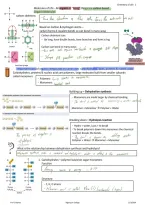
Molecules of Life - All organic or “living” things are carbon based
Organic Molecules
carbon skeletons
-
Based on Carbon & Hydrogen atoms –
double bond carbon forms 4 covalent bonds so can bond in many ways
Carbon skeletons can:
- Be long, have double bonds, have branches and form a ring
branch Carbon can bond in many ways:
ring
-
enzyme’s shape
determines which
reaction it will catalyze
functional groups
Important types of organic compounds in human diet: carbohydrates, lipids, proteins & nucleic acids
Carbohydrates, proteins & nucleic acids are polymers, large molecules built from smaller subunits
called monomers
- Polymers:
- Monomers:
Building up = Dehydration synthesis
- Monomers are made larger by chemical bonding
-
Monomer + Monomer → Polymer + Water
Breaking down = Hydrolysis reaction
- Hydro = water, Lysis = to break
- To break polymers down into monomers the chemical
reaction breaks the bonds.
-
Polymer + Water → Monomer + Monomer
What is the relationship between dehydration synthesis and hydrolysis?
1. Carbohydrates – polymer based on sugar monomers
Function
Structure
- C, H, O atoms
-
Prof C Baynes Algonquin College 11/3/2024
, Chemistry of Life 2
Carbohydrates include simple sugars & polysaccharides
A. Simple sugars
Monosaccharides –
- (mono = one, saccharide = sugar)
-
Disaccharides –
- (di = two, saccharide = sugar)
-
Simple sugars
short chains of monosaccharides on
glycoproteins act as identity markers & are
important in immunity
B type blood
B. Polysaccharides (complex carbohydrates) –
3 common types of polysaccharides important for humans
a. Starch
-
-
- Human enzymes digest starch into glucose for cellular respiration
b. Glycogen
-
glucose monomers
- Polymer chain of glucose with many side branches
c. Cellulose -
-
glucose monomers
-Non-digestible to animals
-Dietary fiber
Prof C Baynes Algonquin College 11/3/2024
Molecules of Life - All organic or “living” things are carbon based
Organic Molecules
carbon skeletons
-
Based on Carbon & Hydrogen atoms –
double bond carbon forms 4 covalent bonds so can bond in many ways
Carbon skeletons can:
- Be long, have double bonds, have branches and form a ring
branch Carbon can bond in many ways:
ring
-
enzyme’s shape
determines which
reaction it will catalyze
functional groups
Important types of organic compounds in human diet: carbohydrates, lipids, proteins & nucleic acids
Carbohydrates, proteins & nucleic acids are polymers, large molecules built from smaller subunits
called monomers
- Polymers:
- Monomers:
Building up = Dehydration synthesis
- Monomers are made larger by chemical bonding
-
Monomer + Monomer → Polymer + Water
Breaking down = Hydrolysis reaction
- Hydro = water, Lysis = to break
- To break polymers down into monomers the chemical
reaction breaks the bonds.
-
Polymer + Water → Monomer + Monomer
What is the relationship between dehydration synthesis and hydrolysis?
1. Carbohydrates – polymer based on sugar monomers
Function
Structure
- C, H, O atoms
-
Prof C Baynes Algonquin College 11/3/2024
, Chemistry of Life 2
Carbohydrates include simple sugars & polysaccharides
A. Simple sugars
Monosaccharides –
- (mono = one, saccharide = sugar)
-
Disaccharides –
- (di = two, saccharide = sugar)
-
Simple sugars
short chains of monosaccharides on
glycoproteins act as identity markers & are
important in immunity
B type blood
B. Polysaccharides (complex carbohydrates) –
3 common types of polysaccharides important for humans
a. Starch
-
-
- Human enzymes digest starch into glucose for cellular respiration
b. Glycogen
-
glucose monomers
- Polymer chain of glucose with many side branches
c. Cellulose -
-
glucose monomers
-Non-digestible to animals
-Dietary fiber
Prof C Baynes Algonquin College 11/3/2024