
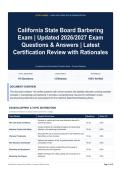
[STUDY GUIDE] • HIGH-YIELD PRACTICE & REVIEW EDITION
California State Board Barbering
Exam | Updated 2026/2027 Exam
Questions & Answers | Latest
Certification Review with Rationales
Comprehensive Examination Question Bank • Concept Mapping
TOTAL QUESTIONS EXAM TOPICS RATIONALES
116 Questions 12 Modules 100% Verified
DOCUMENT OVERVIEW
This document contains 116 verified questions with correct answers and detailed rationales covering essential
concepts in cosmetology and barbering. It provides a comprehensive resource for certification review,
ensuring that practitioners are well-prepared for the California State Board Barbering Exam.
EXAM BLUEPRINT & TOPIC DISTRIBUTION
Systematic breakdown of subject domains and exam coverage.
Topic Module Scope & Core Focus Questions Share (%)
Focuses on various skin and scalp disorders relevant to
Skin and Scalp Conditions barbering practice. 10 Qs 8.6%
Covers protocols for maintaining hygiene and preventing
Infection Control and Safety infection in the barbering environment. 10 Qs 8.6%
Discusses the use of chemical products in hair treatments and
Chemical Treatments their effects on hair structure. 10 Qs 8.6%
Explores the anatomy of hair, its growth phases, and the
Hair Structure and Growth composition of hair. 10 Qs 8.6%
Examines the principles of electricity as they apply to
Electricity and Equipment barbering tools and equipment. 10 Qs 8.6%
Details techniques for cutting, styling, and coloring hair in
Barbering Techniques barbering. 10 Qs 8.6%
Confidential • Student Study Edition • Practice & Review Guide Page 1 of 32
,STUDENT STUDY & MASTERY EDITION PRACTICE & REVIEW GUIDE
Addresses the basic anatomical structures and physiological
Anatomy and Physiology functions relevant to barbering. 10 Qs 8.6%
Focuses on the identification and application of various hair
Product Knowledge and skin care products. 10 Qs 8.6%
Discusses common hair-related disorders and diseases
Hair Disorders and Diseases affecting clients. 9 Qs 7.8%
Barbering History and Covers the historical context and regulatory framework of the
Regulations barbering profession. 9 Qs 7.8%
Nervous System and Sensory Explains the role of the nervous system and sensory functions
Functions in relation to barbering. 9 Qs 7.8%
Chemical Composition and Examines the chemical principles underlying hair treatments
Reactions and cosmetic products. 9 Qs 7.8%
Total Exam Coverage 12 Integrated Topic Modules 116 Qs 100.0%
Confidential • Student Study Edition • Practice & Review Guide Page 2 of 32
,STUDENT STUDY & MASTERY EDITION PRACTICE & REVIEW GUIDE
TOPIC 1: SKIN AND SCALP CONDITIONS
10 Questions • 8.6% of Exam • Focuses on various skin and scalp disorders relevant to barbering practice.
QUESTION 1
What do you do if someone with head lice sits in your chair ?
Answer: Deny the service and recommend them to see a physician.
Rationale: Head lice infestation is a communicable condition requiring medical treatment, and salon professionals must
prevent cross-contamination to protect other clients and themselves. The key concept tested is infection control and
professional responsibility in managing communicable diseases within a service setting.
QUESTION 2
When can you not perform a scalp treatment? ?
Answer: When cuts, abrasions and rash are present.
Rationale: Performing scalp treatments on open wounds, abrasions, or rashes can introduce pathogens, leading to
infection and further irritation of compromised skin. This contraindication protects the client from iatrogenic harm by
preventing the exacerbation of existing scalp conditions.
QUESTION 3
What is tinea ?
Answer: The medical term for ringworm.
Rationale: Tinea is the medical term for a superficial fungal infection of the skin, commonly known as ringworm, which
manifests with characteristic circular rashes. This question tests knowledge of common dermatological nomenclature and
associated conditions.
Confidential • Student Study Edition • Practice & Review Guide Page 3 of 32
, STUDENT STUDY & MASTERY EDITION PRACTICE & REVIEW GUIDE
QUESTION 4
Pityriasis capitis simplex ?
Answer: The technical term for classic dandruff.
Rationale: Pityriasis capitis simplex is the medical term for the common condition known as dandruff, characterized by
excessive shedding of dead skin cells from the scalp. This question tests the understanding of dermatological nomenclature
for prevalent scalp conditions.
QUESTION 5
Spiral or corkscrew-shaped bacteria that cause sexually transmitted diseases ?
Answer: Spirilla.
Rationale: Spirilla are spiral-shaped bacteria, and Treponema pallidum, the causative agent of syphilis, is a type of spirillum
transmitted sexually. This question tests knowledge of bacterial morphology and common sexually transmitted pathogens.
QUESTION 6
Scabies ?
Answer: Contagious disorder caused by the itch mite.
Rationale: Scabies is a contagious parasitic infestation caused by the mite *Sarcoptes scabiei*, which burrows into the skin
to lay eggs, leading to intense itching and a rash. This underlying parasitic etiology defines the condition.
QUESTION 7
Solution ?
Answer: The product created from dissolving a solute in a solvent.
Rationale: A solution is defined by its composition as a homogeneous mixture where a solute is fully dissolved within a
solvent. This process results in a uniform distribution of particles at the molecular level.
Confidential • Student Study Edition • Practice & Review Guide Page 4 of 32
California State Board Barbering
Exam | Updated 2026/2027 Exam
Questions & Answers | Latest
Certification Review with Rationales
Comprehensive Examination Question Bank • Concept Mapping
TOTAL QUESTIONS EXAM TOPICS RATIONALES
116 Questions 12 Modules 100% Verified
DOCUMENT OVERVIEW
This document contains 116 verified questions with correct answers and detailed rationales covering essential
concepts in cosmetology and barbering. It provides a comprehensive resource for certification review,
ensuring that practitioners are well-prepared for the California State Board Barbering Exam.
EXAM BLUEPRINT & TOPIC DISTRIBUTION
Systematic breakdown of subject domains and exam coverage.
Topic Module Scope & Core Focus Questions Share (%)
Focuses on various skin and scalp disorders relevant to
Skin and Scalp Conditions barbering practice. 10 Qs 8.6%
Covers protocols for maintaining hygiene and preventing
Infection Control and Safety infection in the barbering environment. 10 Qs 8.6%
Discusses the use of chemical products in hair treatments and
Chemical Treatments their effects on hair structure. 10 Qs 8.6%
Explores the anatomy of hair, its growth phases, and the
Hair Structure and Growth composition of hair. 10 Qs 8.6%
Examines the principles of electricity as they apply to
Electricity and Equipment barbering tools and equipment. 10 Qs 8.6%
Details techniques for cutting, styling, and coloring hair in
Barbering Techniques barbering. 10 Qs 8.6%
Confidential • Student Study Edition • Practice & Review Guide Page 1 of 32
,STUDENT STUDY & MASTERY EDITION PRACTICE & REVIEW GUIDE
Addresses the basic anatomical structures and physiological
Anatomy and Physiology functions relevant to barbering. 10 Qs 8.6%
Focuses on the identification and application of various hair
Product Knowledge and skin care products. 10 Qs 8.6%
Discusses common hair-related disorders and diseases
Hair Disorders and Diseases affecting clients. 9 Qs 7.8%
Barbering History and Covers the historical context and regulatory framework of the
Regulations barbering profession. 9 Qs 7.8%
Nervous System and Sensory Explains the role of the nervous system and sensory functions
Functions in relation to barbering. 9 Qs 7.8%
Chemical Composition and Examines the chemical principles underlying hair treatments
Reactions and cosmetic products. 9 Qs 7.8%
Total Exam Coverage 12 Integrated Topic Modules 116 Qs 100.0%
Confidential • Student Study Edition • Practice & Review Guide Page 2 of 32
,STUDENT STUDY & MASTERY EDITION PRACTICE & REVIEW GUIDE
TOPIC 1: SKIN AND SCALP CONDITIONS
10 Questions • 8.6% of Exam • Focuses on various skin and scalp disorders relevant to barbering practice.
QUESTION 1
What do you do if someone with head lice sits in your chair ?
Answer: Deny the service and recommend them to see a physician.
Rationale: Head lice infestation is a communicable condition requiring medical treatment, and salon professionals must
prevent cross-contamination to protect other clients and themselves. The key concept tested is infection control and
professional responsibility in managing communicable diseases within a service setting.
QUESTION 2
When can you not perform a scalp treatment? ?
Answer: When cuts, abrasions and rash are present.
Rationale: Performing scalp treatments on open wounds, abrasions, or rashes can introduce pathogens, leading to
infection and further irritation of compromised skin. This contraindication protects the client from iatrogenic harm by
preventing the exacerbation of existing scalp conditions.
QUESTION 3
What is tinea ?
Answer: The medical term for ringworm.
Rationale: Tinea is the medical term for a superficial fungal infection of the skin, commonly known as ringworm, which
manifests with characteristic circular rashes. This question tests knowledge of common dermatological nomenclature and
associated conditions.
Confidential • Student Study Edition • Practice & Review Guide Page 3 of 32
, STUDENT STUDY & MASTERY EDITION PRACTICE & REVIEW GUIDE
QUESTION 4
Pityriasis capitis simplex ?
Answer: The technical term for classic dandruff.
Rationale: Pityriasis capitis simplex is the medical term for the common condition known as dandruff, characterized by
excessive shedding of dead skin cells from the scalp. This question tests the understanding of dermatological nomenclature
for prevalent scalp conditions.
QUESTION 5
Spiral or corkscrew-shaped bacteria that cause sexually transmitted diseases ?
Answer: Spirilla.
Rationale: Spirilla are spiral-shaped bacteria, and Treponema pallidum, the causative agent of syphilis, is a type of spirillum
transmitted sexually. This question tests knowledge of bacterial morphology and common sexually transmitted pathogens.
QUESTION 6
Scabies ?
Answer: Contagious disorder caused by the itch mite.
Rationale: Scabies is a contagious parasitic infestation caused by the mite *Sarcoptes scabiei*, which burrows into the skin
to lay eggs, leading to intense itching and a rash. This underlying parasitic etiology defines the condition.
QUESTION 7
Solution ?
Answer: The product created from dissolving a solute in a solvent.
Rationale: A solution is defined by its composition as a homogeneous mixture where a solute is fully dissolved within a
solvent. This process results in a uniform distribution of particles at the molecular level.
Confidential • Student Study Edition • Practice & Review Guide Page 4 of 32


