
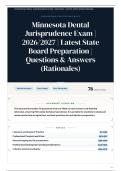
MINNESOTA DENTAL JURISPRUDENCE EXAM | 2026/2027 | LATEST STATE BOARD PREPARA…
P R O F E S S I O N A L P R A C T I C E M AT E R I A L S
Minnesota Dental
Jurisprudence Exam |
2026/2027 | Latest State
Board Preparation |
Questions & Answers
(Rationales)
Verified Answers Exam Ready With Rationales 76 QUESTIONS
DOCUMENT OVERVIEW
This document provides 76 questions with pre-filled correct answers and detailed
rationales, covering Minnesota dental jurisprudence. It is suitable for students to study and
review dental board regulations and best practices for certification preparation.
TOPICS
Licensure and Scope of Practice Q1–Q22
Professional Conduct and Ethics Q23–Q31
Record Keeping and Documentation Q32–Q39
Professional Development and Board Operations Q40–Q63
Infection Control and Safety Q64–Q76
Page 1
, E XA M Q U EST I O N S
Q1 QUESTION 1 OF 76
Which of the following cannot be applied by a licensed dental assistant?
A. Topical anesthetic
B. Topical fluoride
C. Intravenous drugs
D. Cavity varnish
RESPONSE
C. Intravenous drugs
RATIONALE
Minnesota statutes and administrative rules delineate the scope of practice for licensed dental
assistants. Administration of intravenous drugs, due to their inherent risks and the requirement for
advanced medical training and licensure, falls outside the authorized duties of a dental assistant.
Procedures like topical anesthetic, fluoride, and cavity varnish application are within their
established scope of practice.
Q2 QUESTION 2 OF 76
Any person desiring to perform services as a dentist, hygienist, or licensed dental assistant
must submit an application to the board of dentistrya. True b. False
RESPONSE
True
RATIONALE
Practicing dentistry, dental hygiene, or as a licensed dental assistant in Minnesota requires official
authorization. Submitting an application to the board of dentistry is the mandatory prerequisite for
obtaining licensure and legally performing these professional services. This process ensures public
safety and maintains professional standards.
Page 2
, Q3 QUESTION 3 OF 76
A dental technician who repairs a patient's denture at the request of the patient would be
practicing dentistry without a license.a. True b. False
RESPONSE
True
RATIONALE
Minnesota statutes define the practice of dentistry to include the repair of dentures, which requires
a license. A dental technician performing such repairs directly for a patient, without a dentist's
prescription or supervision, exceeds their scope of practice and constitutes unlicensed practice of
dentistry. This action violates professional and legal standards governing dental care delivery.
Q4 QUESTION 4 OF 76
Which of the following functions can be performed by a licensed dental assistant when the
dentist is out of the office?
A. Dry root canals with paper points
B. Pre-select orthodontic bands
C. Take radiographs
D. Remove temporary restorations
RESPONSE
C. Take radiographs
RATIONALE
Minnesota dental jurisprudence regulations delineate specific duties that licensed dental
assistants are permitted to perform independently. Among these, the ability to expose dental
radiographs is a function that does not require direct supervision by a dentist.
Q5 QUESTION 5 OF 76
Which of the following functions can be performed by a dental assistant if the dentist is in
the office?A. Take radiographsB. Take preliminary impressionsC. Mechanical polish to the
clinical crowns onlyD. None of the above
Page 3
, RESPONSE
None of the above
RATIONALE
Minnesota dental jurisprudence regulations delineate specific duties that dental assistants may
perform only under direct supervision. Tasks such as taking radiographs, preliminary impressions,
and performing mechanical polishing are considered expanded functions, requiring licensure or
specific certification beyond that of a basic dental assistant. Therefore, without such qualifications,
these actions are prohibited even when the dentist is present.
Q6 QUESTION 6 OF 76
Apply topical medications, including bleaching agents and cavity varnishes as prescribed
by dentist. (LDA ONLY)
RESPONSE
Indirect
RATIONALE
Dental assistants performing procedures not directly supervised by the dentist are engaging in
indirect patient care. Applying prescribed topical medications, such as bleaching agents or
varnishes, falls under this category. This delegation requires the dentist to have previously
diagnosed the condition and prescribed the treatment.
Q7 QUESTION 7 OF 76
Apply topical medications, including bleaching agents, cavity varnishes, and desensitizing
agents. (DH ONLY)
RESPONSE
General
RATIONALE
Dental hygienists are permitted to perform certain procedures under general supervision. This
includes the application of topical medications like bleaching agents, cavity varnishes, and
desensitizing agents, provided the dentist has established a treatment plan. General supervision
requires the dentist to authorize the procedure but not necessarily be present during its execution.
Page 4
P R O F E S S I O N A L P R A C T I C E M AT E R I A L S
Minnesota Dental
Jurisprudence Exam |
2026/2027 | Latest State
Board Preparation |
Questions & Answers
(Rationales)
Verified Answers Exam Ready With Rationales 76 QUESTIONS
DOCUMENT OVERVIEW
This document provides 76 questions with pre-filled correct answers and detailed
rationales, covering Minnesota dental jurisprudence. It is suitable for students to study and
review dental board regulations and best practices for certification preparation.
TOPICS
Licensure and Scope of Practice Q1–Q22
Professional Conduct and Ethics Q23–Q31
Record Keeping and Documentation Q32–Q39
Professional Development and Board Operations Q40–Q63
Infection Control and Safety Q64–Q76
Page 1
, E XA M Q U EST I O N S
Q1 QUESTION 1 OF 76
Which of the following cannot be applied by a licensed dental assistant?
A. Topical anesthetic
B. Topical fluoride
C. Intravenous drugs
D. Cavity varnish
RESPONSE
C. Intravenous drugs
RATIONALE
Minnesota statutes and administrative rules delineate the scope of practice for licensed dental
assistants. Administration of intravenous drugs, due to their inherent risks and the requirement for
advanced medical training and licensure, falls outside the authorized duties of a dental assistant.
Procedures like topical anesthetic, fluoride, and cavity varnish application are within their
established scope of practice.
Q2 QUESTION 2 OF 76
Any person desiring to perform services as a dentist, hygienist, or licensed dental assistant
must submit an application to the board of dentistrya. True b. False
RESPONSE
True
RATIONALE
Practicing dentistry, dental hygiene, or as a licensed dental assistant in Minnesota requires official
authorization. Submitting an application to the board of dentistry is the mandatory prerequisite for
obtaining licensure and legally performing these professional services. This process ensures public
safety and maintains professional standards.
Page 2
, Q3 QUESTION 3 OF 76
A dental technician who repairs a patient's denture at the request of the patient would be
practicing dentistry without a license.a. True b. False
RESPONSE
True
RATIONALE
Minnesota statutes define the practice of dentistry to include the repair of dentures, which requires
a license. A dental technician performing such repairs directly for a patient, without a dentist's
prescription or supervision, exceeds their scope of practice and constitutes unlicensed practice of
dentistry. This action violates professional and legal standards governing dental care delivery.
Q4 QUESTION 4 OF 76
Which of the following functions can be performed by a licensed dental assistant when the
dentist is out of the office?
A. Dry root canals with paper points
B. Pre-select orthodontic bands
C. Take radiographs
D. Remove temporary restorations
RESPONSE
C. Take radiographs
RATIONALE
Minnesota dental jurisprudence regulations delineate specific duties that licensed dental
assistants are permitted to perform independently. Among these, the ability to expose dental
radiographs is a function that does not require direct supervision by a dentist.
Q5 QUESTION 5 OF 76
Which of the following functions can be performed by a dental assistant if the dentist is in
the office?A. Take radiographsB. Take preliminary impressionsC. Mechanical polish to the
clinical crowns onlyD. None of the above
Page 3
, RESPONSE
None of the above
RATIONALE
Minnesota dental jurisprudence regulations delineate specific duties that dental assistants may
perform only under direct supervision. Tasks such as taking radiographs, preliminary impressions,
and performing mechanical polishing are considered expanded functions, requiring licensure or
specific certification beyond that of a basic dental assistant. Therefore, without such qualifications,
these actions are prohibited even when the dentist is present.
Q6 QUESTION 6 OF 76
Apply topical medications, including bleaching agents and cavity varnishes as prescribed
by dentist. (LDA ONLY)
RESPONSE
Indirect
RATIONALE
Dental assistants performing procedures not directly supervised by the dentist are engaging in
indirect patient care. Applying prescribed topical medications, such as bleaching agents or
varnishes, falls under this category. This delegation requires the dentist to have previously
diagnosed the condition and prescribed the treatment.
Q7 QUESTION 7 OF 76
Apply topical medications, including bleaching agents, cavity varnishes, and desensitizing
agents. (DH ONLY)
RESPONSE
General
RATIONALE
Dental hygienists are permitted to perform certain procedures under general supervision. This
includes the application of topical medications like bleaching agents, cavity varnishes, and
desensitizing agents, provided the dentist has established a treatment plan. General supervision
requires the dentist to authorize the procedure but not necessarily be present during its execution.
Page 4


