

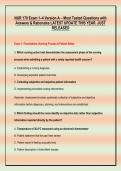
NUR 170 Exam 1–4 Version A – Most Tested Questions with
Answers & Rationales LATEST UPDATE THIS YEAR. JUST
RELEASED
Exam 1: Foundations, Nursing Process & Patient Safety
1. Which nursing action best demonstrates the assessment phase of the nursing
process when admitting a patient with a newly reported health concern?
A. Establishing a nursing diagnosis
B. Developing expected patient outcomes
C. Collecting subjective and objective patient information
D. Implementing prescribed nursing interventions
Rationale: Assessment involves systematic collection of subjective and objective
information before diagnoses, planning, and interventions are established.
2. Which finding should the nurse identify as objective data rather than subjective
information reported directly by the patient?
A. Temperature of 38.4°C measured using an electronic thermometer
B. Patient statement that the pain feels severe
C. Patient report of feeling unusually tired
D. Patient description of intermittent nausea
,Rationale: Objective data are observable or measurable findings obtained through
examination, measurement, or observation.
3. When developing a nursing diagnosis, which information should the nurse
primarily use to identify the patient's current response to a health problem?
A. The patient's medical diagnosis alone
B. The anticipated treatment plan
C. The physician's preferred intervention
D. Assessment findings and patient responses to the health condition
Rationale: Nursing diagnoses describe human responses and are supported by assessment
findings rather than simply naming a medical disease.
4. Which patient-centered goal is written most appropriately for a patient
experiencing difficulty maintaining adequate hydration?
A. Patient will understand hydration.
B. Patient will consume adequate fluids according to the individualized plan within 24
hours.
C. Nurse will encourage fluids every shift.
D. Patient will receive intravenous fluids as ordered.
Rationale: A useful goal identifies a measurable patient outcome and an appropriate
timeframe.
,5. Which nursing action most directly reflects the implementation phase of the
nursing process?
A. Reviewing laboratory results
B. Identifying impaired mobility
C. Establishing a measurable outcome
D. Assisting the patient with prescribed mobility exercises
Rationale: Implementation involves carrying out appropriate nursing interventions designed
to achieve established outcomes.
6. After implementing interventions, which question should the nurse ask during the
evaluation phase of the nursing process?
A. What medical diagnosis caused the condition?
B. Which nursing diagnosis should be documented?
C. Did the patient's condition or response improve toward the established outcome?
D. Which healthcare provider should assume responsibility?
Rationale: Evaluation determines whether interventions produced the desired patient
outcomes.
7. Which action by a beginning nurse demonstrates appropriate use of clinical
judgment when several patient findings are present simultaneously?
, A. Addressing whichever task appears easiest first
B. Waiting until the end of the shift to evaluate all findings
C. Completing interventions according to personal preference
D. Prioritizing findings according to patient safety, urgency, and potential harm
Rationale: Clinical judgment requires recognizing significant findings and prioritizing care
according to urgency and safety.
8. Which intervention should generally receive the highest priority when caring for
multiple hospitalized patients?
A. Completing routine paperwork
B. Addressing an immediate airway or breathing concern
C. Reorganizing a patient's bedside supplies
D. Providing routine dietary education
Rationale: Airway and breathing concerns can rapidly become life-threatening and therefore
take priority.
9. Which nursing practice is most effective for reducing transmission of
microorganisms between patients in healthcare settings?
A. Wearing gloves for every patient interaction
B. Using antibiotics prophylactically
Answers & Rationales LATEST UPDATE THIS YEAR. JUST
RELEASED
Exam 1: Foundations, Nursing Process & Patient Safety
1. Which nursing action best demonstrates the assessment phase of the nursing
process when admitting a patient with a newly reported health concern?
A. Establishing a nursing diagnosis
B. Developing expected patient outcomes
C. Collecting subjective and objective patient information
D. Implementing prescribed nursing interventions
Rationale: Assessment involves systematic collection of subjective and objective
information before diagnoses, planning, and interventions are established.
2. Which finding should the nurse identify as objective data rather than subjective
information reported directly by the patient?
A. Temperature of 38.4°C measured using an electronic thermometer
B. Patient statement that the pain feels severe
C. Patient report of feeling unusually tired
D. Patient description of intermittent nausea
,Rationale: Objective data are observable or measurable findings obtained through
examination, measurement, or observation.
3. When developing a nursing diagnosis, which information should the nurse
primarily use to identify the patient's current response to a health problem?
A. The patient's medical diagnosis alone
B. The anticipated treatment plan
C. The physician's preferred intervention
D. Assessment findings and patient responses to the health condition
Rationale: Nursing diagnoses describe human responses and are supported by assessment
findings rather than simply naming a medical disease.
4. Which patient-centered goal is written most appropriately for a patient
experiencing difficulty maintaining adequate hydration?
A. Patient will understand hydration.
B. Patient will consume adequate fluids according to the individualized plan within 24
hours.
C. Nurse will encourage fluids every shift.
D. Patient will receive intravenous fluids as ordered.
Rationale: A useful goal identifies a measurable patient outcome and an appropriate
timeframe.
,5. Which nursing action most directly reflects the implementation phase of the
nursing process?
A. Reviewing laboratory results
B. Identifying impaired mobility
C. Establishing a measurable outcome
D. Assisting the patient with prescribed mobility exercises
Rationale: Implementation involves carrying out appropriate nursing interventions designed
to achieve established outcomes.
6. After implementing interventions, which question should the nurse ask during the
evaluation phase of the nursing process?
A. What medical diagnosis caused the condition?
B. Which nursing diagnosis should be documented?
C. Did the patient's condition or response improve toward the established outcome?
D. Which healthcare provider should assume responsibility?
Rationale: Evaluation determines whether interventions produced the desired patient
outcomes.
7. Which action by a beginning nurse demonstrates appropriate use of clinical
judgment when several patient findings are present simultaneously?
, A. Addressing whichever task appears easiest first
B. Waiting until the end of the shift to evaluate all findings
C. Completing interventions according to personal preference
D. Prioritizing findings according to patient safety, urgency, and potential harm
Rationale: Clinical judgment requires recognizing significant findings and prioritizing care
according to urgency and safety.
8. Which intervention should generally receive the highest priority when caring for
multiple hospitalized patients?
A. Completing routine paperwork
B. Addressing an immediate airway or breathing concern
C. Reorganizing a patient's bedside supplies
D. Providing routine dietary education
Rationale: Airway and breathing concerns can rapidly become life-threatening and therefore
take priority.
9. Which nursing practice is most effective for reducing transmission of
microorganisms between patients in healthcare settings?
A. Wearing gloves for every patient interaction
B. Using antibiotics prophylactically


