
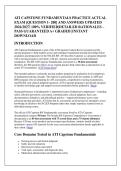
ATI CAPSTONE FUNDAMENTALS PRACTICE ACTUAL
EXAM [QUESTION 1- 200] AND ANSWERS UPDATED
2026/2027| 100% VERIFIED|DETAILED RATIONALES –
PASS GUARANTEED A+ GRADED |INSTANT
DOWNLOAD
INTRODUCTION
ATI Capstone Fundamentals is part of the ATI Capstone Content Review program used by
nursing programs to help students assess and remediate foundational nursing knowledge before
graduation and preparation for the NCLEX-RN. ATI describes Capstone as a program integrated
with a nursing program's curriculum, with pre- and post-assessments and individualized
remediation. The RN ATI Capstone Fundamentals assessment is a 50-item assessment;
therefore, the 200 questions below are an original practice bank rather than a reproduction of an
actual ATI examination. (ATI Testing Store)
The intended audience is primarily nursing students preparing for graduation-level competency
in fundamental nursing concepts. The material is particularly useful for students in ADN and
BSN programs who are preparing for ATI assessments, comprehensive nursing examinations,
and NCLEX-style clinical-judgment questions. ATI's Capstone program is specifically designed
to identify knowledge gaps and support focused remediation before graduation. (Main)
Strong performance in fundamentals is important because foundational competencies—including
safety, infection prevention, assessment, communication, clinical judgment, basic care,
documentation, delegation, and ethical/legal practice—support performance across more
advanced nursing specialties. ATI notes that its assessments are broad and are intended to assess
knowledge in relation to the NCLEX blueprint rather than simply reproduce material from an
individual nursing course.
The official ATI Capstone RN Fundamentals assessment listed by ATI's Capstone
documentation contains 50 items. The broader RN Capstone Comprehensive Assessment is
documented as an 85-item assessment with 75 scored items and a 75-minute allotment.
Because ATI may revise products and assessment specifications, students should use their
institution's current ATI materials for the exact assessment administration details applicable to
their cohort. (Main)
Core Domains Tested in ATI Capstone Fundamentals
Nursing process and clinical judgment
Safety and risk reduction
Infection prevention and control
Vital signs, assessment, and diagnostic data
Medication administration and medication safety
, Mobility, positioning, and activity
Nutrition, hydration, and elimination
Skin integrity, wounds, and pressure-injury prevention
Therapeutic communication, psychosocial care, and patient education
Legal, ethical, professional practice, delegation, and documentation
CONTENT AREA TABLE
% of
Approx. # of
Content Domain Practice Key Topics Covered
Questions
Bank
Assessment, prioritization,
Nursing Process & Clinical
15% 30 planning, implementation,
Judgment
evaluation
Falls, restraints, emergencies,
Safety & Risk Reduction 12% 24
environmental safety
Standard precautions,
Infection Prevention &
12% 24 transmission-based precautions,
Control
asepsis
Assessment & Diagnostic Vital signs, physical assessment,
10% 20
Data laboratory findings
Administration, adverse effects,
Medication Safety 10% 20
medication reconciliation
Transfers, positioning, assistive
Mobility & Activity 8% 16
devices, immobility
Nutrition, Hydration & Enteral nutrition, fluids, bowel and
10% 20
Elimination urinary care
Skin Integrity & Wound Pressure injuries, wound healing,
8% 16
Care dressings
Communication,
Therapeutic communication, grief,
Psychosocial Care & 8% 16
education, health literacy
Teaching
Professional, Legal & Delegation, informed consent,
7% 14
Ethical Practice documentation, confidentiality
Comprehensive fundamentals
Total 100% 200
practice
QUESTIONS 1-200
Q1: A nurse receives handoff for four clients. Which client should the nurse assess first?
A) A client requesting assistance with bathing
B) A client who developed sudden confusion and an oxygen saturation of 86%
,C) A client reporting chronic knee pain rated 6/10
D) A client awaiting discharge instructions
Correct Answer: B
Rationale: Sudden confusion accompanied by significant hypoxemia indicates an acute
alteration in oxygenation and neurologic status and requires immediate assessment. Bathing
assistance and discharge teaching can safely wait. Chronic pain without acute deterioration is
lower priority. The nurse should use airway, breathing, circulation, and acute-versus-chronic
changes to establish priorities.
Q2: A nurse is caring for a client who is at high risk for falls. Which intervention is most
appropriate?
A) Keep all four side rails raised
B) Place the call light within reach and provide nonskid footwear
C) Keep the client's room dark at night
D) Ask the client to remain in bed at all times
Correct Answer: B
Rationale: Keeping the call light accessible and using nonskid footwear directly reduces fall risk
while preserving mobility. Four side rails can constitute a restraint and do not reliably prevent
falls. Darkness increases risk, and unnecessary bed confinement contributes to deconditioning
and does not eliminate fall risk.
Q3: A client receiving oxygen by nasal cannula has an oxygen saturation that decreases
from 96% to 88%. What should the nurse do first?
A) Document the finding
B) Assess the client's respiratory status
C) Notify the provider immediately
D) Remove the oxygen device
Correct Answer: B
Rationale: The nurse should first assess the client to determine whether the saturation reflects
respiratory deterioration, poor probe placement, or another problem. Assessment precedes
notification when the client is not in immediate collapse. Removing oxygen would worsen
hypoxemia, and documentation occurs after assessment and intervention.
Q4: A nurse is preparing to administer an oral medication. Which action best demonstrates
medication safety?
A) Asking the client whether the medication looks familiar
B) Preparing medications for several clients simultaneously
C) Comparing the medication label with the medication administration record during
required verification points
D) Documenting administration before giving the medication
Correct Answer: C
Rationale: Medication labels should be compared with the medication administration record
according to institutional medication-safety procedures. Client recognition is not a substitute for
verification. Preparing multiple clients' medications together increases error risk, and
documentation should occur after administration.
, Q5: A client with dysphagia is prescribed oral medication. Which intervention is most
appropriate?
A) Place the client supine before administration
B) Give all tablets simultaneously
C) Verify the client's swallowing ability and prescribed medication formulation before
administration
D) Crush every medication and mix it with food
Correct Answer: C
Rationale: Dysphagia increases aspiration risk, and some medications cannot safely be crushed.
The nurse should assess swallowing ability and determine whether each medication is
appropriate for crushing or requires an alternative formulation. Supine positioning increases
aspiration risk.
Q6: A nurse enters the room of a client who has a seizure. What is the priority action?
A) Insert an oral airway
B) Restrain the client's extremities
C) Protect the client from injury and maintain a patent airway
D) Give oral fluids
Correct Answer: C
Rationale: During a seizure, the priority is protection from injury and maintenance of airway
and breathing. Nothing should be inserted into the client's mouth, and restraints can cause
injury. Oral intake is unsafe during an active seizure.
Q7: A nurse discovers that a client has fallen. What should the nurse do first?
A) Complete an incident report
B) Return the client to bed immediately
C) Assess the client for injury and level of consciousness
D) Notify the family
Correct Answer: C
Rationale: The immediate priority after a fall is assessment for injury, including neurologic and
musculoskeletal status. The client should not automatically be moved until injury has been
assessed. Documentation, incident reporting, and family notification follow appropriate
assessment and stabilization.
Q8: A client tells the nurse, "I don't understand why I need this procedure." What is the
nurse's best response?
A) "The provider already explained it."
B) "Tell me what you understand about the procedure."
C) "You should sign the form so treatment isn't delayed."
D) "Your family can explain it to you."
Correct Answer: B
Rationale: Asking the client to describe their understanding assesses comprehension and
identifies knowledge gaps. The nurse can reinforce information but should not pressure the client
to sign consent or substitute family explanations. The provider is responsible for explaining the
procedure, risks, benefits, and alternatives.
EXAM [QUESTION 1- 200] AND ANSWERS UPDATED
2026/2027| 100% VERIFIED|DETAILED RATIONALES –
PASS GUARANTEED A+ GRADED |INSTANT
DOWNLOAD
INTRODUCTION
ATI Capstone Fundamentals is part of the ATI Capstone Content Review program used by
nursing programs to help students assess and remediate foundational nursing knowledge before
graduation and preparation for the NCLEX-RN. ATI describes Capstone as a program integrated
with a nursing program's curriculum, with pre- and post-assessments and individualized
remediation. The RN ATI Capstone Fundamentals assessment is a 50-item assessment;
therefore, the 200 questions below are an original practice bank rather than a reproduction of an
actual ATI examination. (ATI Testing Store)
The intended audience is primarily nursing students preparing for graduation-level competency
in fundamental nursing concepts. The material is particularly useful for students in ADN and
BSN programs who are preparing for ATI assessments, comprehensive nursing examinations,
and NCLEX-style clinical-judgment questions. ATI's Capstone program is specifically designed
to identify knowledge gaps and support focused remediation before graduation. (Main)
Strong performance in fundamentals is important because foundational competencies—including
safety, infection prevention, assessment, communication, clinical judgment, basic care,
documentation, delegation, and ethical/legal practice—support performance across more
advanced nursing specialties. ATI notes that its assessments are broad and are intended to assess
knowledge in relation to the NCLEX blueprint rather than simply reproduce material from an
individual nursing course.
The official ATI Capstone RN Fundamentals assessment listed by ATI's Capstone
documentation contains 50 items. The broader RN Capstone Comprehensive Assessment is
documented as an 85-item assessment with 75 scored items and a 75-minute allotment.
Because ATI may revise products and assessment specifications, students should use their
institution's current ATI materials for the exact assessment administration details applicable to
their cohort. (Main)
Core Domains Tested in ATI Capstone Fundamentals
Nursing process and clinical judgment
Safety and risk reduction
Infection prevention and control
Vital signs, assessment, and diagnostic data
Medication administration and medication safety
, Mobility, positioning, and activity
Nutrition, hydration, and elimination
Skin integrity, wounds, and pressure-injury prevention
Therapeutic communication, psychosocial care, and patient education
Legal, ethical, professional practice, delegation, and documentation
CONTENT AREA TABLE
% of
Approx. # of
Content Domain Practice Key Topics Covered
Questions
Bank
Assessment, prioritization,
Nursing Process & Clinical
15% 30 planning, implementation,
Judgment
evaluation
Falls, restraints, emergencies,
Safety & Risk Reduction 12% 24
environmental safety
Standard precautions,
Infection Prevention &
12% 24 transmission-based precautions,
Control
asepsis
Assessment & Diagnostic Vital signs, physical assessment,
10% 20
Data laboratory findings
Administration, adverse effects,
Medication Safety 10% 20
medication reconciliation
Transfers, positioning, assistive
Mobility & Activity 8% 16
devices, immobility
Nutrition, Hydration & Enteral nutrition, fluids, bowel and
10% 20
Elimination urinary care
Skin Integrity & Wound Pressure injuries, wound healing,
8% 16
Care dressings
Communication,
Therapeutic communication, grief,
Psychosocial Care & 8% 16
education, health literacy
Teaching
Professional, Legal & Delegation, informed consent,
7% 14
Ethical Practice documentation, confidentiality
Comprehensive fundamentals
Total 100% 200
practice
QUESTIONS 1-200
Q1: A nurse receives handoff for four clients. Which client should the nurse assess first?
A) A client requesting assistance with bathing
B) A client who developed sudden confusion and an oxygen saturation of 86%
,C) A client reporting chronic knee pain rated 6/10
D) A client awaiting discharge instructions
Correct Answer: B
Rationale: Sudden confusion accompanied by significant hypoxemia indicates an acute
alteration in oxygenation and neurologic status and requires immediate assessment. Bathing
assistance and discharge teaching can safely wait. Chronic pain without acute deterioration is
lower priority. The nurse should use airway, breathing, circulation, and acute-versus-chronic
changes to establish priorities.
Q2: A nurse is caring for a client who is at high risk for falls. Which intervention is most
appropriate?
A) Keep all four side rails raised
B) Place the call light within reach and provide nonskid footwear
C) Keep the client's room dark at night
D) Ask the client to remain in bed at all times
Correct Answer: B
Rationale: Keeping the call light accessible and using nonskid footwear directly reduces fall risk
while preserving mobility. Four side rails can constitute a restraint and do not reliably prevent
falls. Darkness increases risk, and unnecessary bed confinement contributes to deconditioning
and does not eliminate fall risk.
Q3: A client receiving oxygen by nasal cannula has an oxygen saturation that decreases
from 96% to 88%. What should the nurse do first?
A) Document the finding
B) Assess the client's respiratory status
C) Notify the provider immediately
D) Remove the oxygen device
Correct Answer: B
Rationale: The nurse should first assess the client to determine whether the saturation reflects
respiratory deterioration, poor probe placement, or another problem. Assessment precedes
notification when the client is not in immediate collapse. Removing oxygen would worsen
hypoxemia, and documentation occurs after assessment and intervention.
Q4: A nurse is preparing to administer an oral medication. Which action best demonstrates
medication safety?
A) Asking the client whether the medication looks familiar
B) Preparing medications for several clients simultaneously
C) Comparing the medication label with the medication administration record during
required verification points
D) Documenting administration before giving the medication
Correct Answer: C
Rationale: Medication labels should be compared with the medication administration record
according to institutional medication-safety procedures. Client recognition is not a substitute for
verification. Preparing multiple clients' medications together increases error risk, and
documentation should occur after administration.
, Q5: A client with dysphagia is prescribed oral medication. Which intervention is most
appropriate?
A) Place the client supine before administration
B) Give all tablets simultaneously
C) Verify the client's swallowing ability and prescribed medication formulation before
administration
D) Crush every medication and mix it with food
Correct Answer: C
Rationale: Dysphagia increases aspiration risk, and some medications cannot safely be crushed.
The nurse should assess swallowing ability and determine whether each medication is
appropriate for crushing or requires an alternative formulation. Supine positioning increases
aspiration risk.
Q6: A nurse enters the room of a client who has a seizure. What is the priority action?
A) Insert an oral airway
B) Restrain the client's extremities
C) Protect the client from injury and maintain a patent airway
D) Give oral fluids
Correct Answer: C
Rationale: During a seizure, the priority is protection from injury and maintenance of airway
and breathing. Nothing should be inserted into the client's mouth, and restraints can cause
injury. Oral intake is unsafe during an active seizure.
Q7: A nurse discovers that a client has fallen. What should the nurse do first?
A) Complete an incident report
B) Return the client to bed immediately
C) Assess the client for injury and level of consciousness
D) Notify the family
Correct Answer: C
Rationale: The immediate priority after a fall is assessment for injury, including neurologic and
musculoskeletal status. The client should not automatically be moved until injury has been
assessed. Documentation, incident reporting, and family notification follow appropriate
assessment and stabilization.
Q8: A client tells the nurse, "I don't understand why I need this procedure." What is the
nurse's best response?
A) "The provider already explained it."
B) "Tell me what you understand about the procedure."
C) "You should sign the form so treatment isn't delayed."
D) "Your family can explain it to you."
Correct Answer: B
Rationale: Asking the client to describe their understanding assesses comprehension and
identifies knowledge gaps. The nurse can reinforce information but should not pressure the client
to sign consent or substitute family explanations. The provider is responsible for explaining the
procedure, risks, benefits, and alternatives.


