

1|Page
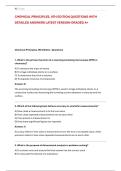
CHEMICAL PRINCIPLES, 9TH EDITION QUESTIONS WITH
DETAILED ANSWERS LATEST VERSION GRADED A+
Chemical Principles, 9th Edition –Questions
1. What is the primary function of a scanning tunneling microscope (STM) in
chemistry?
A) To measure the mass of atoms
B) To image individual atoms on a surface
C) To determine the pH of a solution
D) To separate mixtures of compounds
Answer: B
The scanning tunneling microscope (STM) is used to image individual atoms on a
conductive surface by measuring the tunneling current between a sharp tip and the
surface .
2. Which of the following best defines accuracy in scientific measurements?
A) How close a measurement is to the true value
B) How close repeated measurements are to each other
C) How precise a measurement is
D) How many significant figures are reported
Answer: A
Accuracy refers to how close a measurement is to the true or accepted value, while
precision refers to how close repeated measurements are to each other .
3. What is the purpose of dimensional analysis in problem-solving?
A) To convert units and ensure the final answer has the correct units
B) To calculate the density of a substance
,2|Page
C) To determine the states of matter
D) To identify homogeneous and heterogeneous mixtures
Answer: A
Dimensional analysis (the factor-label method) is used to convert between units and
ensure that the final answer has the correct units by tracking units through calculations .
4. Which of the following is the correct formula for calculating density?
A) Density = mass × volume
B) Density = volume / mass
C) Density = mass / volume
D) Density = mass + volume
Answer: C
Density is defined as mass per unit volume: Density = mass / volume .
5. What are the three main states of matter?
A) Solid, liquid, and gas
B) Element, compound, and mixture
C) Metal, nonmetal, and metalloid
D) Acid, base, and salt
Answer: A
The three main states of matter are solid, liquid, and gas .
6. What is the difference between a homogeneous and a heterogeneous mixture?
A) A homogeneous mixture has uniform composition; a heterogeneous mixture does
not
B) A heterogeneous mixture has uniform composition; a homogeneous mixture does
not
C) Both have uniform composition
D) Neither has uniform composition
Answer: A
A homogeneous mixture (solution) has uniform composition throughout, while a
heterogeneous mixture has visibly different phases or regions .
,3|Page
7. According to the Law of Conservation of Mass, what happens to mass during a
chemical reaction?
A) Mass is created
B) Mass is destroyed
C) Mass is conserved (neither created nor destroyed)
D) Mass is converted to energy
Answer: C
The Law of Conservation of Mass states that mass is neither created nor destroyed in a
chemical reaction .
8. What is the SI unit of temperature?
A) Celsius (°C)
B) Fahrenheit (°F)
C) Kelvin (K)
D) Joule (J)
Answer: C
The SI unit of temperature is the Kelvin (K). Celsius and Fahrenheit are non-SI units .
9. What is the difference between a compound and a mixture?
A) A compound has a fixed composition; a mixture can vary in composition
B) A mixture has a fixed composition; a compound can vary in composition
C) Both have fixed compositions
D) Neither has a fixed composition
Answer: A
A compound has a definite, fixed composition of elements combined chemically. A
mixture has variable composition and components can be separated physically .
10. Which of the following is an example of a chemical change?
A) Melting ice
B) Dissolving sugar in water
C) Rusting of iron
D) Evaporating alcohol
, 4|Page
Answer: C
Rusting of iron is a chemical change because it produces a new substance (iron oxide).
The other options are physical changes .
11. What is the correct scientific notation for 0.00045?
A) 4.5 × 10⁻³
B) 4.5 × 10⁻⁴
C) 4.5 × 10⁴
D) 4.5 × 10³
Answer: B
0.00045 = 4.5 × 10⁻⁴ (move the decimal point 4 places to the right) .
12. How many significant figures are in the measurement 0.00340 m?
A) 2
B) 3
C) 4
D) 5
Answer: B
0.00340 has 3 significant figures: 3, 4, and 0. Leading zeros are not significant .
13. What is the primary difference between a hypothesis and a theory?
A) A hypothesis is well-tested; a theory is a tentative explanation
B) A theory is well-tested; a hypothesis is a tentative explanation
C) Both are equally well-tested
D) Neither is testable
Answer: B
A hypothesis is a tentative explanation that can be tested. A theory is a well-tested,
widely accepted explanation supported by extensive evidence .
14. What is the process of understanding nature and its changes according to the
scientific method?
CHEMICAL PRINCIPLES, 9TH EDITION QUESTIONS WITH
DETAILED ANSWERS LATEST VERSION GRADED A+
Chemical Principles, 9th Edition –Questions
1. What is the primary function of a scanning tunneling microscope (STM) in
chemistry?
A) To measure the mass of atoms
B) To image individual atoms on a surface
C) To determine the pH of a solution
D) To separate mixtures of compounds
Answer: B
The scanning tunneling microscope (STM) is used to image individual atoms on a
conductive surface by measuring the tunneling current between a sharp tip and the
surface .
2. Which of the following best defines accuracy in scientific measurements?
A) How close a measurement is to the true value
B) How close repeated measurements are to each other
C) How precise a measurement is
D) How many significant figures are reported
Answer: A
Accuracy refers to how close a measurement is to the true or accepted value, while
precision refers to how close repeated measurements are to each other .
3. What is the purpose of dimensional analysis in problem-solving?
A) To convert units and ensure the final answer has the correct units
B) To calculate the density of a substance
,2|Page
C) To determine the states of matter
D) To identify homogeneous and heterogeneous mixtures
Answer: A
Dimensional analysis (the factor-label method) is used to convert between units and
ensure that the final answer has the correct units by tracking units through calculations .
4. Which of the following is the correct formula for calculating density?
A) Density = mass × volume
B) Density = volume / mass
C) Density = mass / volume
D) Density = mass + volume
Answer: C
Density is defined as mass per unit volume: Density = mass / volume .
5. What are the three main states of matter?
A) Solid, liquid, and gas
B) Element, compound, and mixture
C) Metal, nonmetal, and metalloid
D) Acid, base, and salt
Answer: A
The three main states of matter are solid, liquid, and gas .
6. What is the difference between a homogeneous and a heterogeneous mixture?
A) A homogeneous mixture has uniform composition; a heterogeneous mixture does
not
B) A heterogeneous mixture has uniform composition; a homogeneous mixture does
not
C) Both have uniform composition
D) Neither has uniform composition
Answer: A
A homogeneous mixture (solution) has uniform composition throughout, while a
heterogeneous mixture has visibly different phases or regions .
,3|Page
7. According to the Law of Conservation of Mass, what happens to mass during a
chemical reaction?
A) Mass is created
B) Mass is destroyed
C) Mass is conserved (neither created nor destroyed)
D) Mass is converted to energy
Answer: C
The Law of Conservation of Mass states that mass is neither created nor destroyed in a
chemical reaction .
8. What is the SI unit of temperature?
A) Celsius (°C)
B) Fahrenheit (°F)
C) Kelvin (K)
D) Joule (J)
Answer: C
The SI unit of temperature is the Kelvin (K). Celsius and Fahrenheit are non-SI units .
9. What is the difference between a compound and a mixture?
A) A compound has a fixed composition; a mixture can vary in composition
B) A mixture has a fixed composition; a compound can vary in composition
C) Both have fixed compositions
D) Neither has a fixed composition
Answer: A
A compound has a definite, fixed composition of elements combined chemically. A
mixture has variable composition and components can be separated physically .
10. Which of the following is an example of a chemical change?
A) Melting ice
B) Dissolving sugar in water
C) Rusting of iron
D) Evaporating alcohol
, 4|Page
Answer: C
Rusting of iron is a chemical change because it produces a new substance (iron oxide).
The other options are physical changes .
11. What is the correct scientific notation for 0.00045?
A) 4.5 × 10⁻³
B) 4.5 × 10⁻⁴
C) 4.5 × 10⁴
D) 4.5 × 10³
Answer: B
0.00045 = 4.5 × 10⁻⁴ (move the decimal point 4 places to the right) .
12. How many significant figures are in the measurement 0.00340 m?
A) 2
B) 3
C) 4
D) 5
Answer: B
0.00340 has 3 significant figures: 3, 4, and 0. Leading zeros are not significant .
13. What is the primary difference between a hypothesis and a theory?
A) A hypothesis is well-tested; a theory is a tentative explanation
B) A theory is well-tested; a hypothesis is a tentative explanation
C) Both are equally well-tested
D) Neither is testable
Answer: B
A hypothesis is a tentative explanation that can be tested. A theory is a well-tested,
widely accepted explanation supported by extensive evidence .
14. What is the process of understanding nature and its changes according to the
scientific method?


