
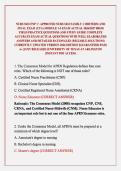
NURS 5432 FNP 1 \ APPROVED NURS 5432 FAMILY 1 MIDTERM AND
FINAL EXAM (UTA) MODULE 1-5 EXAM ACTUAL 2026/2027 HIGH
YIELD PRACTICE QUESTIONS AND STUDY GUIDE COMPLETE
ACCURATE EXAM ACTUAL QUESTIONS WITH WELL ELABORATED
ANSWERS AND DETAILED RATIONALES (RELIABLE SOLUTIONS)
CURRENTLY UPDATED VERSION 2026 EDITION |GUARANTEED PASS
A+ |JUST RELEASED |UNIVERSITY OF TEXAS AT ARLINGTON
|INSTANT PDF ACCESS
1. The Consensus Model for APRN Regulation defines four core
roles. Which of the following is NOT one of those roles?
A. Certified Nurse Practitioner (CNP)
B. Clinical Nurse Specialist (CNS)
C. Certified Registered Nurse Anesthetist (CRNA)
D. Nurse Educator (CORRECT ANSWER)
Rationale: The Consensus Model (2008) recognizes CNP, CNS,
CRNA, and Certified Nurse-Midwife (CNM). Nurse Educator is
an important role but is not one of the four APRN licensure roles.
2. Under the Consensus Model, all APRNs must be prepared at a
minimum of which degree level?
A. Associate's degree in nursing
B. Bachelor's degree in nursing
C. Master's degree (CORRECT ANSWER)
,D. Doctorate
Rationale: The model requires graduate-level preparation
(master's or post-master's certificate) for entry into APRN
practice.
3. Which of the following is a requirement for APRN licensure,
certification, and education under the Consensus Model?
A. Independent practice in all 50 states
B. A single national certification exam for each population focus
(CORRECT ANSWER)
C. Completion of 2,000 clinical hours during graduate training
D. Prescriptive authority limited to Schedule II drugs
Rationale: The model calls for one national certifying exam per
population focus. Clinical hours vary by program; no set national
hour requirement exists.
4. An FNP is seeing a 70-year-old patient with complex
comorbidities. The FNP recognizes that their scope of practice is
defined primarily by:
A. Hospital bylaws only
B. State Nurse Practice Act and board of nursing rules (CORRECT
ANSWER)
C. The Consensus Model only
D. The American Nurses Association Code of Ethics
,Rationale: Scope of practice is legally defined by the state's Nurse
Practice Act and regulations. The Consensus Model provides a
framework but is not legally binding.
5. A newly graduated FNP moves from Texas (restricted practice) to
a full-practice authority state. Which statement is true?
A. They must complete a second residency.
B. They can practice independently without a collaborative
agreement. (CORRECT ANSWER)
C. They lose their certification.
D. They cannot prescribe medications.
Rationale: In full-practice authority states, FNPs can practice
independently after licensure. Texas is a restricted practice state
requiring a collaborative agreement.
6. A family nurse practitioner is caring for a family whose eldest
child is leaving for college. According to family development theory,
which stage is this family likely experiencing?
A. Launching children and moving on (CORRECT ANSWER)
B. Families with adolescents
C. Post-parental family stage
D. Aging family stage
, Rationale: Duvall's family development theory identifies
"launching children and moving on" as the stage where the first
child leaves home through the last child's departure.
7. An FNP is evaluating which theoretical framework to apply when
caring for a family with a chronically ill member. Which statement
best describes the difference between "family as context" and "family
as system" approaches?
A. Family as context focuses on individual health outcomes only
B. Family as system examines reciprocal relationships and family as
the unit of care (CORRECT ANSWER)
C. Family as context ignores family dynamics completely
D. Family as system excludes the individual patient from assessment
Rationale: The "family as system" approach conceptualizes the
family as an interconnected unit where changes in one member
affect all others. This contrasts with "family as context," where
the family environment influences individual health but the
individual remains the primary unit of care.
8. According to Friedman's Family Assessment Model, which
component addresses the family's ability to obtain and manage
resources?
A. Family structure and functions
B. Family developmental tasks
FINAL EXAM (UTA) MODULE 1-5 EXAM ACTUAL 2026/2027 HIGH
YIELD PRACTICE QUESTIONS AND STUDY GUIDE COMPLETE
ACCURATE EXAM ACTUAL QUESTIONS WITH WELL ELABORATED
ANSWERS AND DETAILED RATIONALES (RELIABLE SOLUTIONS)
CURRENTLY UPDATED VERSION 2026 EDITION |GUARANTEED PASS
A+ |JUST RELEASED |UNIVERSITY OF TEXAS AT ARLINGTON
|INSTANT PDF ACCESS
1. The Consensus Model for APRN Regulation defines four core
roles. Which of the following is NOT one of those roles?
A. Certified Nurse Practitioner (CNP)
B. Clinical Nurse Specialist (CNS)
C. Certified Registered Nurse Anesthetist (CRNA)
D. Nurse Educator (CORRECT ANSWER)
Rationale: The Consensus Model (2008) recognizes CNP, CNS,
CRNA, and Certified Nurse-Midwife (CNM). Nurse Educator is
an important role but is not one of the four APRN licensure roles.
2. Under the Consensus Model, all APRNs must be prepared at a
minimum of which degree level?
A. Associate's degree in nursing
B. Bachelor's degree in nursing
C. Master's degree (CORRECT ANSWER)
,D. Doctorate
Rationale: The model requires graduate-level preparation
(master's or post-master's certificate) for entry into APRN
practice.
3. Which of the following is a requirement for APRN licensure,
certification, and education under the Consensus Model?
A. Independent practice in all 50 states
B. A single national certification exam for each population focus
(CORRECT ANSWER)
C. Completion of 2,000 clinical hours during graduate training
D. Prescriptive authority limited to Schedule II drugs
Rationale: The model calls for one national certifying exam per
population focus. Clinical hours vary by program; no set national
hour requirement exists.
4. An FNP is seeing a 70-year-old patient with complex
comorbidities. The FNP recognizes that their scope of practice is
defined primarily by:
A. Hospital bylaws only
B. State Nurse Practice Act and board of nursing rules (CORRECT
ANSWER)
C. The Consensus Model only
D. The American Nurses Association Code of Ethics
,Rationale: Scope of practice is legally defined by the state's Nurse
Practice Act and regulations. The Consensus Model provides a
framework but is not legally binding.
5. A newly graduated FNP moves from Texas (restricted practice) to
a full-practice authority state. Which statement is true?
A. They must complete a second residency.
B. They can practice independently without a collaborative
agreement. (CORRECT ANSWER)
C. They lose their certification.
D. They cannot prescribe medications.
Rationale: In full-practice authority states, FNPs can practice
independently after licensure. Texas is a restricted practice state
requiring a collaborative agreement.
6. A family nurse practitioner is caring for a family whose eldest
child is leaving for college. According to family development theory,
which stage is this family likely experiencing?
A. Launching children and moving on (CORRECT ANSWER)
B. Families with adolescents
C. Post-parental family stage
D. Aging family stage
, Rationale: Duvall's family development theory identifies
"launching children and moving on" as the stage where the first
child leaves home through the last child's departure.
7. An FNP is evaluating which theoretical framework to apply when
caring for a family with a chronically ill member. Which statement
best describes the difference between "family as context" and "family
as system" approaches?
A. Family as context focuses on individual health outcomes only
B. Family as system examines reciprocal relationships and family as
the unit of care (CORRECT ANSWER)
C. Family as context ignores family dynamics completely
D. Family as system excludes the individual patient from assessment
Rationale: The "family as system" approach conceptualizes the
family as an interconnected unit where changes in one member
affect all others. This contrasts with "family as context," where
the family environment influences individual health but the
individual remains the primary unit of care.
8. According to Friedman's Family Assessment Model, which
component addresses the family's ability to obtain and manage
resources?
A. Family structure and functions
B. Family developmental tasks


