

Written by students who passed Immediately available after payment Read online or as PDF Wrong document? Swap it for free 4.6 TrustPilot
logo-home
Document preview thumbnail
Preview 4 out of 51 pages
Exam (elaborations)

SSI Open Water Diver 2026/2027 – 65+ Questions & Answers | Pressure, Equipment, Decompression, Buoyancy, Emergencies & Navigation

Document preview thumbnail
Preview 4 out of 51 pages

This SSI Open Water Diver 2026/2027 study guide contains 65+ multiple-choice exam questions with answers across 51 pages, providing comprehensive revision for core Open Water Diver theory. The material covers pressure and ATA calculations, equalization, underwater light and sound, breathing techniques, Total Diving System equipment, buoyancy, air consumption, decompression theory, dive computers, navigation, emergency procedures, marine life, environmental responsibility, currents, and safe ascent practices. It is organized in an exam-style multiple-choice format, making it suitable for knowledge review and practice before an SSI Open Water Diver assessment. The opening sections concentrate on diving physics and pressure. Questions cover absolute and gauge pressure, pressure changes with depth, air-volume changes, equalization, ear and sinus squeeze, underwater refraction, sound transmission, and heat loss. The document states that seawater adds approximately one atmosphere of pressure every 33 feet, gives 2 ATA at 33 feet, and identifies the 0–33-foot range as having the greatest relative pressure change. It also reviews equalization techniques and the response to ear pain during descent. Equipment and buoyancy form another major part of the material. Students review the SSI Total Diving System, including the delivery, buoyancy, and information systems; regulators and alternate air sources; high-pressure cylinders; buoyancy compensators; exposure systems; dive computers; analogue instruments; and the SSI Total DiveLog. Questions also address Archimedes-style buoyancy principles, air consumption at different pressures, cylinder storage, equipment servicing, neutral buoyancy, and controlling ascent and descent rates. The guide provides extensive preparation on decompression theory and diving physiology, including nitrogen absorption, residual nitrogen, surface intervals, repetitive dives, safety stops, lung over-expansion injuries, decompression sickness, arterial gas embolism, pneumothorax, mediastinal emphysema, subcutaneous emphysema, and nitrogen narcosis. It also reviews gas partial pressures, alveolar gas exchange, no-decompression limits, dive-computer use, altitude diving, and flying after diving as presented in the source. Because these topics involve real-world diving safety, the exam answers should be used for study alongside current SSI instructional materials and instructor guidance rather than as standalone emergency or medical instructions. Emergency-management questions include out-of-air situations, buddy air sharing, panic recognition, assisting a panicked diver, controlled ascents, and the three basic scuba rules presented in the document. Navigation material covers compass use and reciprocal azimuths, while dive-planning questions address ascent rates, safety stops, repetitive dives, currents, and maintaining communication with a buddy. The later pages also review SSI Specialty Diver and Master Diver requirements as stated in this 2026/2027 study document. Environmental sections address Marine Protected Areas, marine-life interactions, coral reefs, responsible diving, neutral buoyancy, freshwater species, ocean ecosystems, waves, currents, and rip currents. The material emphasizes respecting local marine-park regulations, avoiding unnecessary coral contact, securing equipment to prevent dangling, and following the SSI Responsible Diver Code. Professional Reference: Scuba Schools International (SSI) is the official source for SSI diver education, training programs, standards, and current course information. Students should prioritize their current official SSI learning materials and certified instructor guidance where any safety procedure or certification requirement differs from these exam notes. Relevant students: This resource is particularly relevant to SSI Open Water Diver candidates, beginner scuba divers, recreational diving students, entry-level scuba certification learners, and students reviewing SSI diving theory. It is especially useful for revision of pressure and buoyancy, Total Diving System components, dive physiology, nitrogen absorption, decompression concepts, emergency procedures, compass navigation, marine environments, dive planning, and responsible-diver practices. No university or conventional academic course code is identified in the document. Keywords: SSI Open Water Diver , SSI Open Water Diver exam, SSI Open Water Diver questions and answers, SSI exam questions, SSI scuba exam, Open Water Diver study guide, scuba certification exam, scuba diving theory, diving pressure questions, ATA diving calculations, absolute pressure scuba, gauge pressure diving, equalization scuba diving, ear squeeze diving, sinus squeeze diving, underwater buoyancy, scuba equipment questions, SSI Total Diving System, buoyancy compensator, scuba regulator, scuba cylinder, dive computer, decompression sickness, arterial gas embolism, nitrogen narcosis, residual nitrogen, repetitive diving, safety stop diving, no decompression limits, scuba emergency procedures, out of air emergency, buddy air sharing, panicked diver, scuba compass navigation, reciprocal azimuth, marine protected areas, coral reef diving, SSI Responsible Diver Code, scuba currents, rip current diving, SSI certification preparation

Content preview

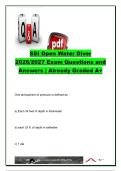
SSI Open Water Diver
2026/2027 Exam Questions and
Answers | Already Graded A+


One atmosphere of pressure is defined as:


a) Each 34 feet of depth in freshwater


b) each 33 ft. of depth in saltwater


c) 1 ata

,d) All answers are correct. - ANSWER ✔✔All answers are correct


The absolute pressure expressed in terms of atmospheres absolute at

33 ft. in sea water is:


a) 1 ata


b) 3 ata


c) 2 ata


d) 4 ata - ANSWER ✔✔2 ata


Underwater, the bending of light rays causes objects to appear to be:


a) closer


b) the same as the surface

,c) At an angle consistent with the bend of the light


d) Farther away - ANSWER ✔✔Closer


If you experience pain in your ears during descent:


a) Place a finger in the ear canal and gently massage the ear until the

pain ceases.


b) Continue the descent while gently exhaling into the mask


c) Abort the dive


d) Stop the descent and ascend until the pain stops. - ANSWER

✔✔Stop the descent and ascend until the pain stops.


Sinus squeeze can be prevented by:


a) Not diving with a cold

3
COPYRIGHT©JOSHCLAY 2026/2027. YEAR PUBLISHED 2026. COMPANY REGISTRATION NUMBER: 619652435. TERMS OF USE. PRIVACY
STATEMENT. ALL RIGHTS RESERVED

, b) Wearing earplugs


c) Tilting the divers head back and forth


d) The Valsalva technique - ANSWER ✔✔Not diving with a cold


Ear squeeze can be prevented by:


a) Rotating the jaw, swallowing or Valsalva


b) All answers are correct


c) Never diving with a cold


d) Relaxing - ANSWER ✔✔All answers are correct


The purpose of equalization is to:

Document information

Uploaded on
September 12, 2026
Number of pages
51
Written in
2026/2027
Type
Exam (elaborations)
Contains
Questions & answers
CA$31.69

Wrong document? Swap it for free Within 14 days of purchase and before downloading, you can choose a different document. You can simply spend the amount again.
Written by students who passed
Immediately available after payment
Read online or as PDF

Seller avatar
Reputation scores are based on the amount of documents a seller has sold for a fee and the reviews they have received for those documents. There are three levels: Bronze, Silver and Gold. The better the reputation, the more your can rely on the quality of the sellers work.
JOSHCLAY
3.6
(86)
Sold
397
Followers
15
Items
20770
Last sold
1 day ago


Why students choose Stuvia

Created by fellow students, verified by reviews

Quality you can trust: written by students who passed their tests and reviewed by others who've used these notes.

Didn't get what you expected? Choose another document

No worries! You can instantly pick a different document that better fits what you're looking for.

Pay as you like, start learning right away

No subscription, no commitments. Pay the way you're used to via credit card and download your PDF document instantly.

Student with book image

“Bought, downloaded, and aced it. It really can be that simple.”

Alisha Student

Working on your references?

Create accurate citations in APA, MLA and Harvard with our free citation generator.

Working on your references?

Frequently asked questions

