

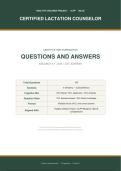
HEALTHY CHILDREN PROJECT · ALPP · IBLCE
CERTIFIED LACTATION COUNSELOR
CERTIFICATION EXAMINATION
QUESTIONS AND ANSWERS
GRADED A | EDITION
Total Questions 150
Sections 8 (Anatomy → Cultural/Ethics)
Cognitive Mix 25% Recall · 50% Application · 25% Analysis
Question Style 75% Scenario-based · 25% Direct knowledge
Format Multiple choice (A-D), one correct answer
Healthy Children Project / ALPP Blueprint / IBLCE
Aligned With
Competencies
Use this exam for self-assessment and board-style practice.
Answers and rationales appear immediately after each question.
Evidence-based practice · 150 questions · Graded A
,Certified Lactation Counselor Exam | Graded A 2026/2027 Page 2
SECTION 1 · QUESTIONS 1–20
Section 1: Lactation Anatomy & Physiology
Breast anatomy, lactogenesis stages, hormonal regulation, milk composition, immune factors, supply-and-demand
physiology.
Q1.
A lactation counselor is reviewing breast anatomy with a prenatal client. Which structure is the PRIMARY
site of milk synthesis?
A. Alveoli *[CORRECT]*
B. Lactiferous ducts
C. Lactiferous sinuses
D. Montgomery glands
Correct Answer: A
Rationale: Alveoli are the grape-like clusters of milk-producing cells (lactocytes) where milk synthesis occurs in response
to prolactin. Lactiferous ducts transport milk, Montgomery glands secrete lubricating oils on the areola, and lactiferous
sinuses are dilated portions of ducts beneath the areola that store milk during feeding.
Q2.
A mother asks when her mature milk will fully come in. Lactogenesis II, the onset of copious milk secretion,
typically occurs how many hours postpartum?
A. Between 24 and 48 hours
B. Between 48 and 72 hours *[CORRECT]*
C. After 7 days
D. Within the first 6 hours
Correct Answer: B
Rationale: Lactogenesis II begins approximately 48-72 hours postpartum, triggered by the dramatic drop in progesterone
and estrogen after placental delivery. Lactogenesis I occurs during pregnancy (colostrum production), and Lactogenesis III
(mature milk regulation) begins around day 10 and continues as supply-demand driven.
Q3.
Which hormone is responsible for the milk ejection reflex (let-down)?
A. Estrogen
B. Human placental lactogen
C. Oxytocin *[CORRECT]*
D. Prolactin
Correct Answer: C
Rationale: Oxytocin, released from the posterior pituitary in response to suckling, causes contraction of myoepithelial
cells surrounding the alveoli, pushing milk into the ducts (let-down reflex). Prolactin drives milk synthesis; estrogen and
progesterone actually inhibit milk production during pregnancy.
Aligned with Healthy Children Project / ALPP / IBLCE competencies — 2026/2027 Edition
,Certified Lactation Counselor Exam | Graded A 2026/2027 Page 3
Q4.
A new mother is stressed and reports difficulty with let-down when pumping at work. The CLC explains
that oxytocin release is inhibited by which factor?
A. Listening to soft music
B. Looking at a photo of her baby
C. Skin-to-skin contact
D. Elevated cortisol from stress *[CORRECT]*
Correct Answer: D
Rationale: Stress elevates cortisol and sympathetic nervous system activity, both of which inhibit oxytocin release and
impair the milk ejection reflex. Skin-to-skin contact, relaxation techniques, looking at baby photos, and listening to
calming music all enhance oxytocin release and promote let-down.
Q5.
A mother delivers a preterm infant at 32 weeks. Her milk will differ from term mother's milk in which
way?
A. Higher sodium and protein concentration *[CORRECT]*
B. Higher lactose concentration
C. Lower IgA concentration
D. Lower protein content
Correct Answer: A
Rationale: Milk produced after preterm delivery contains higher concentrations of protein, sodium, chloride, and iron,
and higher levels of immune factors like IgA and lactoferrin, reflecting the preterm infant's greater physiological needs.
This specialized preterm milk supports the infant's immature organ systems and immune function.
Q6.
Colostrum is particularly rich in which immune factor that provides passive immunity to the newborn's
gastrointestinal tract?
A. IgG
B. IgA (secretory) *[CORRECT]*
C. IgM
D. IgE
Correct Answer: B
Rationale: Secretory IgA (sIgA) is the predominant immunoglobulin in colostrum and mature breast milk. It coats the
infant's mucosal surfaces, providing passive immunity against pathogens the mother has encountered. Unlike IgG (which
crosses the placenta), sIgA is delivered exclusively through breast milk.
Aligned with Healthy Children Project / ALPP / IBLCE competencies — 2026/2027 Edition
, Certified Lactation Counselor Exam | Graded A 2026/2027 Page 4
Q7.
A CLC is explaining milk composition to a mother concerned about foremilk/hindmilk balance. Which
statement is accurate?
A. Hindmilk is released at the start of a feed
B. Foremilk is higher in fat content
C. Hindmilk has higher fat and calorie content, released later in the feed *[CORRECT]*
D. Foremilk and hindmilk are nutritionally identical
Correct Answer: C
Rationale: Foremilk, available at the start of a feed, is lower in fat and higher in lactose and water. As the feed
progresses, milk fat content increases, producing hindmilk, which is richer in calories and fat necessary for infant weight
gain and satiety. Allowing the infant to fully drain one breast before switching helps ensure adequate hindmilk intake.
Q8.
Lactoferrin, a key protein in breast milk, functions primarily by:
A. Producing bile for digestion
B. Synthesizing vitamin D
C. Breaking down milk fat
D. Binding iron to deprive bacteria of this essential nutrient *[CORRECT]*
Correct Answer: D
Rationale: Lactoferrin binds iron, making it unavailable to iron-dependent pathogenic bacteria like E. coli and
Staphylococcus, thereby inhibiting their growth. It also has direct antimicrobial and anti-inflammatory properties and
supports the infant's developing immune system.
Q9.
Human placental lactogen (hPL) plays a role in lactation primarily by:
A. Stimulating mammary gland development during pregnancy and competing with prolactin receptors
*[CORRECT]*
B. Activating the let-down reflex
C. Inhibiting oxytocin release
D. Stimulating milk ejection during feeding
Correct Answer: A
Rationale: hPL, produced by the placenta during pregnancy, promotes mammary gland development and works with
prolactin to prepare the breasts for lactation. After delivery, hPL levels drop sharply, allowing prolactin to freely stimulate
milk synthesis without competitive inhibition.
Q10.
A mother who gave birth 5 days ago reports her breasts feel soft and she is making less milk than yesterday.
The baby is feeding 10 times per 24 hours with 6 wet diapers. The CLC's analysis should recognize this as:
A. Lactogenesis failure requiring immediate supplementation
B. Normal transition as supply regulates to infant demand (Lactogenesis III) *[CORRECT]*
C. Indicator of insufficient glandular tissue
D. Sign of impending mastitis
Correct Answer: B
Rationale: Around days 3-5 postpartum, breasts may transition from feeling engorged to softer as supply begins to
regulate (Lactogenesis III). Adequate diaper output (6+ wet/24h), frequent feeding, and normal infant behavior indicate
appropriate supply regulation, not failure. This is an expected physiological transition.
Aligned with Healthy Children Project / ALPP / IBLCE competencies — 2026/2027 Edition
CERTIFIED LACTATION COUNSELOR
CERTIFICATION EXAMINATION
QUESTIONS AND ANSWERS
GRADED A | EDITION
Total Questions 150
Sections 8 (Anatomy → Cultural/Ethics)
Cognitive Mix 25% Recall · 50% Application · 25% Analysis
Question Style 75% Scenario-based · 25% Direct knowledge
Format Multiple choice (A-D), one correct answer
Healthy Children Project / ALPP Blueprint / IBLCE
Aligned With
Competencies
Use this exam for self-assessment and board-style practice.
Answers and rationales appear immediately after each question.
Evidence-based practice · 150 questions · Graded A
,Certified Lactation Counselor Exam | Graded A 2026/2027 Page 2
SECTION 1 · QUESTIONS 1–20
Section 1: Lactation Anatomy & Physiology
Breast anatomy, lactogenesis stages, hormonal regulation, milk composition, immune factors, supply-and-demand
physiology.
Q1.
A lactation counselor is reviewing breast anatomy with a prenatal client. Which structure is the PRIMARY
site of milk synthesis?
A. Alveoli *[CORRECT]*
B. Lactiferous ducts
C. Lactiferous sinuses
D. Montgomery glands
Correct Answer: A
Rationale: Alveoli are the grape-like clusters of milk-producing cells (lactocytes) where milk synthesis occurs in response
to prolactin. Lactiferous ducts transport milk, Montgomery glands secrete lubricating oils on the areola, and lactiferous
sinuses are dilated portions of ducts beneath the areola that store milk during feeding.
Q2.
A mother asks when her mature milk will fully come in. Lactogenesis II, the onset of copious milk secretion,
typically occurs how many hours postpartum?
A. Between 24 and 48 hours
B. Between 48 and 72 hours *[CORRECT]*
C. After 7 days
D. Within the first 6 hours
Correct Answer: B
Rationale: Lactogenesis II begins approximately 48-72 hours postpartum, triggered by the dramatic drop in progesterone
and estrogen after placental delivery. Lactogenesis I occurs during pregnancy (colostrum production), and Lactogenesis III
(mature milk regulation) begins around day 10 and continues as supply-demand driven.
Q3.
Which hormone is responsible for the milk ejection reflex (let-down)?
A. Estrogen
B. Human placental lactogen
C. Oxytocin *[CORRECT]*
D. Prolactin
Correct Answer: C
Rationale: Oxytocin, released from the posterior pituitary in response to suckling, causes contraction of myoepithelial
cells surrounding the alveoli, pushing milk into the ducts (let-down reflex). Prolactin drives milk synthesis; estrogen and
progesterone actually inhibit milk production during pregnancy.
Aligned with Healthy Children Project / ALPP / IBLCE competencies — 2026/2027 Edition
,Certified Lactation Counselor Exam | Graded A 2026/2027 Page 3
Q4.
A new mother is stressed and reports difficulty with let-down when pumping at work. The CLC explains
that oxytocin release is inhibited by which factor?
A. Listening to soft music
B. Looking at a photo of her baby
C. Skin-to-skin contact
D. Elevated cortisol from stress *[CORRECT]*
Correct Answer: D
Rationale: Stress elevates cortisol and sympathetic nervous system activity, both of which inhibit oxytocin release and
impair the milk ejection reflex. Skin-to-skin contact, relaxation techniques, looking at baby photos, and listening to
calming music all enhance oxytocin release and promote let-down.
Q5.
A mother delivers a preterm infant at 32 weeks. Her milk will differ from term mother's milk in which
way?
A. Higher sodium and protein concentration *[CORRECT]*
B. Higher lactose concentration
C. Lower IgA concentration
D. Lower protein content
Correct Answer: A
Rationale: Milk produced after preterm delivery contains higher concentrations of protein, sodium, chloride, and iron,
and higher levels of immune factors like IgA and lactoferrin, reflecting the preterm infant's greater physiological needs.
This specialized preterm milk supports the infant's immature organ systems and immune function.
Q6.
Colostrum is particularly rich in which immune factor that provides passive immunity to the newborn's
gastrointestinal tract?
A. IgG
B. IgA (secretory) *[CORRECT]*
C. IgM
D. IgE
Correct Answer: B
Rationale: Secretory IgA (sIgA) is the predominant immunoglobulin in colostrum and mature breast milk. It coats the
infant's mucosal surfaces, providing passive immunity against pathogens the mother has encountered. Unlike IgG (which
crosses the placenta), sIgA is delivered exclusively through breast milk.
Aligned with Healthy Children Project / ALPP / IBLCE competencies — 2026/2027 Edition
, Certified Lactation Counselor Exam | Graded A 2026/2027 Page 4
Q7.
A CLC is explaining milk composition to a mother concerned about foremilk/hindmilk balance. Which
statement is accurate?
A. Hindmilk is released at the start of a feed
B. Foremilk is higher in fat content
C. Hindmilk has higher fat and calorie content, released later in the feed *[CORRECT]*
D. Foremilk and hindmilk are nutritionally identical
Correct Answer: C
Rationale: Foremilk, available at the start of a feed, is lower in fat and higher in lactose and water. As the feed
progresses, milk fat content increases, producing hindmilk, which is richer in calories and fat necessary for infant weight
gain and satiety. Allowing the infant to fully drain one breast before switching helps ensure adequate hindmilk intake.
Q8.
Lactoferrin, a key protein in breast milk, functions primarily by:
A. Producing bile for digestion
B. Synthesizing vitamin D
C. Breaking down milk fat
D. Binding iron to deprive bacteria of this essential nutrient *[CORRECT]*
Correct Answer: D
Rationale: Lactoferrin binds iron, making it unavailable to iron-dependent pathogenic bacteria like E. coli and
Staphylococcus, thereby inhibiting their growth. It also has direct antimicrobial and anti-inflammatory properties and
supports the infant's developing immune system.
Q9.
Human placental lactogen (hPL) plays a role in lactation primarily by:
A. Stimulating mammary gland development during pregnancy and competing with prolactin receptors
*[CORRECT]*
B. Activating the let-down reflex
C. Inhibiting oxytocin release
D. Stimulating milk ejection during feeding
Correct Answer: A
Rationale: hPL, produced by the placenta during pregnancy, promotes mammary gland development and works with
prolactin to prepare the breasts for lactation. After delivery, hPL levels drop sharply, allowing prolactin to freely stimulate
milk synthesis without competitive inhibition.
Q10.
A mother who gave birth 5 days ago reports her breasts feel soft and she is making less milk than yesterday.
The baby is feeding 10 times per 24 hours with 6 wet diapers. The CLC's analysis should recognize this as:
A. Lactogenesis failure requiring immediate supplementation
B. Normal transition as supply regulates to infant demand (Lactogenesis III) *[CORRECT]*
C. Indicator of insufficient glandular tissue
D. Sign of impending mastitis
Correct Answer: B
Rationale: Around days 3-5 postpartum, breasts may transition from feeling engorged to softer as supply begins to
regulate (Lactogenesis III). Adequate diaper output (6+ wet/24h), frequent feeding, and normal infant behavior indicate
appropriate supply regulation, not failure. This is an expected physiological transition.
Aligned with Healthy Children Project / ALPP / IBLCE competencies — 2026/2027 Edition


