
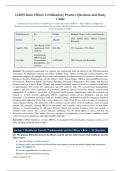
IAHSS Basic Officer Certification | Practice Questions and Study
Guide
International Association for Healthcare Security and Safety (IAHSS) — Basic Officer Certification:
Healthcare Security Operations, Patient De-escalation, Hospital Emergency Management, and Healthcare
Legal Compliance (2026)
Total Questions: 50 Format: Multiple Choice (A-D) with Rationales
2026 IAHSS Basic Officer Content
Sections: 5 Aligned:
Blueprint
30% Recall / 50%
Cognitive Mix: Application / 20% Item Mix: 75% Scenario / 25% Direct
Analysis
Fundamentals,
HIPAA/Legal,
Coverage: De-escalation, Verification: 100% Keyed with Rationales
Emergencies, Use
of Force
Abstract. This practice examination is an original, non-confidential study aid aligned to the 2026 International
Association for Healthcare Security and Safety (IAHSS) Basic Officer Certification content blueprint. The
instrument comprises 50 multiple-choice items with rationales distributed across five sections of 10 items each:
Healthcare Security Fundamentals and the Officer’s Role; Patient Rights, HIPAA, and Legal/Ethical Issues;
De-escalation, Behavioral Health, and Patient Handling; Emergency Management, Fire Safety, and Physical
Security; and Use of Force, Report Writing, and Incident Command. Items are keyed to a cognitive distribution
of approximately 30% recall, 50% application, and 20% analysis, with 75% scenario-based hospital/clinic
vignettes and 25% direct regulatory or procedural questions. Special inclusions address scenario-based
management of combative, intoxicated, or behavioral health patients emphasizing verbal de-escalation and
clinical vs. security restraint application; HIPAA compliance, patient privacy boundaries, and the legal
parameters of involuntary psychiatric holds in a hospital setting; and healthcare-specific emergency responses
including infant abduction (Code Pink), active shooter in a clinic (Code Silver), and evacuation of immobile or
surgical patients during a fire. Distractors reflect common security officer errors in healthcare, such as treating
patients like criminals, violating HIPAA by discussing cases in public, using excessive force on psychiatric
patients, or misunderstanding the difference between clinical and security restraints. Each item includes a
verified correct answer and a concise rationale explaining why the keyed option is correct and why the
distractors are incorrect. This artifact does not reproduce any proprietary exam content; candidates should
verify all current requirements with official IAHSS materials.
Keywords: IAHSS; healthcare security; HIPAA; de-escalation; behavioral health; emergency codes; use of
force; incident command; patient rights
Section 1: Healthcare Security Fundamentals and the Officer’s Role — 10 Questions
Q1: The primary distinction between healthcare security and law enforcement is that healthcare security
officers must:
A. Treat all patients as criminal suspects
B. Balance safety and security with the healing environment, preserving patient dignity and therapeutic
milieu *[CORRECT]*
C. Prioritize apprehension over patient care
D. Ignore clinical staff directions entirely
Correct Answer: B
, Rationale: Healthcare security balances safety with the healing environment; treating patients as suspects,
prioritizing apprehension, or ignoring clinical staff contradict the therapeutic mission.
Q2: A healthcare security officer's customer service role includes:
A. Refusing to assist visitors
B. Treating all visitors as threats
C. Greeting visitors, providing directions, escorting vulnerable patients, and maintaining a calm,
professional demeanor *[CORRECT]*
D. Avoiding all patient interaction
Correct Answer: C
Rationale: Customer service in healthcare includes greeting, directing, escorting, and professional demeanor;
refusing, treating visitors as threats, and avoiding interaction are inappropriate.
Q3: Effective patrol strategy in a hospital includes:
A. Predictable fixed routes only
B. Avoiding the ED entirely
C. Patrolling only during shift change
D. High-visibility patrolling of vulnerable areas (ED, pharmacy, maternal-child), random routes, and
documentation of anomalies *[CORRECT]*
Correct Answer: D
Rationale: Effective patrol covers vulnerable areas with varied routes and documentation; predictable routes,
avoiding the ED, and shift-change-only are ineffective.
Q4: Access control in a healthcare facility during normal operations requires:
A. Verifying identity of visitors, restricting sensitive areas (pharmacy, nursery, behavioral health), and
following visitor management policies *[CORRECT]*
B. Allowing unrestricted access to all areas
C. Locking all doors permanently
D. Ignoring visitor identification
Correct Answer: A
Rationale: Access control verifies visitors and restricts sensitive areas per policy; unrestricted access, permanent
lockdown, and ignoring ID are unsafe.
Q5: A security officer in a healing environment should be guided by the principle of:
A. Maximizing authority displays always
B. Preserving the therapeutic milieu and patient dignity while maintaining safety *[CORRECT]*
C. Treating patients punitively
D. Removing all patient autonomy
Correct Answer: B
Rationale: Preserving the therapeutic milieu and dignity while ensuring safety is the guiding principle; authority
displays, punitive treatment, and removing autonomy harm patients.
Q6: Which is a core competency for an IAHSS Basic Officer?
A. Performing surgery
B. Diagnosing mental illness
C. Recognizing and responding to healthcare-specific threats including workplace violence, infant
abduction, and behavioral emergencies *[CORRECT]*
D. Prescribing medication
Correct Answer: C
Guide
International Association for Healthcare Security and Safety (IAHSS) — Basic Officer Certification:
Healthcare Security Operations, Patient De-escalation, Hospital Emergency Management, and Healthcare
Legal Compliance (2026)
Total Questions: 50 Format: Multiple Choice (A-D) with Rationales
2026 IAHSS Basic Officer Content
Sections: 5 Aligned:
Blueprint
30% Recall / 50%
Cognitive Mix: Application / 20% Item Mix: 75% Scenario / 25% Direct
Analysis
Fundamentals,
HIPAA/Legal,
Coverage: De-escalation, Verification: 100% Keyed with Rationales
Emergencies, Use
of Force
Abstract. This practice examination is an original, non-confidential study aid aligned to the 2026 International
Association for Healthcare Security and Safety (IAHSS) Basic Officer Certification content blueprint. The
instrument comprises 50 multiple-choice items with rationales distributed across five sections of 10 items each:
Healthcare Security Fundamentals and the Officer’s Role; Patient Rights, HIPAA, and Legal/Ethical Issues;
De-escalation, Behavioral Health, and Patient Handling; Emergency Management, Fire Safety, and Physical
Security; and Use of Force, Report Writing, and Incident Command. Items are keyed to a cognitive distribution
of approximately 30% recall, 50% application, and 20% analysis, with 75% scenario-based hospital/clinic
vignettes and 25% direct regulatory or procedural questions. Special inclusions address scenario-based
management of combative, intoxicated, or behavioral health patients emphasizing verbal de-escalation and
clinical vs. security restraint application; HIPAA compliance, patient privacy boundaries, and the legal
parameters of involuntary psychiatric holds in a hospital setting; and healthcare-specific emergency responses
including infant abduction (Code Pink), active shooter in a clinic (Code Silver), and evacuation of immobile or
surgical patients during a fire. Distractors reflect common security officer errors in healthcare, such as treating
patients like criminals, violating HIPAA by discussing cases in public, using excessive force on psychiatric
patients, or misunderstanding the difference between clinical and security restraints. Each item includes a
verified correct answer and a concise rationale explaining why the keyed option is correct and why the
distractors are incorrect. This artifact does not reproduce any proprietary exam content; candidates should
verify all current requirements with official IAHSS materials.
Keywords: IAHSS; healthcare security; HIPAA; de-escalation; behavioral health; emergency codes; use of
force; incident command; patient rights
Section 1: Healthcare Security Fundamentals and the Officer’s Role — 10 Questions
Q1: The primary distinction between healthcare security and law enforcement is that healthcare security
officers must:
A. Treat all patients as criminal suspects
B. Balance safety and security with the healing environment, preserving patient dignity and therapeutic
milieu *[CORRECT]*
C. Prioritize apprehension over patient care
D. Ignore clinical staff directions entirely
Correct Answer: B
, Rationale: Healthcare security balances safety with the healing environment; treating patients as suspects,
prioritizing apprehension, or ignoring clinical staff contradict the therapeutic mission.
Q2: A healthcare security officer's customer service role includes:
A. Refusing to assist visitors
B. Treating all visitors as threats
C. Greeting visitors, providing directions, escorting vulnerable patients, and maintaining a calm,
professional demeanor *[CORRECT]*
D. Avoiding all patient interaction
Correct Answer: C
Rationale: Customer service in healthcare includes greeting, directing, escorting, and professional demeanor;
refusing, treating visitors as threats, and avoiding interaction are inappropriate.
Q3: Effective patrol strategy in a hospital includes:
A. Predictable fixed routes only
B. Avoiding the ED entirely
C. Patrolling only during shift change
D. High-visibility patrolling of vulnerable areas (ED, pharmacy, maternal-child), random routes, and
documentation of anomalies *[CORRECT]*
Correct Answer: D
Rationale: Effective patrol covers vulnerable areas with varied routes and documentation; predictable routes,
avoiding the ED, and shift-change-only are ineffective.
Q4: Access control in a healthcare facility during normal operations requires:
A. Verifying identity of visitors, restricting sensitive areas (pharmacy, nursery, behavioral health), and
following visitor management policies *[CORRECT]*
B. Allowing unrestricted access to all areas
C. Locking all doors permanently
D. Ignoring visitor identification
Correct Answer: A
Rationale: Access control verifies visitors and restricts sensitive areas per policy; unrestricted access, permanent
lockdown, and ignoring ID are unsafe.
Q5: A security officer in a healing environment should be guided by the principle of:
A. Maximizing authority displays always
B. Preserving the therapeutic milieu and patient dignity while maintaining safety *[CORRECT]*
C. Treating patients punitively
D. Removing all patient autonomy
Correct Answer: B
Rationale: Preserving the therapeutic milieu and dignity while ensuring safety is the guiding principle; authority
displays, punitive treatment, and removing autonomy harm patients.
Q6: Which is a core competency for an IAHSS Basic Officer?
A. Performing surgery
B. Diagnosing mental illness
C. Recognizing and responding to healthcare-specific threats including workplace violence, infant
abduction, and behavioral emergencies *[CORRECT]*
D. Prescribing medication
Correct Answer: C


