Exam 4:NUR 155 Exam 4: Questions & Answers:Latest Updated 2026: Guaranteed A+ Score Solution
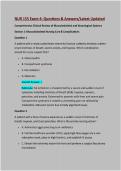
A patient with a newly casted lower extremity fracture suddenly develops suddenonset shortness of breath, severe anxiety, and hypoxia. Which complication should the nurse suspect first? • A. Osteomyelitis • B. Compartment syndrome • C. Fat embolism • D. Malunion Correct Answer: C Rationale: Fat embolism is characterized by a severe and sudden onset of symptoms including shortness of breath (SOB), hypoxia, cyanosis, petechiae, and anxiety. Osteomyelitis presents with fever and severe pain. Compartment syndrome is noted by unrelenting pain not relieved by medication. Malunion occurs due to body alignment issues. Question 2 A patient with a femur fracture experiences a sudden onset of shortness of breath, hypoxia, and chest petechiae. What is the priority nursing action? • A. Administer aggressive long-term antibiotics • B. Call the healthcare provider (HCP), apply high-flow oxygen via a nonrebreather mask, place in high Fowler's, and establish IV access • C. Elevate the extremity above the heart and perform a surgical fasciotomy immediately• D. Prepare the patient for a bivalve cast procedure at the bedside Correct Answer: B Rationale: Immediate treatment for a fat embolism involves calling the HCP, administering high flow O2 via a non-rebreather mask, placing the patient in high Fowler's position, and securing IV access. Fasciotomies and bivalving casts are specific treatments for compartment syndrome, not fat emboli. Question 3 The nurse is caring for a patient after orthopedic surgery. Which symptom is the hallmark clinical indicator of compartment syndrome? • A. High fever and localized redness over a surgical site • B. Sudden shortness of breath and chest wall petechiae • C. Severe, unrelenting pain that is not relieved by pain medications • D. Cool extremities with a slow pulse below baseline Correct Answer: C Rationale: Compartment syndrome is clinically characterized by edema and severe, unrelenting pain that is not relieved by pain medications. Fever and localized pain point to osteomyelitis. Shortness of breath and petechiae are signs of fat embolism. Question 4 Which nursing intervention is essential when caring for a patient with skeletal traction to prevent osteomyelitis? • A. Applying an ACE wrap tightly to compress the extremity • B. Performing pin care using aseptic technique • C. Elevating the extremity above heart level for 6 weeks • D. Avoiding the use of the extremity entirely Correct Answer: BRationale: Skeletal traction introduces a risk for osteomyelitis; therefore, pin care and aseptic technique must be used. ACE wraps are utilized for sprains and strains. Question 5 To prevent malunion in a patient undergoing skin traction, what is the primary nursing action? • A. Ensure the patient is in the knee-to-chest position • B. Check body alignment and verify that the traction weights are hanging freely • C. Massage the affected limb to increase blood circulation • D. Keep the traction weights resting flat on the floor Correct Answer: B Rationale: For both skin and skeletal traction, the treatment/prevention of malunion is to check body alignment and make sure the weights are hanging freely. Question 6 When teaching a patient about the RICE protocol for a sprain, how should the nurse instruct them to apply ice? • A. Apply ice continuously for 24 hours without awake breaks • B. Apply ice for 10–20 minutes every 1–2 hours while awake • C. Apply ice only when pain reaches a severe level of 8 to 10 • D. Massage the sprain with ice directly for 30 minutes Correct Answer: B Rationale: The "I" (Ice) in the RICE protocol involves applying ice for 10–20 minutes every 1–2 hours while awake.Question 7 What should the nurse include in the teaching plan for a patient diagnosed with carpal tunnel syndrome? • A. Avoid heavy gripping and pinching for 6 weeks • B. Keep the wrist hyperextended at all times, especially at night • C. Apply direct hot packs to the wrist for 2 hours daily • D. Use rapid repetitive wrist exercises to build muscle strength Correct Answer: A
Document information
- Uploaded on
- September 8, 2026
- Number of pages
- 29
- Written in
- 2026/2027
- Type
- Exam (elaborations)
- Contains
- Questions & answers