

Module 3 1001A Independent Assignment
Name:
Group Members:
Creating a phylogenetic tree: INDEPENDENT
What does the length of an arrow in a phylogenetic tree indicate?
A phylogenetic tree is a diagram that represents evolutionary relationships among organisms.
The phylogenetic trees are hypotheses not definitive facts. The branch length represents
evolutionary time between the nodes. The vertical lines represent nodes/evolutionary splits.
What is a potential hypothesis you could test by making this phylogenetic tree?
A potential hypothesis that can be tested by making a phylogenetic tree would be if species 1 is
evolutionary close to species 2 (i.e. they are both descended from a recent common ancestor).
A phylogenetic tree can also determine which group of species (i.e a clade) is evolutionarily distinct
from another group of species, or which individual species is the most divergent of the rest (i.e.
outgroup).
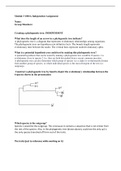
Construct a phylogenetic tree by hand to depict the evolutionary relationship between the
6 species shown in the presentation
Which species is the outgroup?
Species 1 would be the outgroup. This is because it contains a sequence that is not similar from
the rest of the species. Also, in the phylogenetic tree (drawn above), could see the only sp1 is
the only species branched off form rest of the traits.
The traits (just to reference while working on it)
Name:
Group Members:
Creating a phylogenetic tree: INDEPENDENT
What does the length of an arrow in a phylogenetic tree indicate?
A phylogenetic tree is a diagram that represents evolutionary relationships among organisms.
The phylogenetic trees are hypotheses not definitive facts. The branch length represents
evolutionary time between the nodes. The vertical lines represent nodes/evolutionary splits.
What is a potential hypothesis you could test by making this phylogenetic tree?
A potential hypothesis that can be tested by making a phylogenetic tree would be if species 1 is
evolutionary close to species 2 (i.e. they are both descended from a recent common ancestor).
A phylogenetic tree can also determine which group of species (i.e a clade) is evolutionarily distinct
from another group of species, or which individual species is the most divergent of the rest (i.e.
outgroup).
Construct a phylogenetic tree by hand to depict the evolutionary relationship between the
6 species shown in the presentation
Which species is the outgroup?
Species 1 would be the outgroup. This is because it contains a sequence that is not similar from
the rest of the species. Also, in the phylogenetic tree (drawn above), could see the only sp1 is
the only species branched off form rest of the traits.
The traits (just to reference while working on it)


