

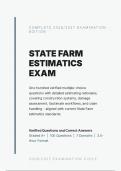
C O M P L E T E 2 0 2 0 2 7 E X A M I N AT I O N
EDITION
STATE FARM
ESTIMATICS
EXAM
One hundred verified multiple-choice
questions with detailed estimating rationales,
covering construction systems, damage
assessment, Xactimate workflows, and claim
handling - aligned with current State Farm
estimatics standards.
Verified Questions and Correct Answers
Graded A+ | 100 Questions | 7 Domains | 3.5-
Hour Format
2 0 2 0 2 7 E X A M I N AT I O N C YC L E
,State Farm Estimatics Exam | Complete 2026/2027 Edition Graded A+ | Verified Questions and Correct Answers
STATE FARM ESTIMATICS EXAM
Complete 2026/2027 Edition with Verified Questions and Correct Answers - Graded A+
Time Limit: 3.5 hours | Total Questions: 100 | Format: Multiple choice, four options (A-D), one
correct answer | Cognitive Mix: 25% recall, 55% application, 20% analysis
Coverage: Seven content domains spanning estimating fundamentals, building construction and systems,
damage assessment and documentation, Xactimate operations, residential building systems, claim handling and
insurance principles, and ethics, safety, and professional standards.
Directions: Select the single best answer for each question. Verified answers are printed directly beneath each
item, followed by an estimating-specific rationale explaining the correct choice and the defects in the
distractors. Study each rationale carefully: it reflects construction methods, Xactimate application, policy
interpretation, and the estimating standards expected on State Farm property losses.
Contents
Section 1: Estimating Fundamentals and Construction Terminology 2
Section 2: Building Construction and Systems 7
Section 3: Damage Assessment and Documentation 12
Section 4: Xactimate Software and Estimating 17
Section 5: Residential Building Systems 22
Section 6: Claim Handling and Insurance Principles 27
Section 7: Ethics, Safety, and Professional Standards 32
1
,State Farm Estimatics Exam | Complete 2026/2027 Edition Graded A+ | Verified Questions and Correct Answers
Section 1: Estimating Fundamentals and Construction Terminology
Construction Methods, Materials, and Estimating Principles | Questions 1-15
Q1. In insurance property damage estimating, the term 'scope of work' is BEST defined as:
A. A complete, itemized list of all repair operations, materials, quantities, and labor
required to restore damaged property to its pre-loss condition [CORRECT]
B. The insurance policy language that determines whether a reported peril is covered under
the contract
C. The contractor's projected overhead and profit margin for the entire repair project
D. The total dollar amount the insurer has approved for settlement of the claim
Correct Answer: A
Rationale: The scope of work is the comprehensive written documentation of every repair operation
needed to return the property to pre-loss condition, including line items, quantities, materials, and labor.
Option B describes coverage analysis, which is a separate claims function governed by policy language
rather than the estimate. Option C describes pricing components that are applied to the scope, not the
scope itself, and Option D describes the settlement figure that results from the priced scope.
Q2. A 12-year-old asphalt shingle roof has a 20-year expected service life and a replacement
cost value (RCV) of $14,500. Using straight-line depreciation, what is the actual cash value
(ACV) of the roof?
A. $8,700
B. $5,800 [CORRECT]
C. $14,500
D. $2,900
Correct Answer: B
Rationale: Straight-line depreciation divides age by life expectancy: 12 years used out of 20 years
equals 60% depreciated, leaving 40% of value remaining. Applying 40% to the $14,500 RCV yields an
ACV of $5,800. Option A ($8,700) incorrectly treats the 60% depreciation as remaining value, Option
C ignores depreciation entirely, and Option D uses an unsupported 20% figure.
Q3. A restoration estimate contains $18,000 of combined labor and material costs requiring
general contractor coordination across multiple trades. Applying 10% overhead and 10% profit,
what is the correct total including overhead and profit (O&P;)?
A. $21,600
B. $19,800
C. $21,780 [CORRECT]
D. $23,400
Correct Answer: C
Rationale: Overhead and profit are applied sequentially in standard estimating practice: $18,000 plus
10% overhead equals $19,800, and 10% profit on $19,800 equals $21,780. This compounding produces
21% total, not a flat 20%. Option A applies a flat 20% to the base, Option B adds overhead only and
omits profit, and Option D inflates the base beyond any accepted O&P; convention.
2
, State Farm Estimatics Exam | Complete 2026/2027 Edition Graded A+ | Verified Questions and Correct Answers
Q4. Unit cost estimating differs from actual cost estimating in that unit cost estimating:
A. Relies on actual contractor invoices collected after the work is completed
B. Applies only to properties that have been declared total losses
C. Eliminates the need for labor charges by bundling them into material prices
D. Assigns a pre-priced cost per unit of measurement, such as per square foot or per lineal
foot, for each task and material [CORRECT]
Correct Answer: D
Rationale: Unit cost estimating prices each scope line item by its unit of measure using published,
pre-priced unit costs, which is the method used by Xactimate and required for claim estimates prepared
before repairs occur. Option A describes actual cost estimating, which occurs after completion and
cannot support a pre-repair settlement. Options B and C are incorrect because unit costing applies to all
repair estimates and always separates or itemizes labor.
Q5. A field estimator measures a gable roof plane at 42 feet by 28 feet. Expressed in roofing
squares for the estimate, this plane contains:
A. 8.82 SQ
B. 11.76 SQ [CORRECT]
C. 14.70 SQ
D. 16.80 SQ
Correct Answer: B
Rationale: A roofing square equals 100 square feet of roof surface. Multiplying 42 feet by 28 feet
yields 1,176 square feet, which converts to 11.76 squares. Option A incorrectly divides by 100 twice,
Option C errors by adding instead of multiplying dimensions, and Option D confuses the conversion
factor and overstates the plane area.
Q6. An estimator determines a hip roof requires exactly 20 squares of asphalt shingles. Applying
the standard waste factor recognized for hip roof geometry, how many squares should the
estimate include?
A. 21 SQ
B. 23 SQ [CORRECT]
C. 25 SQ
D. 20 SQ
Correct Answer: B
Rationale: Standard industry waste is 10% for simple gable roofs and 15% for hip roofs because hip
and ridge cutting generates offcut loss; 20 squares multiplied by 1.15 equals 23 squares. Option A
applies an unrealistically low 5% waste, Option C doubles the allowance beyond accepted convention,
and Option D omits waste entirely, which guarantees a material shortage during installation.
3
EDITION
STATE FARM
ESTIMATICS
EXAM
One hundred verified multiple-choice
questions with detailed estimating rationales,
covering construction systems, damage
assessment, Xactimate workflows, and claim
handling - aligned with current State Farm
estimatics standards.
Verified Questions and Correct Answers
Graded A+ | 100 Questions | 7 Domains | 3.5-
Hour Format
2 0 2 0 2 7 E X A M I N AT I O N C YC L E
,State Farm Estimatics Exam | Complete 2026/2027 Edition Graded A+ | Verified Questions and Correct Answers
STATE FARM ESTIMATICS EXAM
Complete 2026/2027 Edition with Verified Questions and Correct Answers - Graded A+
Time Limit: 3.5 hours | Total Questions: 100 | Format: Multiple choice, four options (A-D), one
correct answer | Cognitive Mix: 25% recall, 55% application, 20% analysis
Coverage: Seven content domains spanning estimating fundamentals, building construction and systems,
damage assessment and documentation, Xactimate operations, residential building systems, claim handling and
insurance principles, and ethics, safety, and professional standards.
Directions: Select the single best answer for each question. Verified answers are printed directly beneath each
item, followed by an estimating-specific rationale explaining the correct choice and the defects in the
distractors. Study each rationale carefully: it reflects construction methods, Xactimate application, policy
interpretation, and the estimating standards expected on State Farm property losses.
Contents
Section 1: Estimating Fundamentals and Construction Terminology 2
Section 2: Building Construction and Systems 7
Section 3: Damage Assessment and Documentation 12
Section 4: Xactimate Software and Estimating 17
Section 5: Residential Building Systems 22
Section 6: Claim Handling and Insurance Principles 27
Section 7: Ethics, Safety, and Professional Standards 32
1
,State Farm Estimatics Exam | Complete 2026/2027 Edition Graded A+ | Verified Questions and Correct Answers
Section 1: Estimating Fundamentals and Construction Terminology
Construction Methods, Materials, and Estimating Principles | Questions 1-15
Q1. In insurance property damage estimating, the term 'scope of work' is BEST defined as:
A. A complete, itemized list of all repair operations, materials, quantities, and labor
required to restore damaged property to its pre-loss condition [CORRECT]
B. The insurance policy language that determines whether a reported peril is covered under
the contract
C. The contractor's projected overhead and profit margin for the entire repair project
D. The total dollar amount the insurer has approved for settlement of the claim
Correct Answer: A
Rationale: The scope of work is the comprehensive written documentation of every repair operation
needed to return the property to pre-loss condition, including line items, quantities, materials, and labor.
Option B describes coverage analysis, which is a separate claims function governed by policy language
rather than the estimate. Option C describes pricing components that are applied to the scope, not the
scope itself, and Option D describes the settlement figure that results from the priced scope.
Q2. A 12-year-old asphalt shingle roof has a 20-year expected service life and a replacement
cost value (RCV) of $14,500. Using straight-line depreciation, what is the actual cash value
(ACV) of the roof?
A. $8,700
B. $5,800 [CORRECT]
C. $14,500
D. $2,900
Correct Answer: B
Rationale: Straight-line depreciation divides age by life expectancy: 12 years used out of 20 years
equals 60% depreciated, leaving 40% of value remaining. Applying 40% to the $14,500 RCV yields an
ACV of $5,800. Option A ($8,700) incorrectly treats the 60% depreciation as remaining value, Option
C ignores depreciation entirely, and Option D uses an unsupported 20% figure.
Q3. A restoration estimate contains $18,000 of combined labor and material costs requiring
general contractor coordination across multiple trades. Applying 10% overhead and 10% profit,
what is the correct total including overhead and profit (O&P;)?
A. $21,600
B. $19,800
C. $21,780 [CORRECT]
D. $23,400
Correct Answer: C
Rationale: Overhead and profit are applied sequentially in standard estimating practice: $18,000 plus
10% overhead equals $19,800, and 10% profit on $19,800 equals $21,780. This compounding produces
21% total, not a flat 20%. Option A applies a flat 20% to the base, Option B adds overhead only and
omits profit, and Option D inflates the base beyond any accepted O&P; convention.
2
, State Farm Estimatics Exam | Complete 2026/2027 Edition Graded A+ | Verified Questions and Correct Answers
Q4. Unit cost estimating differs from actual cost estimating in that unit cost estimating:
A. Relies on actual contractor invoices collected after the work is completed
B. Applies only to properties that have been declared total losses
C. Eliminates the need for labor charges by bundling them into material prices
D. Assigns a pre-priced cost per unit of measurement, such as per square foot or per lineal
foot, for each task and material [CORRECT]
Correct Answer: D
Rationale: Unit cost estimating prices each scope line item by its unit of measure using published,
pre-priced unit costs, which is the method used by Xactimate and required for claim estimates prepared
before repairs occur. Option A describes actual cost estimating, which occurs after completion and
cannot support a pre-repair settlement. Options B and C are incorrect because unit costing applies to all
repair estimates and always separates or itemizes labor.
Q5. A field estimator measures a gable roof plane at 42 feet by 28 feet. Expressed in roofing
squares for the estimate, this plane contains:
A. 8.82 SQ
B. 11.76 SQ [CORRECT]
C. 14.70 SQ
D. 16.80 SQ
Correct Answer: B
Rationale: A roofing square equals 100 square feet of roof surface. Multiplying 42 feet by 28 feet
yields 1,176 square feet, which converts to 11.76 squares. Option A incorrectly divides by 100 twice,
Option C errors by adding instead of multiplying dimensions, and Option D confuses the conversion
factor and overstates the plane area.
Q6. An estimator determines a hip roof requires exactly 20 squares of asphalt shingles. Applying
the standard waste factor recognized for hip roof geometry, how many squares should the
estimate include?
A. 21 SQ
B. 23 SQ [CORRECT]
C. 25 SQ
D. 20 SQ
Correct Answer: B
Rationale: Standard industry waste is 10% for simple gable roofs and 15% for hip roofs because hip
and ridge cutting generates offcut loss; 20 squares multiplied by 1.15 equals 23 squares. Option A
applies an unrealistically low 5% waste, Option C doubles the allowance beyond accepted convention,
and Option D omits waste entirely, which guarantees a material shortage during installation.
3


