

NIMS ICS 400 REVIEWED EXAM — 2026/2027 Edition — Verified Questions & Correct Answers (A+ Graded) Page 1
NIMS ICS 400 REVIEWED EXAM
Verified Questions and Correct Answers — A+ Graded — 2026/2027 Edition
Aligned with FEMA Emergency Management Institute ICS 400 Curriculum, NIMS Doctrine, and Advanced Incident
Command System Standards
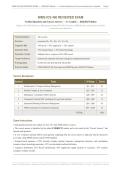
Total Questions 100 (exactly)
Sections 6 sections (20 + 25 + 20 + 15 + 10 + 10)
Cognitive Mix 25% Recall / 50% Application / 25% Analysis
Question Style 75% Scenario-Based / 25% Direct Knowledge
Question Format Multiple Choice, 4 options (A-D), ONE correct
Target Audience Experienced responders and senior emergency management personnel
Prerequisites IS-700, ICS-100, ICS-200, ICS-300, IS-800
Doctrine Basis FEMA EMI ICS 400 Curriculum and NIMS Doctrine (2026/2027 Edition)
Section Breakdown
Section Topic Q Range Count
1 Fundamentals of Complex Incident Management Q1 - Q20 20
2 Incident Complex & Area Command Q21 - Q45 25
3 Multiagency Coordination (MAC) Systems Q46 - Q65 20
4 Command & General Staff Leadership in Large-Scale Incidents Q66 - Q80 15
5 Operational Planning & Resource Management Q81 - Q90 10
6 NIMS Command & Coordination Components Q91 - Q100 10
TOTAL 100
Exam Instructions
• Each question presents four options (A, B, C, D). Only ONE option is correct.
• The correct answer is identified by the inline [CORRECT] marker and is also stated in the "Correct Answer:" line
beneath each question.
• A 2-to-3 sentence rationale follows each question, explaining why the correct answer is right and why the distractors
are wrong, citing NIMS doctrine and ICS 400 standards.
• Scenario-based questions (~75%) describe complex incident situations, management decisions, and coordination
scenarios; direct-knowledge questions (~25%) test doctrinal recall and definition.
• Cognitive distribution: 25% Recall (definitional), 50% Application (apply doctrine to scenarios), 25% Analysis
(compare, evaluate, decide).
Aligned with FEMA Emergency Management Institute ICS 400 Curriculum and NIMS Doctrine (2026/2027 Edition) A+ Graded - Verified Correct Answers
,NIMS ICS 400 REVIEWED EXAM — 2026/2027 Edition — Verified Questions & Correct Answers (A+ Graded) Page 2
Section 1: Fundamentals of Complex Incident Management
Coverage: ICS 400 prerequisites, characteristics of complex incidents, Type 1/Type 2 distinctions, target audience.
Q1: Which sequence of courses represents the COMPLETE and correct prerequisite chain that an
experienced responder must complete BEFORE enrolling in ICS 400?
A. IS-100, IS-200, IS-700, ICS-300
B. IS-700, ICS-100, ICS-200, ICS-300, IS-800
C. ICS-100, ICS-200, ICS-300, IS-700, IS-800 [CORRECT]
D. IS-700, IS-800, ICS-300, ICS-400
Correct Answer: C
Rationale: Per the FEMA EMI ICS 400 curriculum, prerequisites are IS-700 (NIMS Introduction), ICS-100, ICS-200, ICS-300
(Intermediate ICS), and IS-800 (National Response Framework). Option A omits IS-800, option B misorders the sequence, and
option D includes ICS-400 as a prerequisite to itself, which is impossible.
Q2: An experienced fire captain is being considered to serve as Incident Commander for a regional
wildfire burning across two counties, requiring 35 strike teams, expected to last 14 operational periods,
and drawing national media coverage. Which incident type best characterizes this incident?
A. Type 3 incident, because state resources are still able to manage it
B. Type 5 incident, because command is being delegated downward
C. Type 1 or Type 2 incident, because it exceeds jurisdictional resource capacity and spans multiple
operational periods [CORRECT]
D. Type 4 incident, because the IC remains on scene throughout the response
Correct Answer: C
Rationale: NIMS doctrine classifies complex incidents as Type 1 or Type 2 when they require numerous tactical and support
resources exceeding the jurisdiction's internal capacity, span multiple operational periods, draw national media interest, and
involve multijurisdictional/multidisciplinary efforts. Type 3, 4, and 5 incidents are lower-complexity and typically managed
within a single jurisdiction with shorter durations.
Q3: A county emergency manager is deciding whether to assign a recently certified ICS-300 trained
battalion chief as Incident Commander for a hurricane response projected to require 50+ operational
periods and federal assistance. What is the most appropriate action under ICS 400 standards?
A. Assign the battalion chief immediately; ICS-300 is sufficient for any incident
B. Reassign to a Type 3 incident only; ICS-300 graduates cannot serve in any ICS 400 capacity
C. Ensure the Incident Commander (or Unified Command members) holds ICS 400 training commensurate
with a Type 1/Type 2 complex incident [CORRECT]
D. Wait for FEMA deployment; only federal personnel can command complex incidents
Correct Answer: C
Rationale: ICS 400 is specifically targeted at experienced responders and senior emergency management personnel who may
perform in a management capacity for major or complex (Type 1/Type 2) incidents. ICS-300 alone is insufficient for a
multi-operational-period hurricane requiring federal assistance, while options A and B misunderstand the prerequisite tiering,
and option D misstates authority — local ICs retain incident command even with federal support.
Aligned with FEMA Emergency Management Institute ICS 400 Curriculum and NIMS Doctrine (2026/2027 Edition) A+ Graded - Verified Correct Answers
,NIMS ICS 400 REVIEWED EXAM — 2026/2027 Edition — Verified Questions & Correct Answers (A+ Graded) Page 3
Q4: Which of the following is NOT a defining characteristic of a complex incident under NIMS ICS 400
doctrine?
A. Requires numerous tactical and support resources normally exceeding the jurisdiction's internal resource
capacity
B. Spans multiple operational periods
C. Is managed by a single Incident Commander with no Section Chiefs required [CORRECT]
D. Involves multijurisdictional and/or multidisciplinary efforts of more than one agency
Correct Answer: C
Rationale: Complex incidents (Type 1/Type 2) are characterized by resource demand beyond local capacity, multiple
operational periods, national media interest, and multijurisdictional/multidisciplinary involvement. The activation of a full
Command and General Staff, including Section Chiefs, is a hallmark of complex incidents — option C directly contradicts
this. Options A, B, and D are all explicitly listed characteristics in FEMA EMI ICS 400 materials.
Q5: A tornado outbreak has impacted four jurisdictions, requires 12 Type I IMTs, will continue for 21
operational periods, and is being covered live by national news networks. Based on ICS 400 doctrine,
which classification is correct?
A. Type 3 incident due to multi-jurisdictional nature
B. Type 2 incident because Type I IMTs are being used
C. Type 1 incident meeting all four criteria of a complex incident [CORRECT]
D. Type 4 incident because local ICs retain command authority
Correct Answer: C
Rationale: This scenario exhibits all four ICS 400 markers of a complex incident: resource demand exceeding jurisdictional
capacity (12 Type I IMTs), multiple operational periods (21), national media interest (live national coverage), and
multijurisdictional/multidisciplinary involvement (four jurisdictions). Type 1 is the appropriate classification. Type 2, while
also a complex incident, typically has a slightly smaller scale than what is described here.
Q6: Which statement most accurately reflects the target audience for ICS 400 training?
A. Entry-level responders seeking their first ICS certification
B. Experienced responders and senior emergency management personnel who may perform in a management
capacity for major or complex incidents [CORRECT]
C. Public Information Officers assigned to single-operational-period incidents
D. EOC support staff with no field command responsibilities
Correct Answer: B
Rationale: ICS 400 (Advanced ICS for Complex Incidents) is explicitly designed for experienced responders and senior
emergency management personnel who may perform in a management capacity for major or complex incidents. Entry-level
responders begin with IS-100 and IS-200; PIOs and EOC support staff take other targeted courses, not ICS 400.
Aligned with FEMA Emergency Management Institute ICS 400 Curriculum and NIMS Doctrine (2026/2027 Edition) A+ Graded - Verified Correct Answers
, NIMS ICS 400 REVIEWED EXAM — 2026/2027 Edition — Verified Questions & Correct Answers (A+ Graded) Page 4
Q7: A state emergency management director is reviewing candidate credentials for an Incident
Commander position on a complex chemical spill. Candidate A completed IS-700, ICS-100, ICS-200, and
ICS-300. Candidate B completed IS-700, ICS-100, ICS-200, ICS-300, and IS-800. Candidate C completed
the same as Candidate B plus ICS-400. Which candidate is fully qualified per ICS 400 prerequisite
standards?
A. Candidate A, because ICS-300 is the highest prerequisite
B. Candidate B, because IS-800 is the final required course
C. Candidate C, because ICS-400 is required to serve in a management capacity for complex incidents
[CORRECT]
D. Any of the three, because prerequisites are recommendations only
Correct Answer: C
Rationale: Although Candidates A and B have completed the prerequisite *chain* for entry into ICS 400, only Candidate C
has actually completed ICS 400 itself, which is required for personnel serving in a management capacity for complex incidents.
Prerequisites are mandatory, not recommended — options A, B, and D all misunderstand the layered credentialing model.
Q8: An Incident Commander is managing a wildland-urban interface fire. On Day 3, the fire crosses into a
neighboring state, the National Weather Service issues red flag warnings for the next 72 hours, and a
Federal Disaster Declaration is approved. What does this escalation most directly indicate under ICS 400
doctrine?
A. The incident has stabilized and may begin demobilization
B. The incident has transitioned from a Type 3 to a Type 1 or Type 2 complex incident [CORRECT]
C. The IC should immediately transfer command to the federal government
D. Unified Command is no longer necessary because one jurisdiction now has lead
Correct Answer: B
Rationale: The cross-state expansion, extended red-flag warnings (multiple operational periods), and federal declaration all
meet ICS 400 criteria for complex incident designation (Type 1/Type 2). Federal declaration does NOT transfer command
(option C); the local IC retains command with federal support. The expanded jurisdictional footprint actually strengthens the
case for Unified Command, not eliminates it (option D).
Q9: Which incident attribute is the strongest single indicator that ICS 400-trained management personnel
are required?
A. The incident has been reported on by local media
B. The incident requires resources that exceed the jurisdiction's internal resource capacity [CORRECT]
C. The incident is contained within a single operational period
D. The incident is being managed by a single discipline (e.g., law enforcement only)
Correct Answer: B
Rationale: Exceeding jurisdictional internal resource capacity is a defining characteristic that distinguishes complex (Type
1/Type 2) incidents from lower-complexity incidents (Type 3/4/5). Local media coverage (option A) is not national media
interest; a single operational period (option C) is the opposite of complex; and single-discipline incidents (option D) do not meet
the multidisciplinary criterion.
Aligned with FEMA Emergency Management Institute ICS 400 Curriculum and NIMS Doctrine (2026/2027 Edition) A+ Graded - Verified Correct Answers
NIMS ICS 400 REVIEWED EXAM
Verified Questions and Correct Answers — A+ Graded — 2026/2027 Edition
Aligned with FEMA Emergency Management Institute ICS 400 Curriculum, NIMS Doctrine, and Advanced Incident
Command System Standards
Total Questions 100 (exactly)
Sections 6 sections (20 + 25 + 20 + 15 + 10 + 10)
Cognitive Mix 25% Recall / 50% Application / 25% Analysis
Question Style 75% Scenario-Based / 25% Direct Knowledge
Question Format Multiple Choice, 4 options (A-D), ONE correct
Target Audience Experienced responders and senior emergency management personnel
Prerequisites IS-700, ICS-100, ICS-200, ICS-300, IS-800
Doctrine Basis FEMA EMI ICS 400 Curriculum and NIMS Doctrine (2026/2027 Edition)
Section Breakdown
Section Topic Q Range Count
1 Fundamentals of Complex Incident Management Q1 - Q20 20
2 Incident Complex & Area Command Q21 - Q45 25
3 Multiagency Coordination (MAC) Systems Q46 - Q65 20
4 Command & General Staff Leadership in Large-Scale Incidents Q66 - Q80 15
5 Operational Planning & Resource Management Q81 - Q90 10
6 NIMS Command & Coordination Components Q91 - Q100 10
TOTAL 100
Exam Instructions
• Each question presents four options (A, B, C, D). Only ONE option is correct.
• The correct answer is identified by the inline [CORRECT] marker and is also stated in the "Correct Answer:" line
beneath each question.
• A 2-to-3 sentence rationale follows each question, explaining why the correct answer is right and why the distractors
are wrong, citing NIMS doctrine and ICS 400 standards.
• Scenario-based questions (~75%) describe complex incident situations, management decisions, and coordination
scenarios; direct-knowledge questions (~25%) test doctrinal recall and definition.
• Cognitive distribution: 25% Recall (definitional), 50% Application (apply doctrine to scenarios), 25% Analysis
(compare, evaluate, decide).
Aligned with FEMA Emergency Management Institute ICS 400 Curriculum and NIMS Doctrine (2026/2027 Edition) A+ Graded - Verified Correct Answers
,NIMS ICS 400 REVIEWED EXAM — 2026/2027 Edition — Verified Questions & Correct Answers (A+ Graded) Page 2
Section 1: Fundamentals of Complex Incident Management
Coverage: ICS 400 prerequisites, characteristics of complex incidents, Type 1/Type 2 distinctions, target audience.
Q1: Which sequence of courses represents the COMPLETE and correct prerequisite chain that an
experienced responder must complete BEFORE enrolling in ICS 400?
A. IS-100, IS-200, IS-700, ICS-300
B. IS-700, ICS-100, ICS-200, ICS-300, IS-800
C. ICS-100, ICS-200, ICS-300, IS-700, IS-800 [CORRECT]
D. IS-700, IS-800, ICS-300, ICS-400
Correct Answer: C
Rationale: Per the FEMA EMI ICS 400 curriculum, prerequisites are IS-700 (NIMS Introduction), ICS-100, ICS-200, ICS-300
(Intermediate ICS), and IS-800 (National Response Framework). Option A omits IS-800, option B misorders the sequence, and
option D includes ICS-400 as a prerequisite to itself, which is impossible.
Q2: An experienced fire captain is being considered to serve as Incident Commander for a regional
wildfire burning across two counties, requiring 35 strike teams, expected to last 14 operational periods,
and drawing national media coverage. Which incident type best characterizes this incident?
A. Type 3 incident, because state resources are still able to manage it
B. Type 5 incident, because command is being delegated downward
C. Type 1 or Type 2 incident, because it exceeds jurisdictional resource capacity and spans multiple
operational periods [CORRECT]
D. Type 4 incident, because the IC remains on scene throughout the response
Correct Answer: C
Rationale: NIMS doctrine classifies complex incidents as Type 1 or Type 2 when they require numerous tactical and support
resources exceeding the jurisdiction's internal capacity, span multiple operational periods, draw national media interest, and
involve multijurisdictional/multidisciplinary efforts. Type 3, 4, and 5 incidents are lower-complexity and typically managed
within a single jurisdiction with shorter durations.
Q3: A county emergency manager is deciding whether to assign a recently certified ICS-300 trained
battalion chief as Incident Commander for a hurricane response projected to require 50+ operational
periods and federal assistance. What is the most appropriate action under ICS 400 standards?
A. Assign the battalion chief immediately; ICS-300 is sufficient for any incident
B. Reassign to a Type 3 incident only; ICS-300 graduates cannot serve in any ICS 400 capacity
C. Ensure the Incident Commander (or Unified Command members) holds ICS 400 training commensurate
with a Type 1/Type 2 complex incident [CORRECT]
D. Wait for FEMA deployment; only federal personnel can command complex incidents
Correct Answer: C
Rationale: ICS 400 is specifically targeted at experienced responders and senior emergency management personnel who may
perform in a management capacity for major or complex (Type 1/Type 2) incidents. ICS-300 alone is insufficient for a
multi-operational-period hurricane requiring federal assistance, while options A and B misunderstand the prerequisite tiering,
and option D misstates authority — local ICs retain incident command even with federal support.
Aligned with FEMA Emergency Management Institute ICS 400 Curriculum and NIMS Doctrine (2026/2027 Edition) A+ Graded - Verified Correct Answers
,NIMS ICS 400 REVIEWED EXAM — 2026/2027 Edition — Verified Questions & Correct Answers (A+ Graded) Page 3
Q4: Which of the following is NOT a defining characteristic of a complex incident under NIMS ICS 400
doctrine?
A. Requires numerous tactical and support resources normally exceeding the jurisdiction's internal resource
capacity
B. Spans multiple operational periods
C. Is managed by a single Incident Commander with no Section Chiefs required [CORRECT]
D. Involves multijurisdictional and/or multidisciplinary efforts of more than one agency
Correct Answer: C
Rationale: Complex incidents (Type 1/Type 2) are characterized by resource demand beyond local capacity, multiple
operational periods, national media interest, and multijurisdictional/multidisciplinary involvement. The activation of a full
Command and General Staff, including Section Chiefs, is a hallmark of complex incidents — option C directly contradicts
this. Options A, B, and D are all explicitly listed characteristics in FEMA EMI ICS 400 materials.
Q5: A tornado outbreak has impacted four jurisdictions, requires 12 Type I IMTs, will continue for 21
operational periods, and is being covered live by national news networks. Based on ICS 400 doctrine,
which classification is correct?
A. Type 3 incident due to multi-jurisdictional nature
B. Type 2 incident because Type I IMTs are being used
C. Type 1 incident meeting all four criteria of a complex incident [CORRECT]
D. Type 4 incident because local ICs retain command authority
Correct Answer: C
Rationale: This scenario exhibits all four ICS 400 markers of a complex incident: resource demand exceeding jurisdictional
capacity (12 Type I IMTs), multiple operational periods (21), national media interest (live national coverage), and
multijurisdictional/multidisciplinary involvement (four jurisdictions). Type 1 is the appropriate classification. Type 2, while
also a complex incident, typically has a slightly smaller scale than what is described here.
Q6: Which statement most accurately reflects the target audience for ICS 400 training?
A. Entry-level responders seeking their first ICS certification
B. Experienced responders and senior emergency management personnel who may perform in a management
capacity for major or complex incidents [CORRECT]
C. Public Information Officers assigned to single-operational-period incidents
D. EOC support staff with no field command responsibilities
Correct Answer: B
Rationale: ICS 400 (Advanced ICS for Complex Incidents) is explicitly designed for experienced responders and senior
emergency management personnel who may perform in a management capacity for major or complex incidents. Entry-level
responders begin with IS-100 and IS-200; PIOs and EOC support staff take other targeted courses, not ICS 400.
Aligned with FEMA Emergency Management Institute ICS 400 Curriculum and NIMS Doctrine (2026/2027 Edition) A+ Graded - Verified Correct Answers
, NIMS ICS 400 REVIEWED EXAM — 2026/2027 Edition — Verified Questions & Correct Answers (A+ Graded) Page 4
Q7: A state emergency management director is reviewing candidate credentials for an Incident
Commander position on a complex chemical spill. Candidate A completed IS-700, ICS-100, ICS-200, and
ICS-300. Candidate B completed IS-700, ICS-100, ICS-200, ICS-300, and IS-800. Candidate C completed
the same as Candidate B plus ICS-400. Which candidate is fully qualified per ICS 400 prerequisite
standards?
A. Candidate A, because ICS-300 is the highest prerequisite
B. Candidate B, because IS-800 is the final required course
C. Candidate C, because ICS-400 is required to serve in a management capacity for complex incidents
[CORRECT]
D. Any of the three, because prerequisites are recommendations only
Correct Answer: C
Rationale: Although Candidates A and B have completed the prerequisite *chain* for entry into ICS 400, only Candidate C
has actually completed ICS 400 itself, which is required for personnel serving in a management capacity for complex incidents.
Prerequisites are mandatory, not recommended — options A, B, and D all misunderstand the layered credentialing model.
Q8: An Incident Commander is managing a wildland-urban interface fire. On Day 3, the fire crosses into a
neighboring state, the National Weather Service issues red flag warnings for the next 72 hours, and a
Federal Disaster Declaration is approved. What does this escalation most directly indicate under ICS 400
doctrine?
A. The incident has stabilized and may begin demobilization
B. The incident has transitioned from a Type 3 to a Type 1 or Type 2 complex incident [CORRECT]
C. The IC should immediately transfer command to the federal government
D. Unified Command is no longer necessary because one jurisdiction now has lead
Correct Answer: B
Rationale: The cross-state expansion, extended red-flag warnings (multiple operational periods), and federal declaration all
meet ICS 400 criteria for complex incident designation (Type 1/Type 2). Federal declaration does NOT transfer command
(option C); the local IC retains command with federal support. The expanded jurisdictional footprint actually strengthens the
case for Unified Command, not eliminates it (option D).
Q9: Which incident attribute is the strongest single indicator that ICS 400-trained management personnel
are required?
A. The incident has been reported on by local media
B. The incident requires resources that exceed the jurisdiction's internal resource capacity [CORRECT]
C. The incident is contained within a single operational period
D. The incident is being managed by a single discipline (e.g., law enforcement only)
Correct Answer: B
Rationale: Exceeding jurisdictional internal resource capacity is a defining characteristic that distinguishes complex (Type
1/Type 2) incidents from lower-complexity incidents (Type 3/4/5). Local media coverage (option A) is not national media
interest; a single operational period (option C) is the opposite of complex; and single-discipline incidents (option D) do not meet
the multidisciplinary criterion.
Aligned with FEMA Emergency Management Institute ICS 400 Curriculum and NIMS Doctrine (2026/2027 Edition) A+ Graded - Verified Correct Answers


