

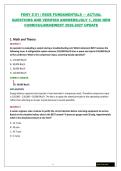
FDNY Z-51 / RSOE FUNDAMENTALS — ACTUAL
QUESTIONS AND VERIFIED ANSWERS|JULY 1, 2026 NEW
CURRICULUM|NEWEST 2026-2027 UPDATE
1. Math and Theory
Question 1
An operator is evaluating a system during a troubleshooting call. Which statement BEST resolves the
following issue: A refrigeration system removes 120,000 Btu/h from a space and rejects 150,000 Btu/h
at the condenser. What is the compressor input, assuming steady operation?
A. 270,000 Btu/h
B. 30,000 Btu/h
C. 20,000 Btu/h
D. 120,000 Btu/h
CORRECT ANSWER
B. 30,000 Btu/h
EXPLANATION
Energy balance requires heat rejected = heat absorbed + compressor work. Therefore compressor input
is 150,000 − 120,000 = 30,000 Btu/h. The key is to apply the stated principle to the operating condition
rather than selecting an answer merely because it sounds plausible.
Question 2
A senior engineer asks a trainee to justify the correct decision before returning equipment to service.
Based on the situation below, what is the BEST answer? A pressure gauge reads 20 psig. Approximately
what is the absolute pressure at sea level?
A. 14.7 psia
B. 20 psia
C. 34.7 psia
D. 5.3 psia
1 @THE STUDY VAULT
,CORRECT ANSWER
C. 34.7 psia
EXPLANATION
Absolute pressure is gauge pressure plus atmospheric pressure. At sea level, 20 + 14.7 = 34.7 psia. The
key is to apply the stated principle to the operating condition rather than selecting an answer merely
because it sounds plausible.
Question 3
During a scheduled operating review, the following condition is identified. Which response is MOST
technically defensible? A chiller removes 240 tons of refrigeration. Approximately how much heat is
being removed per hour?
A. 24,000 Btu/h
B. 240,000 Btu/h
C. 8,640,000 Btu/h
D. 2,880,000 Btu/h
CORRECT ANSWER
D. 2,880,000 Btu/h
EXPLANATION
One refrigeration ton is 12,000 Btu/h. Thus 240 × 12,000 = 2,880,000 Btu/h. The key is to apply the
stated principle to the operating condition rather than selecting an answer merely because it sounds
plausible.
Question 4
A technician is given the following problem and must choose the response that is safest and most
consistent with proper refrigeration practice. Which is correct? Water enters a heat exchanger at 60°F
and leaves at 50°F. What is the water temperature difference?
A. 10°F
B. 5°F
C. 50°F
D. 110°F
2 @THE STUDY VAULT
,CORRECT ANSWER
A. 10°F
EXPLANATION
The temperature difference is the entering temperature minus the leaving temperature: 60 − 50 = 10°F.
The key is to apply the stated principle to the operating condition rather than selecting an answer merely
because it sounds plausible.
Question 5
Consider a system in which the following condition has been observed. Which choice BEST explains
what the operator should conclude? If a pump moves 600 gallons per minute for 2 minutes,
approximately how many gallons are moved?
A. 1,800 gal
B. 1,200 gal
C. 300 gal
D. 600 gal
CORRECT ANSWER
B. 1,200 gal
EXPLANATION
Volume equals flow rate multiplied by time: 600 gpm × 2 min = 1,200 gallons. The key is to apply the
stated principle to the operating condition rather than selecting an answer merely because it sounds
plausible.
Question 6
An operator is evaluating a system during a troubleshooting call. Which statement BEST resolves the
following issue: A compressor operates at 3,600 rpm. How many revolutions does it make in 10
seconds?
A. 1,800
B. 36,000
C. 600
D. 360
3 @THE STUDY VAULT
, CORRECT ANSWER
C. 600
EXPLANATION
3,600 revolutions per minute equals 60 revolutions per second. In 10 seconds, it makes 60 × 10 = 600
revolutions. The key is to apply the stated principle to the operating condition rather than selecting an
answer merely because it sounds plausible.
Question 7
A senior engineer asks a trainee to justify the correct decision before returning equipment to service.
Based on the situation below, what is the BEST answer? A 50-ton chiller is operating at 80% of its rated
cooling capacity. What is its approximate present load?
A. 10 tons
B. 20 tons
C. 62.5 tons
D. 40 tons
CORRECT ANSWER
D. 40 tons
EXPLANATION
80% of 50 tons is 0.80 × 50 = 40 tons. The key is to apply the stated principle to the operating condition
rather than selecting an answer merely because it sounds plausible.
Question 8
During a scheduled operating review, the following condition is identified. Which response is MOST
technically defensible? Which statement best describes sensible heat?
A. Heat that changes temperature without changing phase
B. Heat that changes a substance from liquid to vapor
C. Heat stored only in refrigerant oil
D. Heat that exists only below freezing
CORRECT ANSWER
A. Heat that changes temperature without changing phase
4 @THE STUDY VAULT
QUESTIONS AND VERIFIED ANSWERS|JULY 1, 2026 NEW
CURRICULUM|NEWEST 2026-2027 UPDATE
1. Math and Theory
Question 1
An operator is evaluating a system during a troubleshooting call. Which statement BEST resolves the
following issue: A refrigeration system removes 120,000 Btu/h from a space and rejects 150,000 Btu/h
at the condenser. What is the compressor input, assuming steady operation?
A. 270,000 Btu/h
B. 30,000 Btu/h
C. 20,000 Btu/h
D. 120,000 Btu/h
CORRECT ANSWER
B. 30,000 Btu/h
EXPLANATION
Energy balance requires heat rejected = heat absorbed + compressor work. Therefore compressor input
is 150,000 − 120,000 = 30,000 Btu/h. The key is to apply the stated principle to the operating condition
rather than selecting an answer merely because it sounds plausible.
Question 2
A senior engineer asks a trainee to justify the correct decision before returning equipment to service.
Based on the situation below, what is the BEST answer? A pressure gauge reads 20 psig. Approximately
what is the absolute pressure at sea level?
A. 14.7 psia
B. 20 psia
C. 34.7 psia
D. 5.3 psia
1 @THE STUDY VAULT
,CORRECT ANSWER
C. 34.7 psia
EXPLANATION
Absolute pressure is gauge pressure plus atmospheric pressure. At sea level, 20 + 14.7 = 34.7 psia. The
key is to apply the stated principle to the operating condition rather than selecting an answer merely
because it sounds plausible.
Question 3
During a scheduled operating review, the following condition is identified. Which response is MOST
technically defensible? A chiller removes 240 tons of refrigeration. Approximately how much heat is
being removed per hour?
A. 24,000 Btu/h
B. 240,000 Btu/h
C. 8,640,000 Btu/h
D. 2,880,000 Btu/h
CORRECT ANSWER
D. 2,880,000 Btu/h
EXPLANATION
One refrigeration ton is 12,000 Btu/h. Thus 240 × 12,000 = 2,880,000 Btu/h. The key is to apply the
stated principle to the operating condition rather than selecting an answer merely because it sounds
plausible.
Question 4
A technician is given the following problem and must choose the response that is safest and most
consistent with proper refrigeration practice. Which is correct? Water enters a heat exchanger at 60°F
and leaves at 50°F. What is the water temperature difference?
A. 10°F
B. 5°F
C. 50°F
D. 110°F
2 @THE STUDY VAULT
,CORRECT ANSWER
A. 10°F
EXPLANATION
The temperature difference is the entering temperature minus the leaving temperature: 60 − 50 = 10°F.
The key is to apply the stated principle to the operating condition rather than selecting an answer merely
because it sounds plausible.
Question 5
Consider a system in which the following condition has been observed. Which choice BEST explains
what the operator should conclude? If a pump moves 600 gallons per minute for 2 minutes,
approximately how many gallons are moved?
A. 1,800 gal
B. 1,200 gal
C. 300 gal
D. 600 gal
CORRECT ANSWER
B. 1,200 gal
EXPLANATION
Volume equals flow rate multiplied by time: 600 gpm × 2 min = 1,200 gallons. The key is to apply the
stated principle to the operating condition rather than selecting an answer merely because it sounds
plausible.
Question 6
An operator is evaluating a system during a troubleshooting call. Which statement BEST resolves the
following issue: A compressor operates at 3,600 rpm. How many revolutions does it make in 10
seconds?
A. 1,800
B. 36,000
C. 600
D. 360
3 @THE STUDY VAULT
, CORRECT ANSWER
C. 600
EXPLANATION
3,600 revolutions per minute equals 60 revolutions per second. In 10 seconds, it makes 60 × 10 = 600
revolutions. The key is to apply the stated principle to the operating condition rather than selecting an
answer merely because it sounds plausible.
Question 7
A senior engineer asks a trainee to justify the correct decision before returning equipment to service.
Based on the situation below, what is the BEST answer? A 50-ton chiller is operating at 80% of its rated
cooling capacity. What is its approximate present load?
A. 10 tons
B. 20 tons
C. 62.5 tons
D. 40 tons
CORRECT ANSWER
D. 40 tons
EXPLANATION
80% of 50 tons is 0.80 × 50 = 40 tons. The key is to apply the stated principle to the operating condition
rather than selecting an answer merely because it sounds plausible.
Question 8
During a scheduled operating review, the following condition is identified. Which response is MOST
technically defensible? Which statement best describes sensible heat?
A. Heat that changes temperature without changing phase
B. Heat that changes a substance from liquid to vapor
C. Heat stored only in refrigerant oil
D. Heat that exists only below freezing
CORRECT ANSWER
A. Heat that changes temperature without changing phase
4 @THE STUDY VAULT



