

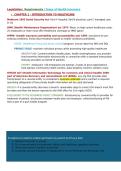
Legislation/ Requirements / Types of Health Insurance
CHAPTER 1 - INTRODUCTION TO HEALTHCARE
Medicare 1965 Social Security Act- Part A- Hospital, Part B physician, part C managed care,
D- Rx
HMO (Health Maintenance Organization) act 1973- Nixon, to help control healthcare costs-
25 employees or more must offer Healthcare coverage w/ HMO option
HIPPA- (health insurance portability and accountability act) 1996- exclusions for pre-
existing conditions, limits/ discriminations based on health conditions prohibited.
HCFAC- (Healthcare Fraud and abuse control) program- annual report by HHS and DOJ
PRIVACY RULE- maintain individual privacy while promoting high-quality healthcare
HEALTH PLAN- Covered entities (health plans, health clearinghouses, any provider
that transmits information electronically in connection with a standard transaction)
that pay providers on behalf of patients
EXEMPT- employers <50 employees are exempt, 2 types of govt organizations -
food stamps, Community health centers, Auto/ property insurers, workers comp
HITECH ACT (Health Information Technology for economic and clinical health) 2009
part of American Recovery and reinvestment act (ARRA)- any org that provides data
transmission to a covered entity is considered a business associate and a contract is required
specifying safeguards of how private health information will be used/ disclosed.
BREACH- if a covered entity discovers a breach- reasonable steps to correct the breach must first
be taken and then the breach reported to the HHS office for Civil rights (OCR).
EXCLUSIONS TO THE BUSSINESS ASSOC STANDARD- disclosures by covered entity to provider for
treatment of patient, disclosures between health plan and employer, collection/sharing of PHI
that is part of a govt health program
Exceptions to need for written permission by patient by Privacy Rule:
1) Release of records to patient
2) By a covered entity for treatment, billing, and healthcare operation activities
3) Verbal permission if patient cannot sign
4) Incidental use and disclosure if safeguards to12 national
insure exceptions
Minimum to privacy
and Necessary rule rule:
1) Required by law
1
, 2) Public health activities 6) Law enforcement purposes
3) Victims of domestic violence, abuse or 7) Decedents
neglect 8) Organ donation
4) Health oversight activities 9) Research
5) Judicial and administrative proceed 10) Essential govt functions
11) Workers’ compensation
12) Serious health or safety threat
Privacy Rule states Covered entities MUST-
1. Supply a notice by request to anyone whether direct or indirect care was provided
2. make its privacy notice available electronically on any website
3. must make a good faith effort to supply written confirmation that the patient has received
the privacy practice notice
4. provide patients with their own PHI (except psychotherapy notes, info related to legal
proceedings, research lab results- but may charge for copies.
Privacy Rule Administrative Requirements:
1) Covered entities must have written policies that comply with the privacy rule
2) Privacy Official must be delegated
3) All members must be trained in Privacy practices
4) Required to mitigate any harmful effect from breach
5) Process for complaints must be in place
6) May not retaliate against anyone for exercising their rights
7) Must be maintained for 6 years
8) Fully insured group health plans only have 2 requirements:
a. Refrain from retaliation
b. provide documentation for disclosure of PHI
SECURITY RULE- establish national standards to protect patient data that is stored or
transmitted electronically- 6 year
8 standard transactions for EDI under HIPPA:
1) Claims and encounter info
2) Healthcare payment and remittance
3) HC claims status 6) Referrals
4) Enrollment 7) COB
5) Eligibility 8) Premium Payments
Code set Adoptions:
1) HCPCS (Healthcare Common Procedure Coding System)- services not covered by
CPT
2) CPT
3) ICD-10 CM (International Classification of Diseases)-
4) ICD-10 PCS procedures for IP hospital Services
2
, 5) NDC- National Drug Codes
6) CDT- Current Dental Terminology
7) Place of service codes
8) Unique identifier for employers and Providers must be used
CMS requirements for records:
Medical records- 5 yrs
Cost reports for providers- 5 yrs
Managed care- 10 yrs
FRAUD- making false statements to receive benefit or payment
ABUSE- actions that result in waste or overcharge to Federal HC programs
QUI-TAM- whistleblower
STARK LAW- amendment to the SSA that prevents physicians from self- referral
ANTI-KICKBACK LAW- punishable by up to 25K fine, exclusion from any Federal Healthcare Plan
MACRA- Medicare Access and CHIP Reauthorization Act
Truth in lending act- finance charges or interest
LIMITING CHARGE- 115% of Nonparticipating fee schedule
CHAPTER 2: HEALTH INSURANCE MODELS AND CONSUMER DRIVEN
HEALTH PLANS
OPT OUT of Medicare- no limiting charge, Medicare will not pay patient or provider,
Patient pays100%
SHIP- (State Health Insurance Program)- free benefits counseling to Medicare patients
HMO ACT 1973- companies w/ > 50 employees must provide an HMO option with Basic
+ Selection of Supplemental
Basic Health Services required for HMO-
Physician Services
IP and OP Hospital services
Emergency
OP and short-term crisis intervention Mental Health 20 visits
Alcohol and Drug Addiction Treatment
Dx Labs and Dx and therapeutic radiology
Home health
Preventative health (includes family planning, infertility, preventative dental for
children, children’s eye exams)
Supplemental selection required for HMO-
Facility intermediate and long-term care
Vision care
Dental
Mental Health
Long term physical med and rehab
Prescription drugs prescribed in treatment of basic services
HMO MODELS:
Group Model- HMO contracts w/ multi-specialty group of MDs
Types of Group ins-
3
, Fully insured group
Small employer group
Self-funded ERISA
Association Group
1. Staff Model- HMO employees MDs
2. Network Model- HMO contracts w/ multiple multi-specialty groups, individual
MDs, provider network
3. Individual Practice Association Model (IPA)- Doctors provide services to HMO
and NON-HMO patients and maintain their own offices, receive a fixed
amount per patient
4. Mixed Model- HMO has both kinds, offers greatest choice to patients
5. EPO (Exclusive provider organization)- if members use an out-of-net network
provider, they pay 100%, members pay % up to OOP MAX.
IDS INTEGRATED DELIVERY SYSTEMS-
Physician-Hospital Organization (PHO)- owned by doctors and hospitals
MANAGEMENT SERVICE ORGANIZATION (MSO)- PROVIDES NON- CLINICAL SERVICES TO
PROVIDERS
Group Practice Without Walls (GPWW)- physician group that shares risks, expenses
but separate offices
Integrated Provider Organization (IPO)- Corporate umbrella of doctors, hospitals and
MSO
Preferred Provider Organization- (PPO)- Members choose Network or pay more for
out, no gatekeeper
TRIPLE OPTION PLAN- insurer has 3 options for patient to pick from, straight
indemnity, PPO or HMO
Patient Protection and Affordable Care Act- banned lifetime limits, pre-existing
condition denial, college aged kids can remain on parents’ health ins until age 26,
appeal rights for patients denied coverage,
Accountable Care Organization (ACO)- must agree to join for at least 3 years and be
responsible for at least 5000 Medicare fee for service beneficiaries. Are not insurance
companies
Medicare uses the MEDICARE PHYSICIAN FEE SCHEDULE (MPFS) to reimburse part B
fees
MPFS= physician work+ practice expense+ liability ins (each part assigned a Relative
Value Unit (RVU) adjusted geographically for wage and cost differences
Medicare Part A- hospital, skilled nursing facility, nursing home, hospice, home health
$505/ month if not qualified through workforce or spouse/ children
Medicare Part B- MDS, ambulance, medical equipment, mental health $174/ month
TRICARE-
Tricare Prime
Tricare Select
Tricare for Life
Tricare Reserve select
Tricare Retired Reserve
4
CHAPTER 1 - INTRODUCTION TO HEALTHCARE
Medicare 1965 Social Security Act- Part A- Hospital, Part B physician, part C managed care,
D- Rx
HMO (Health Maintenance Organization) act 1973- Nixon, to help control healthcare costs-
25 employees or more must offer Healthcare coverage w/ HMO option
HIPPA- (health insurance portability and accountability act) 1996- exclusions for pre-
existing conditions, limits/ discriminations based on health conditions prohibited.
HCFAC- (Healthcare Fraud and abuse control) program- annual report by HHS and DOJ
PRIVACY RULE- maintain individual privacy while promoting high-quality healthcare
HEALTH PLAN- Covered entities (health plans, health clearinghouses, any provider
that transmits information electronically in connection with a standard transaction)
that pay providers on behalf of patients
EXEMPT- employers <50 employees are exempt, 2 types of govt organizations -
food stamps, Community health centers, Auto/ property insurers, workers comp
HITECH ACT (Health Information Technology for economic and clinical health) 2009
part of American Recovery and reinvestment act (ARRA)- any org that provides data
transmission to a covered entity is considered a business associate and a contract is required
specifying safeguards of how private health information will be used/ disclosed.
BREACH- if a covered entity discovers a breach- reasonable steps to correct the breach must first
be taken and then the breach reported to the HHS office for Civil rights (OCR).
EXCLUSIONS TO THE BUSSINESS ASSOC STANDARD- disclosures by covered entity to provider for
treatment of patient, disclosures between health plan and employer, collection/sharing of PHI
that is part of a govt health program
Exceptions to need for written permission by patient by Privacy Rule:
1) Release of records to patient
2) By a covered entity for treatment, billing, and healthcare operation activities
3) Verbal permission if patient cannot sign
4) Incidental use and disclosure if safeguards to12 national
insure exceptions
Minimum to privacy
and Necessary rule rule:
1) Required by law
1
, 2) Public health activities 6) Law enforcement purposes
3) Victims of domestic violence, abuse or 7) Decedents
neglect 8) Organ donation
4) Health oversight activities 9) Research
5) Judicial and administrative proceed 10) Essential govt functions
11) Workers’ compensation
12) Serious health or safety threat
Privacy Rule states Covered entities MUST-
1. Supply a notice by request to anyone whether direct or indirect care was provided
2. make its privacy notice available electronically on any website
3. must make a good faith effort to supply written confirmation that the patient has received
the privacy practice notice
4. provide patients with their own PHI (except psychotherapy notes, info related to legal
proceedings, research lab results- but may charge for copies.
Privacy Rule Administrative Requirements:
1) Covered entities must have written policies that comply with the privacy rule
2) Privacy Official must be delegated
3) All members must be trained in Privacy practices
4) Required to mitigate any harmful effect from breach
5) Process for complaints must be in place
6) May not retaliate against anyone for exercising their rights
7) Must be maintained for 6 years
8) Fully insured group health plans only have 2 requirements:
a. Refrain from retaliation
b. provide documentation for disclosure of PHI
SECURITY RULE- establish national standards to protect patient data that is stored or
transmitted electronically- 6 year
8 standard transactions for EDI under HIPPA:
1) Claims and encounter info
2) Healthcare payment and remittance
3) HC claims status 6) Referrals
4) Enrollment 7) COB
5) Eligibility 8) Premium Payments
Code set Adoptions:
1) HCPCS (Healthcare Common Procedure Coding System)- services not covered by
CPT
2) CPT
3) ICD-10 CM (International Classification of Diseases)-
4) ICD-10 PCS procedures for IP hospital Services
2
, 5) NDC- National Drug Codes
6) CDT- Current Dental Terminology
7) Place of service codes
8) Unique identifier for employers and Providers must be used
CMS requirements for records:
Medical records- 5 yrs
Cost reports for providers- 5 yrs
Managed care- 10 yrs
FRAUD- making false statements to receive benefit or payment
ABUSE- actions that result in waste or overcharge to Federal HC programs
QUI-TAM- whistleblower
STARK LAW- amendment to the SSA that prevents physicians from self- referral
ANTI-KICKBACK LAW- punishable by up to 25K fine, exclusion from any Federal Healthcare Plan
MACRA- Medicare Access and CHIP Reauthorization Act
Truth in lending act- finance charges or interest
LIMITING CHARGE- 115% of Nonparticipating fee schedule
CHAPTER 2: HEALTH INSURANCE MODELS AND CONSUMER DRIVEN
HEALTH PLANS
OPT OUT of Medicare- no limiting charge, Medicare will not pay patient or provider,
Patient pays100%
SHIP- (State Health Insurance Program)- free benefits counseling to Medicare patients
HMO ACT 1973- companies w/ > 50 employees must provide an HMO option with Basic
+ Selection of Supplemental
Basic Health Services required for HMO-
Physician Services
IP and OP Hospital services
Emergency
OP and short-term crisis intervention Mental Health 20 visits
Alcohol and Drug Addiction Treatment
Dx Labs and Dx and therapeutic radiology
Home health
Preventative health (includes family planning, infertility, preventative dental for
children, children’s eye exams)
Supplemental selection required for HMO-
Facility intermediate and long-term care
Vision care
Dental
Mental Health
Long term physical med and rehab
Prescription drugs prescribed in treatment of basic services
HMO MODELS:
Group Model- HMO contracts w/ multi-specialty group of MDs
Types of Group ins-
3
, Fully insured group
Small employer group
Self-funded ERISA
Association Group
1. Staff Model- HMO employees MDs
2. Network Model- HMO contracts w/ multiple multi-specialty groups, individual
MDs, provider network
3. Individual Practice Association Model (IPA)- Doctors provide services to HMO
and NON-HMO patients and maintain their own offices, receive a fixed
amount per patient
4. Mixed Model- HMO has both kinds, offers greatest choice to patients
5. EPO (Exclusive provider organization)- if members use an out-of-net network
provider, they pay 100%, members pay % up to OOP MAX.
IDS INTEGRATED DELIVERY SYSTEMS-
Physician-Hospital Organization (PHO)- owned by doctors and hospitals
MANAGEMENT SERVICE ORGANIZATION (MSO)- PROVIDES NON- CLINICAL SERVICES TO
PROVIDERS
Group Practice Without Walls (GPWW)- physician group that shares risks, expenses
but separate offices
Integrated Provider Organization (IPO)- Corporate umbrella of doctors, hospitals and
MSO
Preferred Provider Organization- (PPO)- Members choose Network or pay more for
out, no gatekeeper
TRIPLE OPTION PLAN- insurer has 3 options for patient to pick from, straight
indemnity, PPO or HMO
Patient Protection and Affordable Care Act- banned lifetime limits, pre-existing
condition denial, college aged kids can remain on parents’ health ins until age 26,
appeal rights for patients denied coverage,
Accountable Care Organization (ACO)- must agree to join for at least 3 years and be
responsible for at least 5000 Medicare fee for service beneficiaries. Are not insurance
companies
Medicare uses the MEDICARE PHYSICIAN FEE SCHEDULE (MPFS) to reimburse part B
fees
MPFS= physician work+ practice expense+ liability ins (each part assigned a Relative
Value Unit (RVU) adjusted geographically for wage and cost differences
Medicare Part A- hospital, skilled nursing facility, nursing home, hospice, home health
$505/ month if not qualified through workforce or spouse/ children
Medicare Part B- MDS, ambulance, medical equipment, mental health $174/ month
TRICARE-
Tricare Prime
Tricare Select
Tricare for Life
Tricare Reserve select
Tricare Retired Reserve
4


