

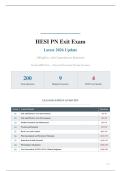
HESI PN Exit Exam
Latest 2026 Update
200 Q&As; with Comprehensive Rationales
Nursing HESI Prep — Practical/Vocational Nursing Licensure
200 9 4
Total Questions Blueprint Sections NGN Case Studies
EXAM BLUEPRINT OVERVIEW
Section Content Domain Questions
S1 Safe and Effective Care Environment Q1-30
S2 Safe and Effective Care Environment Q31-50
S3 Health Promotion and Maintenance Q51-70
S4 Psychosocial Integrity Q71-90
S5 Basic Care and Comfort Q91-110
S6 Pharmacological and Parenteral Therapies Q111-135
S7 Reduction of Risk Potential Q136-155
S8 Physiological Adaptation Q156-185
S9 Next Generation NCLEX (NGN) Clinical Judgment Q186-200
Cover
,HESI PN Exit Exam 2026 | 200 Q&As with Rationales
Aligned with 2026-2027 HESI PN Exit Exam Standards & NGN Clinical Judgment Measurement Model
LPN/LVN Scope of Practice Emphasis Throughout
Practical Nursing Licensure Preparation Page 2
,HESI PN Exit Exam 2026 | 200 Q&As with Rationales
Section 1: Safe and Effective Care Environment - Coordinated Care
Q1-30
Focus: Advocacy, Client Rights, Delegation, Supervision, Assignment, Ethics, Legal Issues, Advance Directives, HIPAA,
Continuity of Care, Interdisciplinary Collaboration, & Case Management - PN Scope
Q1
An LPN/LVN on a medical-surgical unit is assigned to care for four clients. Which client should the
LPN/LVN recognize as requiring the most immediate intervention by the RN supervisor?
A. A client 2 hours post-colonoscopy reporting mild abdominal cramping.
B. A client with chronic heart failure reporting new-onset dyspnea and a 3-pound weight gain since
yesterday. [CORRECT]
C. A client receiving IV antibiotics for cellulitis who is requesting pain medication for incisional discomfort
rated 4/10.
D. A client preparing for discharge after total hip replacement who needs reinforcement of home precautions.
Correct Answer: B. A client with chronic heart failure reporting new-onset dyspnea and a 3-pound weight
gain since yesterday.
Rationale:
The LPN/LVN must recognize that new-onset dyspnea with sudden weight gain in a heart failure client signals acute
decompensation and possible pulmonary edema, requiring immediate RN assessment and provider notification. This
client's condition reflects physiological instability (ABCs compromised — airway/breathing) and exceeds the
LPN/LVN's independent scope, warranting escalation. The post-colonoscopy client (A) has expected findings within
normal recovery parameters. Pain management for cellulitis (C) and discharge teaching for hip replacement (D) are
within LPN/LVN scope and do not represent emergencies. The HESI PN strategy here is to apply the ABC framework
and acute-vs-chronic prioritization, and to recognize that complex, unstable clients require RN involvement.
Q2
Which task is most appropriate for the LPN/LVN to delegate to a UAP (unlicensed assistive
personnel)?
A. Teaching a newly diagnosed diabetic client about foot care.
B. Measuring intake and output for a client receiving IV diuretic therapy. [CORRECT]
C. Assessing a stage 3 pressure injury for signs of infection.
D. Evaluating the effectiveness of prescribed opioid analgesia.
Correct Answer: B. Measuring intake and output for a client receiving IV diuretic therapy.
Rationale:
Measuring intake and output is a routine, standardized task with established parameters that falls within the UAP scope
under the LPN/LVN's direction. The five rights of delegation (right task, right circumstance, right person, right
direction, right supervision) support assigning non-invasive measurement activities to UAPs. Teaching diabetic foot
care (A) requires nursing knowledge and is outside UAP scope. Wound assessment (C) requires clinical judgment and
licensure. Evaluating medication effectiveness (D) is a nursing function requiring assessment skills and pharmacologic
knowledge. The LPN/LVN retains accountability for the accuracy of the delegated measurement and verifies results.
Q3
Practical Nursing Licensure Preparation Page 3
, HESI PN Exit Exam 2026 | 200 Q&As with Rationales
A client scheduled for an elective cholecystectomy tells the LPN/LVN, "I changed my mind — I don't
want this surgery." What is the LPN/LVN's best initial action?
A. Document the client's statement and notify the surgeon. [CORRECT]
B. Remind the client that the surgery has already been scheduled.
C. Explain the consequences of cancelling the procedure.
D. Ask the client to discuss concerns with the anesthesiologist.
Correct Answer: A. Document the client's statement and notify the surgeon.
Rationale:
A competent adult client has the legal right to refuse treatment at any time, even after signing a consent form. The
LPN/LVN's role is to acknowledge the refusal, document the client's statement verbatim, and notify the surgeon so the
provider can speak directly with the client. Reminding the client that surgery is scheduled (B) is coercive. Explaining
consequences (C) may be perceived as pressuring and exceeds LPN/LVN scope; the provider must give procedural
information. The anesthesiologist (D) is not the appropriate professional to address the client's broader decision. This
protects client autonomy and meets legal documentation standards.
Q4
A client with a living will is admitted with end-stage COPD and develops respiratory failure. The
family insists on intubation, but the client previously documented refusal of mechanical
ventilation. What should the LPN/LVN do?
A. Follow the family's request because they are next of kin.
B. Notify the RN and provider immediately and ensure the advance directive is in the chart.
[CORRECT]
C. Withhold all respiratory support until ethics committee review.
D. Administer prescribed anxiolytics and continue oxygen by nasal cannula only.
Correct Answer: B. Notify the RN and provider immediately and ensure the advance directive is in the
chart.
Rationale:
A living will is a legally binding advance directive that must be honored when the client loses decision-making capacity.
The LPN/LVN must advocate for the client's documented wishes by immediately escalating to the RN and provider,
who will direct care in accordance with the directive. Family members cannot override a valid advance directive (A).
Withholding all support without provider direction (C) is premature. The nurse cannot independently decide to limit
care (D). HIPAA and Patient Self-Determination Act require that advance directives be honored and accessible in the
medical record.
Q5
A client diagnosed with HIV asks the LPN/LVN not to disclose the diagnosis to the client's spouse.
Which response by the nurse best demonstrates HIPAA compliance?
A. "I have to tell your spouse because they are at risk of exposure."
B. "I will keep your diagnosis confidential, but I encourage you to discuss this with your spouse and
provider." [CORRECT]
C. "Your spouse will be notified by the public health department automatically."
D. "It is my legal duty to inform all family members living in your household."
Practical Nursing Licensure Preparation Page 4
Latest 2026 Update
200 Q&As; with Comprehensive Rationales
Nursing HESI Prep — Practical/Vocational Nursing Licensure
200 9 4
Total Questions Blueprint Sections NGN Case Studies
EXAM BLUEPRINT OVERVIEW
Section Content Domain Questions
S1 Safe and Effective Care Environment Q1-30
S2 Safe and Effective Care Environment Q31-50
S3 Health Promotion and Maintenance Q51-70
S4 Psychosocial Integrity Q71-90
S5 Basic Care and Comfort Q91-110
S6 Pharmacological and Parenteral Therapies Q111-135
S7 Reduction of Risk Potential Q136-155
S8 Physiological Adaptation Q156-185
S9 Next Generation NCLEX (NGN) Clinical Judgment Q186-200
Cover
,HESI PN Exit Exam 2026 | 200 Q&As with Rationales
Aligned with 2026-2027 HESI PN Exit Exam Standards & NGN Clinical Judgment Measurement Model
LPN/LVN Scope of Practice Emphasis Throughout
Practical Nursing Licensure Preparation Page 2
,HESI PN Exit Exam 2026 | 200 Q&As with Rationales
Section 1: Safe and Effective Care Environment - Coordinated Care
Q1-30
Focus: Advocacy, Client Rights, Delegation, Supervision, Assignment, Ethics, Legal Issues, Advance Directives, HIPAA,
Continuity of Care, Interdisciplinary Collaboration, & Case Management - PN Scope
Q1
An LPN/LVN on a medical-surgical unit is assigned to care for four clients. Which client should the
LPN/LVN recognize as requiring the most immediate intervention by the RN supervisor?
A. A client 2 hours post-colonoscopy reporting mild abdominal cramping.
B. A client with chronic heart failure reporting new-onset dyspnea and a 3-pound weight gain since
yesterday. [CORRECT]
C. A client receiving IV antibiotics for cellulitis who is requesting pain medication for incisional discomfort
rated 4/10.
D. A client preparing for discharge after total hip replacement who needs reinforcement of home precautions.
Correct Answer: B. A client with chronic heart failure reporting new-onset dyspnea and a 3-pound weight
gain since yesterday.
Rationale:
The LPN/LVN must recognize that new-onset dyspnea with sudden weight gain in a heart failure client signals acute
decompensation and possible pulmonary edema, requiring immediate RN assessment and provider notification. This
client's condition reflects physiological instability (ABCs compromised — airway/breathing) and exceeds the
LPN/LVN's independent scope, warranting escalation. The post-colonoscopy client (A) has expected findings within
normal recovery parameters. Pain management for cellulitis (C) and discharge teaching for hip replacement (D) are
within LPN/LVN scope and do not represent emergencies. The HESI PN strategy here is to apply the ABC framework
and acute-vs-chronic prioritization, and to recognize that complex, unstable clients require RN involvement.
Q2
Which task is most appropriate for the LPN/LVN to delegate to a UAP (unlicensed assistive
personnel)?
A. Teaching a newly diagnosed diabetic client about foot care.
B. Measuring intake and output for a client receiving IV diuretic therapy. [CORRECT]
C. Assessing a stage 3 pressure injury for signs of infection.
D. Evaluating the effectiveness of prescribed opioid analgesia.
Correct Answer: B. Measuring intake and output for a client receiving IV diuretic therapy.
Rationale:
Measuring intake and output is a routine, standardized task with established parameters that falls within the UAP scope
under the LPN/LVN's direction. The five rights of delegation (right task, right circumstance, right person, right
direction, right supervision) support assigning non-invasive measurement activities to UAPs. Teaching diabetic foot
care (A) requires nursing knowledge and is outside UAP scope. Wound assessment (C) requires clinical judgment and
licensure. Evaluating medication effectiveness (D) is a nursing function requiring assessment skills and pharmacologic
knowledge. The LPN/LVN retains accountability for the accuracy of the delegated measurement and verifies results.
Q3
Practical Nursing Licensure Preparation Page 3
, HESI PN Exit Exam 2026 | 200 Q&As with Rationales
A client scheduled for an elective cholecystectomy tells the LPN/LVN, "I changed my mind — I don't
want this surgery." What is the LPN/LVN's best initial action?
A. Document the client's statement and notify the surgeon. [CORRECT]
B. Remind the client that the surgery has already been scheduled.
C. Explain the consequences of cancelling the procedure.
D. Ask the client to discuss concerns with the anesthesiologist.
Correct Answer: A. Document the client's statement and notify the surgeon.
Rationale:
A competent adult client has the legal right to refuse treatment at any time, even after signing a consent form. The
LPN/LVN's role is to acknowledge the refusal, document the client's statement verbatim, and notify the surgeon so the
provider can speak directly with the client. Reminding the client that surgery is scheduled (B) is coercive. Explaining
consequences (C) may be perceived as pressuring and exceeds LPN/LVN scope; the provider must give procedural
information. The anesthesiologist (D) is not the appropriate professional to address the client's broader decision. This
protects client autonomy and meets legal documentation standards.
Q4
A client with a living will is admitted with end-stage COPD and develops respiratory failure. The
family insists on intubation, but the client previously documented refusal of mechanical
ventilation. What should the LPN/LVN do?
A. Follow the family's request because they are next of kin.
B. Notify the RN and provider immediately and ensure the advance directive is in the chart.
[CORRECT]
C. Withhold all respiratory support until ethics committee review.
D. Administer prescribed anxiolytics and continue oxygen by nasal cannula only.
Correct Answer: B. Notify the RN and provider immediately and ensure the advance directive is in the
chart.
Rationale:
A living will is a legally binding advance directive that must be honored when the client loses decision-making capacity.
The LPN/LVN must advocate for the client's documented wishes by immediately escalating to the RN and provider,
who will direct care in accordance with the directive. Family members cannot override a valid advance directive (A).
Withholding all support without provider direction (C) is premature. The nurse cannot independently decide to limit
care (D). HIPAA and Patient Self-Determination Act require that advance directives be honored and accessible in the
medical record.
Q5
A client diagnosed with HIV asks the LPN/LVN not to disclose the diagnosis to the client's spouse.
Which response by the nurse best demonstrates HIPAA compliance?
A. "I have to tell your spouse because they are at risk of exposure."
B. "I will keep your diagnosis confidential, but I encourage you to discuss this with your spouse and
provider." [CORRECT]
C. "Your spouse will be notified by the public health department automatically."
D. "It is my legal duty to inform all family members living in your household."
Practical Nursing Licensure Preparation Page 4


