

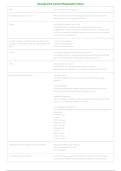
Georgia Pest Control Registration Exam
EPA Environmental Protection Agency
Endangered Species Act of 1973 Required EPA to ensure that using registered pesticides would not harm
species placed on endangered species list.
FQPA Food Quality Protection Act of 1996
Amended FIFRA and directed EPA to regulate pesticides through
establishment of tolerance levels for pesticides from dietary, drinking water,
and non-occupational (residential) exposure in conjunction with the Federal,
Food, Drug, and Cosmetic Act.
In order to obtain a registration, EPA and GDA require -Toxicity of the pesticide
pesticide manufactures provide what information to the -Hazard to the applicator
EPA? -Effect on the environment
OSHA Occupational Safety and Health Administration 1970
Any company with 10 or more employees to keep certain records and make
reports including all work related deaths, injuries, and illnesses.
SPCA Structural Pest Control Act
Primary law for the pest management industry in Georgia.
The Department of Agriculture is the enforcement agency for the SPCA.
Requirements for Georgia SPCA Company License
-All pest management companies must be licensed before they begin
operation
Certified Operator
-Every pest management company (branch) must employee at least one
person who has taken and passed the certification exam.
Registered Employees
-all non-certified technicians must be registered, in order to work without the
presence of a certified or registered employee.
Re-certification/re-registration
-All certified and registered employees must be re-certified and re-registered
periodically.
Re-certification
-5 years
-HPC- 25 hours
-WDO- 25 hours
-FUM- 12 hours
Re-registration
-2 years
-HPC- 8 hours
-WDO- 8 hours
-FUM- 3 hours
Designated Certified Operators (DCO) Categories WDO- Wood Destroying Organisms
HPC- Household Pest Control
FUM- Fumigation
Contracts for Control of WDO A contract must be issued for every WDO service before the work begins.
Copied must be kept for 2 years following the expiration of the contract.
, Georgia Pest Control Registration Exam
Comprehensive Post Construction Soil Termiticide Removal of all cellulosic material from under the building
Application for Subterranean Termites Removal of all wood to earth contacts except pressure treated wood designed
for ground contact
Removal of all visible and accessible termite tunnels
Application of of an approved termiticide to all exterior and interior soils
Defined Post Construction Soil Termiticide Application Removal of all cellulosic material from under the building
for Subterranean Termites Removal of all wood to earth contacts except pressure treated wood designed
for ground contact
Removal of all accessible termite tunnels
Application of of an approved termiticide
Post Construction Soil Termiticide Application for Removal of all cellulosic material from under the building
Subterranean Termites, Other than Baits Removal of all wood to earth contacts except pressure treated wood designed
for ground contact
Removal of all visible and accessible termite tunnels
Application of of an approved termiticide
Post Construction Termiticide Bait Application for Removal of all cellulosic material from under the building
Subterranean Termites Removal of all wood to earth contacts except pressure treated wood designed
for ground contact
Removal of all visible and accessible termite tunnels
Install/service an approved baiting system
Pre-Construction Termiticide Bait Application for Systems must be monitored for one year at no additional cost when installed
Subterranean Termites for pre-construction or to control infestations found during the coverage
period of an official Georgia Wood Infestation Inspection Report.
Alternate Application Techniques (AAT) AATs must be approved by the commission prior to use
Removal of all cellulosic material from under the building
Removal of all wood to earth contacts except pressure treated wood designed
for ground contact
Removal of all visible and accessible termite tunnels
Application of an approved soil termiticide, where application includes all
areas specified in defined, comprehensive, or pre-construction treatments
Treatment of Powder Post Beetles and Wood Borers Application of an approved pesticide
Ventilation of the under-floor space between the bottom of the floor joists and
the earth to meet the requirements of the International Residential Building
Code for one and two family dwellings
Treatment of Wood Decay Fungi Ventilation of the under-floor space between the bottom of the floor joists and
the earth to meet the requirements of the International Residential Building
Code for one and two family dwellings
Installation of a vapor barrier to cover a minimum of 70% of the exposed soil
surface in a crawl space
Treatment of Dry Wood Termites Application of an approved pesticide
, Georgia Pest Control Registration Exam
Treatment of Schools Treatment of Schools involves taking special precautions to minimize the
potential exposure of students to pesticides.
-Application of pesticides in rooms vacant for 3+ hours
-Applications of bait formulations, rodenticide baits in tamper-resistant
containers, insecticides when students not in the room.
-Outdoor: allowed if students are not expected to be present within 20 feet of
the application site. Must be clearly marked by fence or similar barrier.
-All dilutions must be mixed outside of student occupied areas.
-Liquid termiticides must be performed when students are not present (20+
feet away) and are not expected to be present for 3+ hours
Fair Business Practices Act All contracts signed contain a notice that the contract can be canceled for up
to 3 business days after signing. Requires all work be performed in a quality
manner.
Hazardous Waste Management Act 1979- Follow the Federal Resource Conservation and Recover Act (RCRA). This
law protects human health and the environment from improper activities
involving hazardous waste.
Pesticide Use and Application Act The GDA enforces the Georgia Pesticide Use and Application Act.
This law deals with the regulation and licensing of certain areas related to
structural pest control. Mosquito and Lawn
Three Life Support Requirements a Pest Needs to Food
Survive Water
Harborage (a place to hide)
Three Major Groups of Pests Insects and other arthropods (mites, ticks, spiders)
Vertebrates (birds, squirrels, rats, and mice)
Wood decay fungi
Arthropods A group of animals that includes insects, spiders, mites, and ticks.
All Arthropods share some biological characteristics with Humans:
What biological characteristics do Arthropods share A central nervous system- a main nerve cord that runs the length of the body
with Humans?
Striated skeletal muscles- like in humans, but arthropod muscles are attached
inside the exoskeleton
Bilateral symmetry- like humans, if you cut an arthropod down the middle both
halves look like mirror images
EPA Environmental Protection Agency
Endangered Species Act of 1973 Required EPA to ensure that using registered pesticides would not harm
species placed on endangered species list.
FQPA Food Quality Protection Act of 1996
Amended FIFRA and directed EPA to regulate pesticides through
establishment of tolerance levels for pesticides from dietary, drinking water,
and non-occupational (residential) exposure in conjunction with the Federal,
Food, Drug, and Cosmetic Act.
In order to obtain a registration, EPA and GDA require -Toxicity of the pesticide
pesticide manufactures provide what information to the -Hazard to the applicator
EPA? -Effect on the environment
OSHA Occupational Safety and Health Administration 1970
Any company with 10 or more employees to keep certain records and make
reports including all work related deaths, injuries, and illnesses.
SPCA Structural Pest Control Act
Primary law for the pest management industry in Georgia.
The Department of Agriculture is the enforcement agency for the SPCA.
Requirements for Georgia SPCA Company License
-All pest management companies must be licensed before they begin
operation
Certified Operator
-Every pest management company (branch) must employee at least one
person who has taken and passed the certification exam.
Registered Employees
-all non-certified technicians must be registered, in order to work without the
presence of a certified or registered employee.
Re-certification/re-registration
-All certified and registered employees must be re-certified and re-registered
periodically.
Re-certification
-5 years
-HPC- 25 hours
-WDO- 25 hours
-FUM- 12 hours
Re-registration
-2 years
-HPC- 8 hours
-WDO- 8 hours
-FUM- 3 hours
Designated Certified Operators (DCO) Categories WDO- Wood Destroying Organisms
HPC- Household Pest Control
FUM- Fumigation
Contracts for Control of WDO A contract must be issued for every WDO service before the work begins.
Copied must be kept for 2 years following the expiration of the contract.
, Georgia Pest Control Registration Exam
Comprehensive Post Construction Soil Termiticide Removal of all cellulosic material from under the building
Application for Subterranean Termites Removal of all wood to earth contacts except pressure treated wood designed
for ground contact
Removal of all visible and accessible termite tunnels
Application of of an approved termiticide to all exterior and interior soils
Defined Post Construction Soil Termiticide Application Removal of all cellulosic material from under the building
for Subterranean Termites Removal of all wood to earth contacts except pressure treated wood designed
for ground contact
Removal of all accessible termite tunnels
Application of of an approved termiticide
Post Construction Soil Termiticide Application for Removal of all cellulosic material from under the building
Subterranean Termites, Other than Baits Removal of all wood to earth contacts except pressure treated wood designed
for ground contact
Removal of all visible and accessible termite tunnels
Application of of an approved termiticide
Post Construction Termiticide Bait Application for Removal of all cellulosic material from under the building
Subterranean Termites Removal of all wood to earth contacts except pressure treated wood designed
for ground contact
Removal of all visible and accessible termite tunnels
Install/service an approved baiting system
Pre-Construction Termiticide Bait Application for Systems must be monitored for one year at no additional cost when installed
Subterranean Termites for pre-construction or to control infestations found during the coverage
period of an official Georgia Wood Infestation Inspection Report.
Alternate Application Techniques (AAT) AATs must be approved by the commission prior to use
Removal of all cellulosic material from under the building
Removal of all wood to earth contacts except pressure treated wood designed
for ground contact
Removal of all visible and accessible termite tunnels
Application of an approved soil termiticide, where application includes all
areas specified in defined, comprehensive, or pre-construction treatments
Treatment of Powder Post Beetles and Wood Borers Application of an approved pesticide
Ventilation of the under-floor space between the bottom of the floor joists and
the earth to meet the requirements of the International Residential Building
Code for one and two family dwellings
Treatment of Wood Decay Fungi Ventilation of the under-floor space between the bottom of the floor joists and
the earth to meet the requirements of the International Residential Building
Code for one and two family dwellings
Installation of a vapor barrier to cover a minimum of 70% of the exposed soil
surface in a crawl space
Treatment of Dry Wood Termites Application of an approved pesticide
, Georgia Pest Control Registration Exam
Treatment of Schools Treatment of Schools involves taking special precautions to minimize the
potential exposure of students to pesticides.
-Application of pesticides in rooms vacant for 3+ hours
-Applications of bait formulations, rodenticide baits in tamper-resistant
containers, insecticides when students not in the room.
-Outdoor: allowed if students are not expected to be present within 20 feet of
the application site. Must be clearly marked by fence or similar barrier.
-All dilutions must be mixed outside of student occupied areas.
-Liquid termiticides must be performed when students are not present (20+
feet away) and are not expected to be present for 3+ hours
Fair Business Practices Act All contracts signed contain a notice that the contract can be canceled for up
to 3 business days after signing. Requires all work be performed in a quality
manner.
Hazardous Waste Management Act 1979- Follow the Federal Resource Conservation and Recover Act (RCRA). This
law protects human health and the environment from improper activities
involving hazardous waste.
Pesticide Use and Application Act The GDA enforces the Georgia Pesticide Use and Application Act.
This law deals with the regulation and licensing of certain areas related to
structural pest control. Mosquito and Lawn
Three Life Support Requirements a Pest Needs to Food
Survive Water
Harborage (a place to hide)
Three Major Groups of Pests Insects and other arthropods (mites, ticks, spiders)
Vertebrates (birds, squirrels, rats, and mice)
Wood decay fungi
Arthropods A group of animals that includes insects, spiders, mites, and ticks.
All Arthropods share some biological characteristics with Humans:
What biological characteristics do Arthropods share A central nervous system- a main nerve cord that runs the length of the body
with Humans?
Striated skeletal muscles- like in humans, but arthropod muscles are attached
inside the exoskeleton
Bilateral symmetry- like humans, if you cut an arthropod down the middle both
halves look like mirror images


