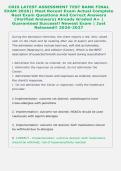
CRIS LATEST ASSESSMENT TEST BANK FINAL
EXAM 2026|| Most Recent Exam Actual Complete
Real Exam Questions And Correct Answers
(Verified Answers) Already Graded A+ |
Guaranteed Success!! Newest Exam | Just
Released!! 2026-2027
During the admission interview, the client reports a red, itchy raised
rash on the chest and lip swelling after use of aspirin and penicillin.
The admission orders include bed rest, soft diet as tolerated,
naproxen (Naprosyn), and cefaclor (Ceclor). Which is the BEST
description of expected breath sounds heard during auscultation?
1. Administer the Ceclor as ordered; do not administer the naproxen.
2. Administer the naproxen as ordered; do not administer the
Ceclor.
3. Administer both the Ceclor and naproxen as ordered; document
the client's response.
4. Do not administer the Ceclor or naproxen; notify the healthcare
provider.
1) Implementation: outcome not desired; cephalosporins have
cross-allergies with penicillins
2) Implementation: outcome not desired; NSAIDs should be used
cautiously with aspirin allergies
3) Implementation: outcome not desired; both medications should
be withheld due to allergies
4) CORRECT - Implementation: outcome desired; both medications
should be withheld; risk of hypersensitivity reaction
,The nurse teaches a client about how to care for an ileostomy.
Which comment, if made by the client to the nurse, indicates further
teaching is needed?
1. "The skin around the stoma should be cleaned with warm water
and thoroughly dried."
2. "The appliance should fit snugly around the ileostomy opening."
3. "I should take polyethylene glycol (MiraLax) with a large glass of
water."
4. "I will continue to take a daily multi-vitamin."
1) Implementation: outcome desired; standard of care for ileostomy
2) Implementation: outcome desired; ileostomy drainage is liquid
and very alkaline; great risk of skin irritation
3) CORRECT - Implementation: outcome not desired; osmotic
laxative and is contraindicated; avoid enteric-coated or capsule
medication, which may not be absorbed through GI tract
4) Implementation: outcome desired; inform healthcare provider
and pharmacist about ileostomy
,The nurse cares for a client diagnosed with chronic bronchitis and
peripheral vascular disease. The nurse expects to assess which of
these breath sounds?
1. Continuous, high-pitched musical sounds heard on expiration.
2. Soft, high-pitched interrupted sounds heard on inspiration.
3. Deep, low-pitched rumbling sounds are heard mainly on
expiration.
4. Harsh, grating sounds heard best during inspiration.
1) Assessment: outcome not expected; sibilant wheezes, heard with
asthma, caused by narrow bronchioles
2) Assessment: outcome not expected; crackles, heard with
pneumonia and CHF, caused by fluid in the alveoli
3) CORRECT - Assessment: outcome expected; sonorous wheezes
or rhonchi, caused by mucus in the airways; excessive mucous
production is primary symptom
4) Assessment: outcome not expected; pericardial friction rub,
caused by inflamed pleura or pericarditis
, The nurse prepares to administer gentamicin (Garamycin) to the 65-
year-old client. Which is the MOST important action for the nurse to
take prior to administration of the medication?
1. Request a daily hemoglobin and hematocrit test.
2. Monitor the serum BUN and creatinine.
3. Request a highly-sensitive C-reactive protein (hs-CRP) test.
4. Monitor the erythrocyte sedimentation rate (ESR).
1) Assessment: outcome not priority; may cause anemia, but not
usually seen
2) CORRECT - Assessment: outcome priority; nephrotoxic; will see
proteinuria, oliguria, hematuria, thirst, increased BUN, decreased
creatine clearance
3) Assessment: outcome not priority; will be increased in
inflammation and rheumatoid arthritis
4) Assessment: outcome not priority; will be increased with any
inflammatory process
EXAM 2026|| Most Recent Exam Actual Complete
Real Exam Questions And Correct Answers
(Verified Answers) Already Graded A+ |
Guaranteed Success!! Newest Exam | Just
Released!! 2026-2027
During the admission interview, the client reports a red, itchy raised
rash on the chest and lip swelling after use of aspirin and penicillin.
The admission orders include bed rest, soft diet as tolerated,
naproxen (Naprosyn), and cefaclor (Ceclor). Which is the BEST
description of expected breath sounds heard during auscultation?
1. Administer the Ceclor as ordered; do not administer the naproxen.
2. Administer the naproxen as ordered; do not administer the
Ceclor.
3. Administer both the Ceclor and naproxen as ordered; document
the client's response.
4. Do not administer the Ceclor or naproxen; notify the healthcare
provider.
1) Implementation: outcome not desired; cephalosporins have
cross-allergies with penicillins
2) Implementation: outcome not desired; NSAIDs should be used
cautiously with aspirin allergies
3) Implementation: outcome not desired; both medications should
be withheld due to allergies
4) CORRECT - Implementation: outcome desired; both medications
should be withheld; risk of hypersensitivity reaction
,The nurse teaches a client about how to care for an ileostomy.
Which comment, if made by the client to the nurse, indicates further
teaching is needed?
1. "The skin around the stoma should be cleaned with warm water
and thoroughly dried."
2. "The appliance should fit snugly around the ileostomy opening."
3. "I should take polyethylene glycol (MiraLax) with a large glass of
water."
4. "I will continue to take a daily multi-vitamin."
1) Implementation: outcome desired; standard of care for ileostomy
2) Implementation: outcome desired; ileostomy drainage is liquid
and very alkaline; great risk of skin irritation
3) CORRECT - Implementation: outcome not desired; osmotic
laxative and is contraindicated; avoid enteric-coated or capsule
medication, which may not be absorbed through GI tract
4) Implementation: outcome desired; inform healthcare provider
and pharmacist about ileostomy
,The nurse cares for a client diagnosed with chronic bronchitis and
peripheral vascular disease. The nurse expects to assess which of
these breath sounds?
1. Continuous, high-pitched musical sounds heard on expiration.
2. Soft, high-pitched interrupted sounds heard on inspiration.
3. Deep, low-pitched rumbling sounds are heard mainly on
expiration.
4. Harsh, grating sounds heard best during inspiration.
1) Assessment: outcome not expected; sibilant wheezes, heard with
asthma, caused by narrow bronchioles
2) Assessment: outcome not expected; crackles, heard with
pneumonia and CHF, caused by fluid in the alveoli
3) CORRECT - Assessment: outcome expected; sonorous wheezes
or rhonchi, caused by mucus in the airways; excessive mucous
production is primary symptom
4) Assessment: outcome not expected; pericardial friction rub,
caused by inflamed pleura or pericarditis
, The nurse prepares to administer gentamicin (Garamycin) to the 65-
year-old client. Which is the MOST important action for the nurse to
take prior to administration of the medication?
1. Request a daily hemoglobin and hematocrit test.
2. Monitor the serum BUN and creatinine.
3. Request a highly-sensitive C-reactive protein (hs-CRP) test.
4. Monitor the erythrocyte sedimentation rate (ESR).
1) Assessment: outcome not priority; may cause anemia, but not
usually seen
2) CORRECT - Assessment: outcome priority; nephrotoxic; will see
proteinuria, oliguria, hematuria, thirst, increased BUN, decreased
creatine clearance
3) Assessment: outcome not priority; will be increased in
inflammation and rheumatoid arthritis
4) Assessment: outcome not priority; will be increased with any
inflammatory process