
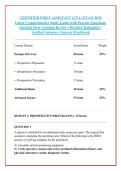
CERTIFIED FIRST ASSISTANT (CFA) EXAM 2026
Latest Comprehensive Study Guide with Practice Questions
Surgical First Assisting Review • Detailed Rationales •
Verified Answers • Success Workbook
Content Domain Scored Items Weight
Perioperative Care 80 items ~55%
─ Preoperative Preparation 15 items
─ Intraoperative Procedures 50 items
─ Postoperative Procedures 15 items
Additional Duties 40 items ~20%
Advanced Science 55 items ~25%
DOMAIN 1: PREOPERATIVE PREPARATION (~15 Items)
QUESTION 1
A patient is scheduled for an abdominal aortic aneurysm repair. The surgical first
assistant is preparing the operating room. Which of the following is the FIRST
priority in verifying readiness for the procedure?
A) Assemble and test positioning equipment
B) Verify operative consent and review pertinent information (history and
physical, laboratory results, diagnostic results)
,C) Open sterile supplies while maintaining aseptic technique
D) Remove casts, splints, braces, and similar devices
RATIONALE:
Correct Answer: B) Verify operative consent and review pertinent
information (history and physical, laboratory results, diagnostic results)
Before any surgical procedure, the first assistant's primary responsibility is
to verify operative consent and review all pertinent patient information, including
the history and physical, advanced directives, laboratory results, and diagnostic
results. This verification step is critical for patient safety and ensures that the
correct procedure is performed on the correct patient. The "time-out" procedure,
which includes identity and site verification, is a key component of preoperative
preparation. While assembling equipment (Option A), opening sterile supplies
(Option C), and removing external appliances (Option D) are important
preoperative tasks, they occur after consent and information verification.
Option A: Equipment assembly occurs later in the preparation process.
Option C: Opening sterile supplies occurs after verifying consent and information.
Option D: Removing casts and appliances is a task that occurs after consent
verification.
QUESTION 2
During the preoperative "time-out" procedure, the surgical first assistant's role
includes:
A) Obtaining informed consent from the patient
B) Verifying the identity of the patient and the operative site
C) Performing the surgical skin preparation
D) Administering preoperative medications
RATIONALE:
Correct Answer: B) Verifying the identity of the patient and the operative site
,The "time-out" is a critical patient safety procedure performed immediately before
the surgical incision. The surgical first assistant participates by verifying the
identity of the patient and the operative site. The time-out includes confirmation
of: (1) correct patient identity (using at least two identifiers), (2) correct procedure,
(3) correct surgical site, (4) availability of necessary equipment and implants, and
(5) administration of prophylactic antibiotics if indicated. Informed consent
(Option A) is obtained by the surgeon, not the first assistant. Skin preparation
(Option C) and medication administration (Option D) are separate tasks.
Option A: Informed consent is obtained by the surgeon.
Option C: Skin preparation is a separate task performed by the surgical team.
Option D: Medication administration is performed by anesthesia or nursing staff.
QUESTION 3
A surgical first assistant is preparing to position a patient for a laparoscopic
cholecystectomy. Which of the following is the CORRECT patient position for this
procedure?
A) Supine with the patient's arms tucked and the table tilted in reverse
Trendelenburg
B) Prone position
C) Lateral decubitus position
D) Lithotomy position
RATIONALE:
Correct Answer: A) Supine with the patient's arms tucked and the table tilted
in reverse Trendelenburg
For a laparoscopic cholecystectomy, the patient is positioned supine with the arms
tucked at the sides. The operating table is tilted in reverse Trendelenburg (head
elevated) to allow the abdominal contents to fall away from the surgical field,
improving visualization of the gallbladder and Triangle of Calot. The surgeon
stands on the patient's left side, and the camera is typically placed through the
umbilicus. The first assistant coordinates and participates in patient positioning,
selecting appropriate positioning devices.
, Option B: Prone position is used for spinal and some orthopedic procedures.
Option C: Lateral decubitus position is used for thoracic and some orthopedic
procedures.
Option D: Lithotomy position is used for gynecological, urological, and perineal
procedures.
QUESTION 4
The surgical first assistant is preparing the skin for surgery. Which of the following
is a CORRECT principle of surgical skin preparation?
A) Prep from the periphery inward toward the incision site
B) Prep from the incision site outward in a concentric circular motion toward
the periphery
C) Prep using a back-and-forth scrubbing motion
D) Prep is not required for laparoscopic procedures
RATIONALE:
Correct Answer: B) Prep from the incision site outward in a concentric
circular motion toward the periphery
The correct technique for surgical skin preparation is to prep from the incision site
outward in a concentric circular motion moving toward the periphery. This
technique ensures that: (1) the cleanest area (the incision site) is prepped first, (2)
contaminants are moved away from the incision site, and (3) the prep solution is
applied in a systematic manner. Skin preparation is required for all surgical
procedures, including laparoscopic procedures (Option D).
Option A: Prepping from the periphery inward would move contaminants toward
the incision site.
Option C: Back-and-forth scrubbing is not the standard technique; circular motion
is preferred.
Option D: Skin preparation is required for laparoscopic procedures.
Latest Comprehensive Study Guide with Practice Questions
Surgical First Assisting Review • Detailed Rationales •
Verified Answers • Success Workbook
Content Domain Scored Items Weight
Perioperative Care 80 items ~55%
─ Preoperative Preparation 15 items
─ Intraoperative Procedures 50 items
─ Postoperative Procedures 15 items
Additional Duties 40 items ~20%
Advanced Science 55 items ~25%
DOMAIN 1: PREOPERATIVE PREPARATION (~15 Items)
QUESTION 1
A patient is scheduled for an abdominal aortic aneurysm repair. The surgical first
assistant is preparing the operating room. Which of the following is the FIRST
priority in verifying readiness for the procedure?
A) Assemble and test positioning equipment
B) Verify operative consent and review pertinent information (history and
physical, laboratory results, diagnostic results)
,C) Open sterile supplies while maintaining aseptic technique
D) Remove casts, splints, braces, and similar devices
RATIONALE:
Correct Answer: B) Verify operative consent and review pertinent
information (history and physical, laboratory results, diagnostic results)
Before any surgical procedure, the first assistant's primary responsibility is
to verify operative consent and review all pertinent patient information, including
the history and physical, advanced directives, laboratory results, and diagnostic
results. This verification step is critical for patient safety and ensures that the
correct procedure is performed on the correct patient. The "time-out" procedure,
which includes identity and site verification, is a key component of preoperative
preparation. While assembling equipment (Option A), opening sterile supplies
(Option C), and removing external appliances (Option D) are important
preoperative tasks, they occur after consent and information verification.
Option A: Equipment assembly occurs later in the preparation process.
Option C: Opening sterile supplies occurs after verifying consent and information.
Option D: Removing casts and appliances is a task that occurs after consent
verification.
QUESTION 2
During the preoperative "time-out" procedure, the surgical first assistant's role
includes:
A) Obtaining informed consent from the patient
B) Verifying the identity of the patient and the operative site
C) Performing the surgical skin preparation
D) Administering preoperative medications
RATIONALE:
Correct Answer: B) Verifying the identity of the patient and the operative site
,The "time-out" is a critical patient safety procedure performed immediately before
the surgical incision. The surgical first assistant participates by verifying the
identity of the patient and the operative site. The time-out includes confirmation
of: (1) correct patient identity (using at least two identifiers), (2) correct procedure,
(3) correct surgical site, (4) availability of necessary equipment and implants, and
(5) administration of prophylactic antibiotics if indicated. Informed consent
(Option A) is obtained by the surgeon, not the first assistant. Skin preparation
(Option C) and medication administration (Option D) are separate tasks.
Option A: Informed consent is obtained by the surgeon.
Option C: Skin preparation is a separate task performed by the surgical team.
Option D: Medication administration is performed by anesthesia or nursing staff.
QUESTION 3
A surgical first assistant is preparing to position a patient for a laparoscopic
cholecystectomy. Which of the following is the CORRECT patient position for this
procedure?
A) Supine with the patient's arms tucked and the table tilted in reverse
Trendelenburg
B) Prone position
C) Lateral decubitus position
D) Lithotomy position
RATIONALE:
Correct Answer: A) Supine with the patient's arms tucked and the table tilted
in reverse Trendelenburg
For a laparoscopic cholecystectomy, the patient is positioned supine with the arms
tucked at the sides. The operating table is tilted in reverse Trendelenburg (head
elevated) to allow the abdominal contents to fall away from the surgical field,
improving visualization of the gallbladder and Triangle of Calot. The surgeon
stands on the patient's left side, and the camera is typically placed through the
umbilicus. The first assistant coordinates and participates in patient positioning,
selecting appropriate positioning devices.
, Option B: Prone position is used for spinal and some orthopedic procedures.
Option C: Lateral decubitus position is used for thoracic and some orthopedic
procedures.
Option D: Lithotomy position is used for gynecological, urological, and perineal
procedures.
QUESTION 4
The surgical first assistant is preparing the skin for surgery. Which of the following
is a CORRECT principle of surgical skin preparation?
A) Prep from the periphery inward toward the incision site
B) Prep from the incision site outward in a concentric circular motion toward
the periphery
C) Prep using a back-and-forth scrubbing motion
D) Prep is not required for laparoscopic procedures
RATIONALE:
Correct Answer: B) Prep from the incision site outward in a concentric
circular motion toward the periphery
The correct technique for surgical skin preparation is to prep from the incision site
outward in a concentric circular motion moving toward the periphery. This
technique ensures that: (1) the cleanest area (the incision site) is prepped first, (2)
contaminants are moved away from the incision site, and (3) the prep solution is
applied in a systematic manner. Skin preparation is required for all surgical
procedures, including laparoscopic procedures (Option D).
Option A: Prepping from the periphery inward would move contaminants toward
the incision site.
Option C: Back-and-forth scrubbing is not the standard technique; circular motion
is preferred.
Option D: Skin preparation is required for laparoscopic procedures.


