
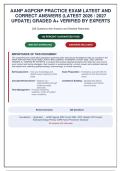
AANP AGPCNP PRACTICE EXAM LATEST AND
CORRECT ANSWERS (LATEST
UPDATE) GRADED A+ VERIFIED BY EXPERTS
229 Questions with Answers and Detailed Rationales
100 PERCENT GUARANTEED PASS
INSTANT DOWNLOAD ANSWERS INCLUDED
IMPORTANCE OF THIS DOCUMENT
This comprehensive examination preparation guide has been meticulously developed to help you succeed in the
AANP AGPCNP PRACTICE EXAM LATEST AND CORRECT ANSWERS (LATEST UPDATE)
GRADED A+ VERIFIED BY EXPERTS. It contains 229 carefully selected questions that reflect the most current
exam content and testing strategies. Each question is accompanied by a correct answer and a detailed rationale
that explains the underlying pathophysiology, pharmacology, or clinical reasoning.
Self-Assessment – Test your knowledge and Exam Preparation – Familiarize yourself with the
identify areas requiring further question format and content
study areas
Concept Reinforcement – Deepen your Confidence Building – Develop test-taking
understanding through strategies and reduce
evidence-based exam anxiety
rationales
Time Management – Practice answering
questions under simulated
exam conditions
Review Summary 229 Questions
Foundations - Application - AANP Agpcnp AND Correct Update A BY Experts
Adult-gerontology Primary CARE Nurse Practitioner Graduate
All answers with rationales
,Table of Contents
Content Area Questions Key Topics
AANP Agpcnp AND Correct 1-39 Appropriate, Diabetes, Chronic, Finding, Presents
Update A BY
Experts Adult-gerontology
Primary CARE Nurse
Practitioner Graduate
Disease 40-78 Presents, Strongly, Appropriate, Kidney, Acute
Chronic 79-117 Appropriate, Disease, Chronic Kidney, Stage, Presents
Presents 118-156 Appropriate, Management, Chronic, Describes, Findings
Kidney 157-195 Appropriate, Disease, History, Chronic, Finding
Diabetes 196-229 Appropriate, Chronic, NEXT STEP, Kidney, Initial
TOTAL 229 All questions include answers and detailed rationales
,Section A - AANP Agpcnp AND Correct Update
A BY Experts Adult-gerontology Primary CARE Nurse
Practitioner Graduate
Q1.
A 72-year-old with CKD stage 3 (eGFR 45) and type 2 diabetes is started on dapagliflozin.
Which metabolic effect requires close monitoring within the first month?
A. Hyperkalemia due to reduced B. Euglycemic diabetic ketoacidosis with
aldosterone secretion normal glucose levels
C. Increased risk of urinary tract infections D. Worsening bone density from increased
from glycosuria calcium excretion
Correct: B - Euglycemic diabetic ketoacidosis with normal glucose levels
Rationale:SGLT2 inhibitors can cause euglycemic DKA, especially in insulin-deficient states
or during stress, with glucose often <250 mg/dL. Hyperkalemia is less common; UTIs are a
risk but not the most critical metabolic effect. Bone density changes are not significant.
Q2.
A patient with atrial fibrillation and heart failure with preserved ejection fraction is being
anticoagulated. Which direct oral anticoagulant requires dose adjustment based on renal
function and is contraindicated if CrCl <15 mL/min?
A. Apixaban B. Rivaroxaban
C. Dabigatran D. Edoxaban
Correct: C - Dabigatran
Rationale:Dabigatran is predominantly renally cleared; it is contraindicated in CrCl <15
mL/min and requires dose adjustment for moderate impairment. Apixaban and rivaroxaban
have some renal clearance but are not absolutely contraindicated at that level. Edoxaban is
avoided in CrCl >95 mL/min.
Q3.
Which of the following assessment findings best distinguishes hypercalcemia of
malignancy from primary hyperparathyroidism in a patient with hypercalcemia and an
elevated PTH?
A. Low serum phosphate and high B. Low serum phosphate and low
1,25-dihydroxyvitamin D 1,25-dihydroxyvitamin D
Page 3
, Section A - AANP Agpcnp AND Correct Update A BY Experts Adult-gerontology Primary CARE Nurse Practitioner Graduate
C. High serum chloride and low bicarbonate D. Elevated alkaline phosphatase and bone
pain
Correct: B - Low serum phosphate and low 1,25-dihydroxyvitamin D
Rationale:In hypercalcemia of malignancy, PTH is suppressed, but if PTH is elevated, it may
be PTHrP-mediated (which lowers phosphate and 1,25-(OH)2D). Primary
hyperparathyroidism typically has high chloride and low bicarbonate. Alkaline phosphatase is
nonspecific.
Q4.
A patient with COPD and chronic respiratory failure has a PaCO2 of 58 mmHg and pH 7.36.
Which oxygen prescription is most appropriate to avoid worsening hypercapnia?
A. High-flow oxygen at 6 L/min via nasal B. Titrate oxygen to maintain SpO2 88-92%
cannula
C. Non-rebreather mask at 15 L/min D. Oxygen at 2 L/min regardless of SpO2
Correct: B - Titrate oxygen to maintain SpO2 88-92%
Rationale:In chronic hypercapnia, oxygen should be titrated to a target SpO2 of 88-92% to
prevent worsening hypercapnia and respiratory acidosis. High-flow oxygen can suppress
hypoxic drive and increase V/Q mismatch. Fixed low-dose oxygen is not individualized.
Q5.
Which of the following best explains the increased risk of hip fractures in patients taking
proton pump inhibitors long-term?
A. Reduced gastric acid impairs calcium B. Increased gastrin levels stimulate
carbonate absorption osteoclast activity
C. PPIs directly inhibit osteoblast function D. Reduced vitamin B12 absorption leads to
neuropathy and falls
Correct: A - Reduced gastric acid impairs calcium carbonate absorption
Rationale:PPIs reduce gastric acidity, impairing absorption of insoluble calcium carbonate,
leading to negative calcium balance and increased fracture risk. Other mechanisms are less
established. Calcium citrate absorption is less affected.
Q6.
A patient with type 2 diabetes has eGFR 30 mL/min/1.73m2 and persistent albuminuria.
Which medication has shown the most benefit in slowing CKD progression in this
population?
A. Finerenone B. Empagliflozin
Page 4
CORRECT ANSWERS (LATEST
UPDATE) GRADED A+ VERIFIED BY EXPERTS
229 Questions with Answers and Detailed Rationales
100 PERCENT GUARANTEED PASS
INSTANT DOWNLOAD ANSWERS INCLUDED
IMPORTANCE OF THIS DOCUMENT
This comprehensive examination preparation guide has been meticulously developed to help you succeed in the
AANP AGPCNP PRACTICE EXAM LATEST AND CORRECT ANSWERS (LATEST UPDATE)
GRADED A+ VERIFIED BY EXPERTS. It contains 229 carefully selected questions that reflect the most current
exam content and testing strategies. Each question is accompanied by a correct answer and a detailed rationale
that explains the underlying pathophysiology, pharmacology, or clinical reasoning.
Self-Assessment – Test your knowledge and Exam Preparation – Familiarize yourself with the
identify areas requiring further question format and content
study areas
Concept Reinforcement – Deepen your Confidence Building – Develop test-taking
understanding through strategies and reduce
evidence-based exam anxiety
rationales
Time Management – Practice answering
questions under simulated
exam conditions
Review Summary 229 Questions
Foundations - Application - AANP Agpcnp AND Correct Update A BY Experts
Adult-gerontology Primary CARE Nurse Practitioner Graduate
All answers with rationales
,Table of Contents
Content Area Questions Key Topics
AANP Agpcnp AND Correct 1-39 Appropriate, Diabetes, Chronic, Finding, Presents
Update A BY
Experts Adult-gerontology
Primary CARE Nurse
Practitioner Graduate
Disease 40-78 Presents, Strongly, Appropriate, Kidney, Acute
Chronic 79-117 Appropriate, Disease, Chronic Kidney, Stage, Presents
Presents 118-156 Appropriate, Management, Chronic, Describes, Findings
Kidney 157-195 Appropriate, Disease, History, Chronic, Finding
Diabetes 196-229 Appropriate, Chronic, NEXT STEP, Kidney, Initial
TOTAL 229 All questions include answers and detailed rationales
,Section A - AANP Agpcnp AND Correct Update
A BY Experts Adult-gerontology Primary CARE Nurse
Practitioner Graduate
Q1.
A 72-year-old with CKD stage 3 (eGFR 45) and type 2 diabetes is started on dapagliflozin.
Which metabolic effect requires close monitoring within the first month?
A. Hyperkalemia due to reduced B. Euglycemic diabetic ketoacidosis with
aldosterone secretion normal glucose levels
C. Increased risk of urinary tract infections D. Worsening bone density from increased
from glycosuria calcium excretion
Correct: B - Euglycemic diabetic ketoacidosis with normal glucose levels
Rationale:SGLT2 inhibitors can cause euglycemic DKA, especially in insulin-deficient states
or during stress, with glucose often <250 mg/dL. Hyperkalemia is less common; UTIs are a
risk but not the most critical metabolic effect. Bone density changes are not significant.
Q2.
A patient with atrial fibrillation and heart failure with preserved ejection fraction is being
anticoagulated. Which direct oral anticoagulant requires dose adjustment based on renal
function and is contraindicated if CrCl <15 mL/min?
A. Apixaban B. Rivaroxaban
C. Dabigatran D. Edoxaban
Correct: C - Dabigatran
Rationale:Dabigatran is predominantly renally cleared; it is contraindicated in CrCl <15
mL/min and requires dose adjustment for moderate impairment. Apixaban and rivaroxaban
have some renal clearance but are not absolutely contraindicated at that level. Edoxaban is
avoided in CrCl >95 mL/min.
Q3.
Which of the following assessment findings best distinguishes hypercalcemia of
malignancy from primary hyperparathyroidism in a patient with hypercalcemia and an
elevated PTH?
A. Low serum phosphate and high B. Low serum phosphate and low
1,25-dihydroxyvitamin D 1,25-dihydroxyvitamin D
Page 3
, Section A - AANP Agpcnp AND Correct Update A BY Experts Adult-gerontology Primary CARE Nurse Practitioner Graduate
C. High serum chloride and low bicarbonate D. Elevated alkaline phosphatase and bone
pain
Correct: B - Low serum phosphate and low 1,25-dihydroxyvitamin D
Rationale:In hypercalcemia of malignancy, PTH is suppressed, but if PTH is elevated, it may
be PTHrP-mediated (which lowers phosphate and 1,25-(OH)2D). Primary
hyperparathyroidism typically has high chloride and low bicarbonate. Alkaline phosphatase is
nonspecific.
Q4.
A patient with COPD and chronic respiratory failure has a PaCO2 of 58 mmHg and pH 7.36.
Which oxygen prescription is most appropriate to avoid worsening hypercapnia?
A. High-flow oxygen at 6 L/min via nasal B. Titrate oxygen to maintain SpO2 88-92%
cannula
C. Non-rebreather mask at 15 L/min D. Oxygen at 2 L/min regardless of SpO2
Correct: B - Titrate oxygen to maintain SpO2 88-92%
Rationale:In chronic hypercapnia, oxygen should be titrated to a target SpO2 of 88-92% to
prevent worsening hypercapnia and respiratory acidosis. High-flow oxygen can suppress
hypoxic drive and increase V/Q mismatch. Fixed low-dose oxygen is not individualized.
Q5.
Which of the following best explains the increased risk of hip fractures in patients taking
proton pump inhibitors long-term?
A. Reduced gastric acid impairs calcium B. Increased gastrin levels stimulate
carbonate absorption osteoclast activity
C. PPIs directly inhibit osteoblast function D. Reduced vitamin B12 absorption leads to
neuropathy and falls
Correct: A - Reduced gastric acid impairs calcium carbonate absorption
Rationale:PPIs reduce gastric acidity, impairing absorption of insoluble calcium carbonate,
leading to negative calcium balance and increased fracture risk. Other mechanisms are less
established. Calcium citrate absorption is less affected.
Q6.
A patient with type 2 diabetes has eGFR 30 mL/min/1.73m2 and persistent albuminuria.
Which medication has shown the most benefit in slowing CKD progression in this
population?
A. Finerenone B. Empagliflozin
Page 4


