
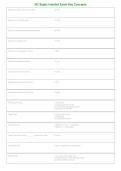
NC Septic Installer Exam Key Concepts
Setback for Well (serving one family) 50 Feet
Setback from Property Line 10 Feet
Setback from Lake/Pond including Streams 50 Feet
Setback from Water Line 10 Feet
Setback from Foundation or Deck 5 Feet
Setback from Basement/Cellar 15 Feet
Setback from In-Ground Pool 15 Feet
Setback from Above-Ground Pool 5 Feet
Setback from Buried Storage Tank 10 Feet
Permitting Process 1) Application
2) Improvement Permit (IP)
3) Construction Authorization (CA)
4 Operation Permit (OP)
Septic Tank 1) Structurally Sound
2) Watertight
3) Covered Receptacle
Septic Tank Size 4 Bedroom or less = 1,000 Gallon
5 Bedroom = 1,250 Gallon
Septic Tank Inlet must be _______ inches about outlet 2 inches
Pump Tank Size Equal to or greater than Septic Tank
Effluent Filter 1) On outlet end of septic tank
2) Shall extend 25 - 50% into liquid depth
3) Solvent welded to 3" pipe
Setback for Well (serving one family) 50 Feet
Setback from Property Line 10 Feet
Setback from Lake/Pond including Streams 50 Feet
Setback from Water Line 10 Feet
Setback from Foundation or Deck 5 Feet
Setback from Basement/Cellar 15 Feet
Setback from In-Ground Pool 15 Feet
Setback from Above-Ground Pool 5 Feet
Setback from Buried Storage Tank 10 Feet
Permitting Process 1) Application
2) Improvement Permit (IP)
3) Construction Authorization (CA)
4 Operation Permit (OP)
Septic Tank 1) Structurally Sound
2) Watertight
3) Covered Receptacle
Septic Tank Size 4 Bedroom or less = 1,000 Gallon
5 Bedroom = 1,250 Gallon
Septic Tank Inlet must be _______ inches about outlet 2 inches
Pump Tank Size Equal to or greater than Septic Tank
Effluent Filter 1) On outlet end of septic tank
2) Shall extend 25 - 50% into liquid depth
3) Solvent welded to 3" pipe


