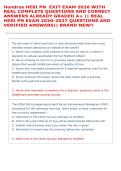
Hondros HESI PN EXIT EXAM 2026 WITH
REAL COMPLETE QUESTIONS AND CORRECT
ANSWERS ALREADY GRADED A+ || REAL
HESI PN EXAM 2026-2027 QUESTIONS AND
VERIFIED ANSWERS|| BRAND NEW!!
The principle of client advocacy is best demonstrated when the nurse
exhibits which behaviors on behalf of the client?
A. Nurse who contacts child protective services to report a mother's
decision to refuse vaccination for her firstborn infant
B. Nurse refusing to care for a convicted rapist stating that personal
discomfort would inhibit provision of quality of care
C. Nurse who translates complaints for a Spanish-speaking client to the
healthcare provider during rounds
D. Nurse sharing information about life after death with a grieving
family who just lost a loved one
C. Nurse who translates complaints for a Spanish- speaking client to the
healthcare provider during rounds
The LPN/LVN is preparing a client for an Intravenous Pyelogram (IVP)
scheduled for the following morning. What action is most important for
the nurse to implement?
A. Determine if the client has any allergies to shellfish
B. Inform the client that an IV dye will be administered before the IVP
C. Explain that dizziness may occur when the dye is given
D. Administer a bowel prep the evening before the procedure
A. Determine if the client has any allergies to shellfish
,A LPN/LVN refuses to perform a procedure because it is beyond the
scope of practice for practical nurses. Which resource best defines the
nurse's legal responsibility in regard to scope of practice?
A. Nursing practice standards for Licensed Practical/Vocational Nurses
B. State Nurse Practice Act
C. Code of Ethics for Licensed Practical/Vocational Nurses
D. Patients Bill of Rights
B. State nurse Practice Act
While making the bed of a female client who is sitting in the bedside
chair, the nurse observes the client seem anxious. To encourage
verbalization by the client, what action should the nurse take?
A. Continue to make the bed while conversing with the client
B. Sit next to the client at a slight angle to continue the conversation
C. Remain standing close enough to the client to hold her hand
D. Bring a chair face-to-face with the client for further discussion
B. Sit next to the client at a slight angle to continue the conversation
A client is admitted for observation after experiencing a Transient
Ischemic Attack (TIA). The nurse anticipates implementing care for
which client problem?
A. High risk for injury
B. Altered breathing patterns
C. Ineffective airway clearance
D. High risk infection
B. Altered breathing patterns
,An elderly postoperative client has the Nursing diagnosis, "Impaired
mobility related to fear of falling." Which desired outcome best directs
Nursing actions for this client?
A. The physical therapist will instruct the client in the use of a walker
B. The nurse will place a gait belt on the client prior to ambulation
C. The client will ambulate with assistance q4h .
D. The client will use self-affirmation statements to decrease fear
C. The client will ambulate with assistance q4h
A female client complains to the nurse about being admitted to a semi-
private room and expresses her displeasure because she requested a
private room prior to admission. What response is best for the nurse to
provide this client?
A. Room assignments are based on client's acuity level, not necessarily
by request
B. I will place your name on the room request list for the next available
private room
C. Your healthcare provider must provide a written request to get you a
private room
D. There are no private rooms available, so you will have to stay here
for the time being.
C. Your healthcare provider must provide a written request to get you a
private room
, During preoperative preparation, the nurse should offer the client
which explanation about why deep breathing exercising with an
incentive spirometer are necessary after surgery?
A. "Deep breathing exercises using spirometer will help prevent
postoperative complications."
B. "failure to keep your lungs working may result in pneumonia and
death."
C. "Incentive spirometry is uncomfortable but necessary for your
postoperative care."
D. "You will use the spirometer for the first postoperative day only."
A. "Deep breathing exercises using spirometer will help prevent
postoperative complications."
The LPN/LVN is caring for a client who had a total Laryngectomy, Left
Radical Neck Dissection, and tracheostomy. The client is receiving
Nasogastric (NG) tube feedings via an enteral pump. Today the rate of
the feeding was increased from 50mL/hr to 75mL/hr. What parameter
should the nurse evaluate the client's tolerance to the rate of feeding?
A. Bowel sounds
B. Urinary and stool outputs
C. Gastric residual volumes
D. Daily weight
C. Gastric residual volumes
A client is admitted with a fever of undermined origin (FUO). During
rounds, the nurse finds the client diaphoretic, and the linens are damp.
What should the nurse do first?
A. Change the bed linen to prevent chilling
B. Check the client's vital signs and pain scale
C. Assess the client for urinary incontinence
D. Determine fluid intake for the past 8 hours
B. Check the client's vital signs and pain scale
REAL COMPLETE QUESTIONS AND CORRECT
ANSWERS ALREADY GRADED A+ || REAL
HESI PN EXAM 2026-2027 QUESTIONS AND
VERIFIED ANSWERS|| BRAND NEW!!
The principle of client advocacy is best demonstrated when the nurse
exhibits which behaviors on behalf of the client?
A. Nurse who contacts child protective services to report a mother's
decision to refuse vaccination for her firstborn infant
B. Nurse refusing to care for a convicted rapist stating that personal
discomfort would inhibit provision of quality of care
C. Nurse who translates complaints for a Spanish-speaking client to the
healthcare provider during rounds
D. Nurse sharing information about life after death with a grieving
family who just lost a loved one
C. Nurse who translates complaints for a Spanish- speaking client to the
healthcare provider during rounds
The LPN/LVN is preparing a client for an Intravenous Pyelogram (IVP)
scheduled for the following morning. What action is most important for
the nurse to implement?
A. Determine if the client has any allergies to shellfish
B. Inform the client that an IV dye will be administered before the IVP
C. Explain that dizziness may occur when the dye is given
D. Administer a bowel prep the evening before the procedure
A. Determine if the client has any allergies to shellfish
,A LPN/LVN refuses to perform a procedure because it is beyond the
scope of practice for practical nurses. Which resource best defines the
nurse's legal responsibility in regard to scope of practice?
A. Nursing practice standards for Licensed Practical/Vocational Nurses
B. State Nurse Practice Act
C. Code of Ethics for Licensed Practical/Vocational Nurses
D. Patients Bill of Rights
B. State nurse Practice Act
While making the bed of a female client who is sitting in the bedside
chair, the nurse observes the client seem anxious. To encourage
verbalization by the client, what action should the nurse take?
A. Continue to make the bed while conversing with the client
B. Sit next to the client at a slight angle to continue the conversation
C. Remain standing close enough to the client to hold her hand
D. Bring a chair face-to-face with the client for further discussion
B. Sit next to the client at a slight angle to continue the conversation
A client is admitted for observation after experiencing a Transient
Ischemic Attack (TIA). The nurse anticipates implementing care for
which client problem?
A. High risk for injury
B. Altered breathing patterns
C. Ineffective airway clearance
D. High risk infection
B. Altered breathing patterns
,An elderly postoperative client has the Nursing diagnosis, "Impaired
mobility related to fear of falling." Which desired outcome best directs
Nursing actions for this client?
A. The physical therapist will instruct the client in the use of a walker
B. The nurse will place a gait belt on the client prior to ambulation
C. The client will ambulate with assistance q4h .
D. The client will use self-affirmation statements to decrease fear
C. The client will ambulate with assistance q4h
A female client complains to the nurse about being admitted to a semi-
private room and expresses her displeasure because she requested a
private room prior to admission. What response is best for the nurse to
provide this client?
A. Room assignments are based on client's acuity level, not necessarily
by request
B. I will place your name on the room request list for the next available
private room
C. Your healthcare provider must provide a written request to get you a
private room
D. There are no private rooms available, so you will have to stay here
for the time being.
C. Your healthcare provider must provide a written request to get you a
private room
, During preoperative preparation, the nurse should offer the client
which explanation about why deep breathing exercising with an
incentive spirometer are necessary after surgery?
A. "Deep breathing exercises using spirometer will help prevent
postoperative complications."
B. "failure to keep your lungs working may result in pneumonia and
death."
C. "Incentive spirometry is uncomfortable but necessary for your
postoperative care."
D. "You will use the spirometer for the first postoperative day only."
A. "Deep breathing exercises using spirometer will help prevent
postoperative complications."
The LPN/LVN is caring for a client who had a total Laryngectomy, Left
Radical Neck Dissection, and tracheostomy. The client is receiving
Nasogastric (NG) tube feedings via an enteral pump. Today the rate of
the feeding was increased from 50mL/hr to 75mL/hr. What parameter
should the nurse evaluate the client's tolerance to the rate of feeding?
A. Bowel sounds
B. Urinary and stool outputs
C. Gastric residual volumes
D. Daily weight
C. Gastric residual volumes
A client is admitted with a fever of undermined origin (FUO). During
rounds, the nurse finds the client diaphoretic, and the linens are damp.
What should the nurse do first?
A. Change the bed linen to prevent chilling
B. Check the client's vital signs and pain scale
C. Assess the client for urinary incontinence
D. Determine fluid intake for the past 8 hours
B. Check the client's vital signs and pain scale