

Test Bank Personality Psychology: Understanding Yourself and Others, 3rd Edition Twenge & Campbell
TOTAL
ASSESSMENT ChapterChapter
1 1
Understanding
Understanding Yourself
Yourself and Others and Others
GUIDE
Learning Remember
No table the Understand
of contents the found.
entries Apply What You
Objective Facts Concepts Know Analyze It
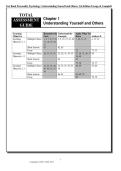
Learning Multiple Choice 1, 6, 7, 8, 9, 16, 2, 5, 12, 15, 23, 24 3, 10, 11, 21 4, 13, 14
Objective 1.1 17, 18, 19, 20,
22
Short Answer 61 62, 63
Essay 72 71, 73
Learning Multiple Choice 26, 33, 39, 41 25, 29, 31, 34, 35 27, 28, 32, 36, 37, 30
Objective 1.2 38, 40
Short Answer 64 65
Essay 75, 76 74, 77
Learning Multiple Choice 42, 43, 44, 46, 45, 47, 51, 54, 57, 48, 59 55, 60
Objective 1.3 49, 50, 52, 53, 58
56
Short Answer 66, 67 68, 69, 70
Essay 80 78, 79
1
Copyright © 2027, 2020, 2017
, Twenge/Campbell; Personality Psychology: Understanding Yourself and Others, 3e
Multiple Choice Questions
1. How do psychologists define personality?
a. a set of enduring characteristics shown by most people
b. a person’s patterns of responsiveness that vary across similar situations
c. a person’s usual pattern of behavior, feelings, and thoughts
d. a pattern of unfolding genetic tendencies toward action
Answer: c
Difficulty Level: Easy
Topic: Defining Personality
Learning Objective: 1.1 Define personality, and describe its history and scope.
Skill Level: Remember the Facts
APA Learning Objective: 1.1 Describe key concepts, principles, and theories in psychological science.
2. What does the phrase “usual” mean when referring to a usual pattern of behavior?
a. Behavior characterizes how most people respond to a given situation.
b. A person reports that they experience the same emotions most of the time.
c. Behavior is regulated by brain activity and genetic tendencies.
d. A person acts consistently across time and situations.
Answer: d
Difficulty Level: Moderate
Topic: Defining Personality
Learning Objective: 1.1 Define personality, and describe its history and scope.
Skill Level: Understand the Concepts
APA Learning Objective: 1.2 Develop a working knowledge of psychology’s major subfields.
3. Ingo has felt anxious and nervous when he’s been asked to speak in public. Given that these feelings are part
of his personality, what is Ingo most likely to say when he’s invited to address members of the Moose Lodge at
their upcoming luncheon?
a. “I’d really rather not; thanks all the same.”
b. “Sounds great; I’m really looking forward to it!”
c. “Would you like me to prepare notes ahead of time or speak extemporaneously?”
d. “Sure, I’ll give it a try.”
Answer: a
Difficulty Level: Easy
Topic: Defining Personality
Learning Objective: 1.1 Define personality, and describe its history and scope.
Skill Level: Apply What You Know
APA Learning Objective: 1.4 Apply psychological content to solve practical problems.
2
Copyright © 2027, 2020, 2017
, Twenge/Campbell; Personality Psychology: Understanding Yourself and Others, 3e
4. Personality reflects shared human tendencies, but how are these tendencies typically conceptualized?
a. as a part of our evolutionary heritage, honed to a common point over time
b. as individual differences that vary from person to person
c. as internal workings of human nature that cannot be measured
d. as core traits that are exhibited to the same degree across people
Answer: b
Difficulty Level: Difficult
Topic: Defining Personality
Learning Objective: 1.1 Define personality, and describe its history and scope.
Skill Level: Analyze It
APA Learning Objective: 1.1 Describe key concepts, principles, and theories in psychological science.
5. What limitation applies to most theoretical systems of personality?
a. Personality has proven to be impossible to measure.
b. No personality system can capture all the unique differences among people.
c. It has been difficult to identify a core set of personality dimensions.
d. Personality is, by definition, an unconscious process.
Answer: b
Difficulty Level: Difficult
Topic: Defining Personality
Learning Objective: 1.1 Define personality, and describe its history and scope.
Skill Level: Understand the Concepts
APA Learning Objective: 1.2 Develop a working knowledge of psychology’s major subfields.
6. How is personality shaped?
a. through a combination of genetic tendencies and environmental influences
b. through a person’s conscious decision-making during the first two years of life
c. haphazardly, through a sequence of random events a person might experience
d. through a process of reward and punishment introduced early in life
Answer: a
Difficulty Level: Easy
Topic: Defining Personality
Learning Objective: 1.1 Define personality, and describe its history and scope.
Skill Level: Remember the Facts
APA Learning Objective: 1.1 Describe key concepts, principles, and theories in psychological science.
7. Where do the historical roots of personality psychology begin?
a. the mental testing movement of the late 1800s
b. the investigations of Sir Francis Galton
c. ancient Greek and Roman philosophy and medicine
d. sociological theories of the 1930s
Answer: c
Difficulty Level: Moderate
Topic: The Story of Personality Psychology
Learning Objective: 1.1 Define personality, and describe its history and scope.
Skill Level: Remember the Facts
APA Learning Objective: 1.3 Portray significant aspects of the history of psychological science.
3
Copyright © 2027, 2020, 2017
, Twenge/Campbell; Personality Psychology: Understanding Yourself and Others, 3e
8. What metaphor did Plato use to describe the struggle between passion and reason?
a. an architect designing a complex structure
b. a chariot driver guiding two horses
c. a bull and an ox pulling in opposite directions
d. a still lake disrupted by ripples from a stone
Answer: b
Difficulty Level: Difficult
Topic: The Story of Personality Psychology
Learning Objective: 1.1 Define personality, and describe its history and scope.
Skill Level: Remember the Facts
APA Learning Objective: 1.3 Portray significant aspects of the history of psychological science.
9. Where do the roots of modern trait theory begin?
a. Henry Murray’s approach to understanding motivation
b. Carl Jung’s psychodynamic view of the self
c. James Cattell’s early work on mental testing
d. Hippocrates’s and Galen’s idea of “humors”
Answer: d
Difficulty Level: Moderate
Topic: The Story of Personality Psychology
Learning Objective: 1.1 Define personality, and describe its history and scope.
Skill Level: Remember the Facts
APA Learning Objective: 1.3 Portray significant aspects of the history of psychological science.
10. Which example represents the assessment and measurement root of personality psychology?
a. administering a test of extraversion to a large group of people
b. proposing a set number of traits that define the entirety of personality
c. developing a personality theory based on people’s unconscious impulses
d. drawing conclusions about personality dimensions based on works of fiction by great authors
Answer: a
Difficulty Level: Easy
Topic: The Story of Personality Psychology
Learning Objective: 1.1 Define personality, and describe its history and scope.
Skill Level: Apply What You Know
APA Learning Objective: 1.4 Apply psychological content to solve practical problems.
11. What question would a trait theorist be most likely to ask?
a. “Why are thoughts and behaviors products of momentary experiences?”
b. “What are the unconscious drives that motivate human behavior?”
c. “How do situational constraints influence behavior?”
d. “Which core personality dimensions determine individual differences?”
Answer: d
Difficulty Level: Moderate
Topic: The Story of Personality Psychology
Learning Objective: 1.1 Define personality, and describe its history and scope.
Skill Level: Apply What You Know
APA Learning Objective: 1.4 Apply psychological content to solve practical problems.
4
Copyright © 2027, 2020, 2017
TOTAL
ASSESSMENT ChapterChapter
1 1
Understanding
Understanding Yourself
Yourself and Others and Others
GUIDE
Learning Remember
No table the Understand
of contents the found.
entries Apply What You
Objective Facts Concepts Know Analyze It
Learning Multiple Choice 1, 6, 7, 8, 9, 16, 2, 5, 12, 15, 23, 24 3, 10, 11, 21 4, 13, 14
Objective 1.1 17, 18, 19, 20,
22
Short Answer 61 62, 63
Essay 72 71, 73
Learning Multiple Choice 26, 33, 39, 41 25, 29, 31, 34, 35 27, 28, 32, 36, 37, 30
Objective 1.2 38, 40
Short Answer 64 65
Essay 75, 76 74, 77
Learning Multiple Choice 42, 43, 44, 46, 45, 47, 51, 54, 57, 48, 59 55, 60
Objective 1.3 49, 50, 52, 53, 58
56
Short Answer 66, 67 68, 69, 70
Essay 80 78, 79
1
Copyright © 2027, 2020, 2017
, Twenge/Campbell; Personality Psychology: Understanding Yourself and Others, 3e
Multiple Choice Questions
1. How do psychologists define personality?
a. a set of enduring characteristics shown by most people
b. a person’s patterns of responsiveness that vary across similar situations
c. a person’s usual pattern of behavior, feelings, and thoughts
d. a pattern of unfolding genetic tendencies toward action
Answer: c
Difficulty Level: Easy
Topic: Defining Personality
Learning Objective: 1.1 Define personality, and describe its history and scope.
Skill Level: Remember the Facts
APA Learning Objective: 1.1 Describe key concepts, principles, and theories in psychological science.
2. What does the phrase “usual” mean when referring to a usual pattern of behavior?
a. Behavior characterizes how most people respond to a given situation.
b. A person reports that they experience the same emotions most of the time.
c. Behavior is regulated by brain activity and genetic tendencies.
d. A person acts consistently across time and situations.
Answer: d
Difficulty Level: Moderate
Topic: Defining Personality
Learning Objective: 1.1 Define personality, and describe its history and scope.
Skill Level: Understand the Concepts
APA Learning Objective: 1.2 Develop a working knowledge of psychology’s major subfields.
3. Ingo has felt anxious and nervous when he’s been asked to speak in public. Given that these feelings are part
of his personality, what is Ingo most likely to say when he’s invited to address members of the Moose Lodge at
their upcoming luncheon?
a. “I’d really rather not; thanks all the same.”
b. “Sounds great; I’m really looking forward to it!”
c. “Would you like me to prepare notes ahead of time or speak extemporaneously?”
d. “Sure, I’ll give it a try.”
Answer: a
Difficulty Level: Easy
Topic: Defining Personality
Learning Objective: 1.1 Define personality, and describe its history and scope.
Skill Level: Apply What You Know
APA Learning Objective: 1.4 Apply psychological content to solve practical problems.
2
Copyright © 2027, 2020, 2017
, Twenge/Campbell; Personality Psychology: Understanding Yourself and Others, 3e
4. Personality reflects shared human tendencies, but how are these tendencies typically conceptualized?
a. as a part of our evolutionary heritage, honed to a common point over time
b. as individual differences that vary from person to person
c. as internal workings of human nature that cannot be measured
d. as core traits that are exhibited to the same degree across people
Answer: b
Difficulty Level: Difficult
Topic: Defining Personality
Learning Objective: 1.1 Define personality, and describe its history and scope.
Skill Level: Analyze It
APA Learning Objective: 1.1 Describe key concepts, principles, and theories in psychological science.
5. What limitation applies to most theoretical systems of personality?
a. Personality has proven to be impossible to measure.
b. No personality system can capture all the unique differences among people.
c. It has been difficult to identify a core set of personality dimensions.
d. Personality is, by definition, an unconscious process.
Answer: b
Difficulty Level: Difficult
Topic: Defining Personality
Learning Objective: 1.1 Define personality, and describe its history and scope.
Skill Level: Understand the Concepts
APA Learning Objective: 1.2 Develop a working knowledge of psychology’s major subfields.
6. How is personality shaped?
a. through a combination of genetic tendencies and environmental influences
b. through a person’s conscious decision-making during the first two years of life
c. haphazardly, through a sequence of random events a person might experience
d. through a process of reward and punishment introduced early in life
Answer: a
Difficulty Level: Easy
Topic: Defining Personality
Learning Objective: 1.1 Define personality, and describe its history and scope.
Skill Level: Remember the Facts
APA Learning Objective: 1.1 Describe key concepts, principles, and theories in psychological science.
7. Where do the historical roots of personality psychology begin?
a. the mental testing movement of the late 1800s
b. the investigations of Sir Francis Galton
c. ancient Greek and Roman philosophy and medicine
d. sociological theories of the 1930s
Answer: c
Difficulty Level: Moderate
Topic: The Story of Personality Psychology
Learning Objective: 1.1 Define personality, and describe its history and scope.
Skill Level: Remember the Facts
APA Learning Objective: 1.3 Portray significant aspects of the history of psychological science.
3
Copyright © 2027, 2020, 2017
, Twenge/Campbell; Personality Psychology: Understanding Yourself and Others, 3e
8. What metaphor did Plato use to describe the struggle between passion and reason?
a. an architect designing a complex structure
b. a chariot driver guiding two horses
c. a bull and an ox pulling in opposite directions
d. a still lake disrupted by ripples from a stone
Answer: b
Difficulty Level: Difficult
Topic: The Story of Personality Psychology
Learning Objective: 1.1 Define personality, and describe its history and scope.
Skill Level: Remember the Facts
APA Learning Objective: 1.3 Portray significant aspects of the history of psychological science.
9. Where do the roots of modern trait theory begin?
a. Henry Murray’s approach to understanding motivation
b. Carl Jung’s psychodynamic view of the self
c. James Cattell’s early work on mental testing
d. Hippocrates’s and Galen’s idea of “humors”
Answer: d
Difficulty Level: Moderate
Topic: The Story of Personality Psychology
Learning Objective: 1.1 Define personality, and describe its history and scope.
Skill Level: Remember the Facts
APA Learning Objective: 1.3 Portray significant aspects of the history of psychological science.
10. Which example represents the assessment and measurement root of personality psychology?
a. administering a test of extraversion to a large group of people
b. proposing a set number of traits that define the entirety of personality
c. developing a personality theory based on people’s unconscious impulses
d. drawing conclusions about personality dimensions based on works of fiction by great authors
Answer: a
Difficulty Level: Easy
Topic: The Story of Personality Psychology
Learning Objective: 1.1 Define personality, and describe its history and scope.
Skill Level: Apply What You Know
APA Learning Objective: 1.4 Apply psychological content to solve practical problems.
11. What question would a trait theorist be most likely to ask?
a. “Why are thoughts and behaviors products of momentary experiences?”
b. “What are the unconscious drives that motivate human behavior?”
c. “How do situational constraints influence behavior?”
d. “Which core personality dimensions determine individual differences?”
Answer: d
Difficulty Level: Moderate
Topic: The Story of Personality Psychology
Learning Objective: 1.1 Define personality, and describe its history and scope.
Skill Level: Apply What You Know
APA Learning Objective: 1.4 Apply psychological content to solve practical problems.
4
Copyright © 2027, 2020, 2017


