

Arizona State University Lab1 Report iCourse EEE341
Pre-lab Section
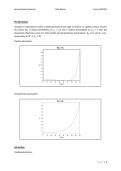
Consider an experiment in which a polarized beam of laser light is incident on a plastic surface. Assume
the plastic has a relative permittivity of 𝜀𝑟2 = 2.3 and a relative permeability of 𝜇𝑟2 = 1. Plot the
theoretical reflectance values for both parallel and perpendicular polarizations: 𝑅𝑝 vs 𝜃𝑖 and 𝑅𝑠 vs 𝜃𝑖 ,
respectively, for 0∘ ≤ 𝜃𝑖 ≤ 90∘ .
Parallel polarization:
Rp vs θi
Perpendicular polarization:
Rs vs θi
Lab Section
Parallel polarization:
Page |1
, Arizona State University Lab1 Report iCourse EEE341
𝜃𝑖 (= 𝜃𝑟 ) 𝑃𝑖 𝑃𝑟 𝑅𝑝
(degree) (mW) (mW) (Dimensionless)
10 0.35 0.0135 0.038571
20 0.35 0.0130 0.037143
30 0.35 0.0090 0.025714
40 0.35 0.00883 0.025229
50 0.35 0.00433 0.012371
60 0.35 0.00255 0.007286
70 0.35 0.0222 0.063429
80 0.35 0.0875 0.25
Perpendicular polarization:
𝜃𝑖 (= 𝜃𝑟 ) 𝑃𝑖 𝑃𝑟 𝑅𝑠
(degree) (mW) (mW) (Dimensionless)
10 0.35 0.012 0.034286
20 0.35 0.016 0.045714
30 0.35 0.0183 0.052286
40 0.35 0.0204 0.058286
50 0.35 0.0264 0.075429
60 0.35 0.042 0.12
70 0.35 0.077 0.22
80 0.35 0.267 0.762857
Did you recognize the Brewster angle from the data in the tables above? For which polarization and
between what angles does the Brewster angle exist?
For the parallel polarization, the data shows the power decrease and rise again
between 60-70 degree, this shows the existence of the Brewster angle from
measured data. Using 𝜺𝒓𝟐 = 𝟐. 𝟑 and the equation (8-227) I can confirm the
Brewster angle exist at 56.6 degrees theoretically.
For the perpendicular polarization, the data supports that a Brewster angle does
not exist. Equation (8-212) confirms this given that 𝝁𝒓𝟏 = 𝝁𝒓𝟐 = 𝟏
Overlap measurement data of 𝑅𝑝 and 𝑅𝑠 on the corresponding plots which were obtained from pre-lab
section.
Page |2
Pre-lab Section
Consider an experiment in which a polarized beam of laser light is incident on a plastic surface. Assume
the plastic has a relative permittivity of 𝜀𝑟2 = 2.3 and a relative permeability of 𝜇𝑟2 = 1. Plot the
theoretical reflectance values for both parallel and perpendicular polarizations: 𝑅𝑝 vs 𝜃𝑖 and 𝑅𝑠 vs 𝜃𝑖 ,
respectively, for 0∘ ≤ 𝜃𝑖 ≤ 90∘ .
Parallel polarization:
Rp vs θi
Perpendicular polarization:
Rs vs θi
Lab Section
Parallel polarization:
Page |1
, Arizona State University Lab1 Report iCourse EEE341
𝜃𝑖 (= 𝜃𝑟 ) 𝑃𝑖 𝑃𝑟 𝑅𝑝
(degree) (mW) (mW) (Dimensionless)
10 0.35 0.0135 0.038571
20 0.35 0.0130 0.037143
30 0.35 0.0090 0.025714
40 0.35 0.00883 0.025229
50 0.35 0.00433 0.012371
60 0.35 0.00255 0.007286
70 0.35 0.0222 0.063429
80 0.35 0.0875 0.25
Perpendicular polarization:
𝜃𝑖 (= 𝜃𝑟 ) 𝑃𝑖 𝑃𝑟 𝑅𝑠
(degree) (mW) (mW) (Dimensionless)
10 0.35 0.012 0.034286
20 0.35 0.016 0.045714
30 0.35 0.0183 0.052286
40 0.35 0.0204 0.058286
50 0.35 0.0264 0.075429
60 0.35 0.042 0.12
70 0.35 0.077 0.22
80 0.35 0.267 0.762857
Did you recognize the Brewster angle from the data in the tables above? For which polarization and
between what angles does the Brewster angle exist?
For the parallel polarization, the data shows the power decrease and rise again
between 60-70 degree, this shows the existence of the Brewster angle from
measured data. Using 𝜺𝒓𝟐 = 𝟐. 𝟑 and the equation (8-227) I can confirm the
Brewster angle exist at 56.6 degrees theoretically.
For the perpendicular polarization, the data supports that a Brewster angle does
not exist. Equation (8-212) confirms this given that 𝝁𝒓𝟏 = 𝝁𝒓𝟐 = 𝟏
Overlap measurement data of 𝑅𝑝 and 𝑅𝑠 on the corresponding plots which were obtained from pre-lab
section.
Page |2


