

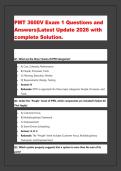
PMT 3600V Exam 1 Questions and
Answers|Latest Update 2026 with
complete Solution.
Q1. What are the three Tenets of IPPD Categories?
A) Cost, Schedule, Performance
B) People, Processes, Tools
C) Planning, Execution, Review
D) Requirements, Design, Testing
Answer: B
Rationale: IPPD is organized into three major categories: People, Processes, and
Tools.
Q2. Under the "People" tenet of IPPD, which components are included? (Select All
That Apply)
A) Customer Focus
B) Multidisciplinary Teamwork
C) Empowerment
D) Event-Driven Scheduling
Answer: A, B, C
Rationale: The "People" tenet includes Customer Focus, Multidisciplinary
Teamwork, and Empowerment.
Q3. Which system property suggests that a system is more than the sum of its
parts?
, A) Interdependence
B) Equifinality
C) Holism
D) Negative Entropy
Answer: C
Rationale: Holism is the system property that the whole is greater than the sum
of its parts.
Q4. What does "Permeability" refer to in the context of systems theory?
A) The ability of a system to sustain itself and grow
B) The need for system components to rely on other components
C) The ability of system components to allow information and materials to flow in
and out
D) The idea that a system can reach the same final state from differing initial
conditions
Answer: C
Rationale: Permeability refers to "permeable boundaries" – the ability of system
components to allow information and materials to flow in and out.
Q5. What is the primary responsibility of a Program Manager (PM)?
A) Approving congressional budgets
B) Delivering program capabilities that meet cost, schedule, and performance
objectives
C) Conducting independent audits
D) Managing military operations
Answer: B
Rationale: The Program Manager's primary responsibility is to deliver capabilities
that meet cost, schedule, and performance objectives.
Q6. Which document formally establishes a program's requirements?
, A) Risk Register
B) Capability Development Document (CDD)
C) Acquisition Strategy
D) Life Cycle Sustainment Plan
Answer: B
Rationale: The Capability Development Document (CDD) formally establishes a
program's requirements.
Q7. Which acquisition pathway is most appropriate for rapidly fielding innovative
technology?
A) Major Capability Acquisition
B) Software Acquisition
C) Urgent Capability Acquisition
D) Defense Business Systems
Answer: C
Rationale: The Urgent Capability Acquisition pathway is designed for rapidly
fielding innovative technology.
Q8. The Systems Engineering process primarily ensures:
A) Compliance with tax laws
B) Technical solutions satisfy stakeholder requirements
C) Personnel promotions
D) Contract payments
Answer: B
Rationale: Systems Engineering ensures that technical solutions satisfy
stakeholder requirements.
Q9. Which milestone generally authorizes entry into production?
A) Milestone A
B) Milestone B
Answers|Latest Update 2026 with
complete Solution.
Q1. What are the three Tenets of IPPD Categories?
A) Cost, Schedule, Performance
B) People, Processes, Tools
C) Planning, Execution, Review
D) Requirements, Design, Testing
Answer: B
Rationale: IPPD is organized into three major categories: People, Processes, and
Tools.
Q2. Under the "People" tenet of IPPD, which components are included? (Select All
That Apply)
A) Customer Focus
B) Multidisciplinary Teamwork
C) Empowerment
D) Event-Driven Scheduling
Answer: A, B, C
Rationale: The "People" tenet includes Customer Focus, Multidisciplinary
Teamwork, and Empowerment.
Q3. Which system property suggests that a system is more than the sum of its
parts?
, A) Interdependence
B) Equifinality
C) Holism
D) Negative Entropy
Answer: C
Rationale: Holism is the system property that the whole is greater than the sum
of its parts.
Q4. What does "Permeability" refer to in the context of systems theory?
A) The ability of a system to sustain itself and grow
B) The need for system components to rely on other components
C) The ability of system components to allow information and materials to flow in
and out
D) The idea that a system can reach the same final state from differing initial
conditions
Answer: C
Rationale: Permeability refers to "permeable boundaries" – the ability of system
components to allow information and materials to flow in and out.
Q5. What is the primary responsibility of a Program Manager (PM)?
A) Approving congressional budgets
B) Delivering program capabilities that meet cost, schedule, and performance
objectives
C) Conducting independent audits
D) Managing military operations
Answer: B
Rationale: The Program Manager's primary responsibility is to deliver capabilities
that meet cost, schedule, and performance objectives.
Q6. Which document formally establishes a program's requirements?
, A) Risk Register
B) Capability Development Document (CDD)
C) Acquisition Strategy
D) Life Cycle Sustainment Plan
Answer: B
Rationale: The Capability Development Document (CDD) formally establishes a
program's requirements.
Q7. Which acquisition pathway is most appropriate for rapidly fielding innovative
technology?
A) Major Capability Acquisition
B) Software Acquisition
C) Urgent Capability Acquisition
D) Defense Business Systems
Answer: C
Rationale: The Urgent Capability Acquisition pathway is designed for rapidly
fielding innovative technology.
Q8. The Systems Engineering process primarily ensures:
A) Compliance with tax laws
B) Technical solutions satisfy stakeholder requirements
C) Personnel promotions
D) Contract payments
Answer: B
Rationale: Systems Engineering ensures that technical solutions satisfy
stakeholder requirements.
Q9. Which milestone generally authorizes entry into production?
A) Milestone A
B) Milestone B


