

NURS 5430: Module 1 – Questions With A+ Answers
Save Groups
Terms in this set (94)
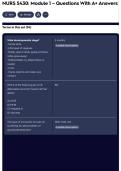
What developmental stage? 2 months
-Social smile 3 multiple choice options
-Lifts head 45 degrees
-Briefly opens hands (grasp primitive
reflex goes away)
-Differentiates cry (depending on
needs)
-Coos
-Tracks objects and makes eye
contact
Which of the following are LIVE, BD
attenuated vaccines? (select all that
apply)
A) DTaP
B) MMR
C) Hepatitis B
D) Varicella
This type of encounter focuses on Well-child visit
screening for abnormalities of
3 multiple choice options
growth/development.
,Scoring that is done immediately APGAR score
after delivery at 1 and 5 minutes.
Sometimes at 10 minutes.
Assesses Appearance (pink, blue,
acrocyanosis), Pulse (> or < 100bpm),
Grimace (reflex irritability), Activity
(tone), Respirations
8-10 = Generally reassuring/normal
adaptation
5-7 = Moderate distress; May need
support
0-4 = Severe distress; Immediate
resuscitation needed
Test used to estimate infant Ballard score
maturation compared to gestational
age, Most accurate at 12-24 hrs and is
based on sum of neuromuscular and
physical maturity score the higher the
number the more mature.
3 multiple choice options
, A 3-day-old exclusively breastfed C
newborn presents for a routine
follow-up visit. Birth weight was 3.4 kg,
and current weight is 3.1 kg. The infant
is otherwise well appearing with
normal vital signs and physical exam
findings. Which of the following
statements regarding newborn weight
loss is TRUE?
A. Any weight loss after birth is
considered abnormal and requires
hospitalization
B. Formula-fed infants commonly lose
more weight than breastfed infants C.
Weight loss of up to 10% of birth
weight during the 2-3 days can be
normal
D. Infants should regain their birth
weight within 48 hours of delivery
A newborn is noted to have dry, D
peeling skin, long fingernails,
abundant plantar creases, decreased
lanugo, and decreased vernix caseosa
on physical exam. Which of the
following best describes this infant?
A. Small for gestational age infant
B. Preterm infant
C. Large for gestational age infant
D. Post-term (older gestational age)
infant
Save Groups
Terms in this set (94)
What developmental stage? 2 months
-Social smile 3 multiple choice options
-Lifts head 45 degrees
-Briefly opens hands (grasp primitive
reflex goes away)
-Differentiates cry (depending on
needs)
-Coos
-Tracks objects and makes eye
contact
Which of the following are LIVE, BD
attenuated vaccines? (select all that
apply)
A) DTaP
B) MMR
C) Hepatitis B
D) Varicella
This type of encounter focuses on Well-child visit
screening for abnormalities of
3 multiple choice options
growth/development.
,Scoring that is done immediately APGAR score
after delivery at 1 and 5 minutes.
Sometimes at 10 minutes.
Assesses Appearance (pink, blue,
acrocyanosis), Pulse (> or < 100bpm),
Grimace (reflex irritability), Activity
(tone), Respirations
8-10 = Generally reassuring/normal
adaptation
5-7 = Moderate distress; May need
support
0-4 = Severe distress; Immediate
resuscitation needed
Test used to estimate infant Ballard score
maturation compared to gestational
age, Most accurate at 12-24 hrs and is
based on sum of neuromuscular and
physical maturity score the higher the
number the more mature.
3 multiple choice options
, A 3-day-old exclusively breastfed C
newborn presents for a routine
follow-up visit. Birth weight was 3.4 kg,
and current weight is 3.1 kg. The infant
is otherwise well appearing with
normal vital signs and physical exam
findings. Which of the following
statements regarding newborn weight
loss is TRUE?
A. Any weight loss after birth is
considered abnormal and requires
hospitalization
B. Formula-fed infants commonly lose
more weight than breastfed infants C.
Weight loss of up to 10% of birth
weight during the 2-3 days can be
normal
D. Infants should regain their birth
weight within 48 hours of delivery
A newborn is noted to have dry, D
peeling skin, long fingernails,
abundant plantar creases, decreased
lanugo, and decreased vernix caseosa
on physical exam. Which of the
following best describes this infant?
A. Small for gestational age infant
B. Preterm infant
C. Large for gestational age infant
D. Post-term (older gestational age)
infant


