

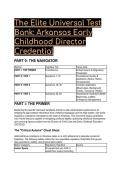
The Elite Universal Test
Bank: Arkansas Early
Childhood Director
Credential
PART 0: THE NAVIGATOR
Section Cognitive Tier Focus Area
PART I: THE PRIMER Foundational Critical Axioms & Regulatory
Thresholds
PART II: TIER 1 Questions 1–15 Foundational Syntax &
Application (Space, Ratios,
Temperatures)
PART II: TIER 2 Questions 16–35 Complex Application
(Mixed-Ages, Background
Checks, Insurance, Health)
PART II: TIER 3 Questions 36–60 Grandmaster Synthesis (Better
Beginnings, Liability,
Emergency Management)
PART I: THE PRIMER
Mastering this specific test bank translates directly to elite administrative performance by
bridging the gap between theoretical early childhood pedagogy and the high-stakes, real-world
regulatory compliance mandated by the state of Arkansas. This document forges candidates
into A-level directors capable of navigating profound liability, optimizing childhood development,
and surviving rigorous audits from the Division of Child Care and Early Childhood Education
(DCCECE).
The "Critical Axioms" Cheat Sheet
Administrative compliance in Arkansas relies on a strict adherence to absolute numerical
baselines. The following tables outline the non-negotiable regulatory thresholds that govern
daily operations, liability, and physical plant safety.
Metric Category Regulatory Standard Source
Indoor Space 35 square feet per child of
usable floor space (excluding
,Metric Category Regulatory Standard Source
bathrooms/kitchens).
Outdoor Space 75 square feet per child present
on the playground at any one
time.
Water Temperature Sinks accessible to children
must not exceed 120°F.
Food Storage Refrigerators must be 41°F or
below; Freezers must be 0°F or
below.
Director Presence Must be on-site a minimum of
50% of the primary operational
day.
Immunizations Exclusion required if no record
or exemption is provided within
15 program days.
Age Group Staff-to-Child Ratio Maximum Group Size Source
Birth – 18 months 1:5 10
18 months – 36 1:8 16
months
2 ½ – 3 years 1:12 24
4 years 1:15 30
5 years to 1:18 36
Kindergarten
Compliance Variable Required Frequency / Source
Threshold
Child Maltreatment Check Every two (2) years.
FBI/State Criminal Check Every five (5) years.
Liability Insurance (1-74 $500,000 per occurrence.
children)
Liability Insurance (75+ $1,000,000 per occurrence.
children)
PART II: THE ELITE TEST BANK
Tier 1 - Foundational Syntax & Application
Q1: A newly constructed child care center is finalizing its architectural footprint. The designated
preschool classroom measures exactly 1,050 square feet. However, 100 square feet is utilized
by a built-in bathroom, and 50 square feet is dedicated to an enclosed mechanical closet. Based
on the Minimum Licensing Requirements (MLR), what is the MAXIMUM number of children
legally permitted to occupy this room? A) 30 children B) 25 children C) 28 children D) 22
children
● The Answer: B (25 children)
, ● Distractor Analysis:
○ A is incorrect: This erroneously divides the gross 1,050 square footage by 35
without subtracting the non-usable space.
○ C is incorrect: This calculation only subtracts the mechanical closet, failing to
exclude the bathroom footprint.
○ D is incorrect: This utilizes an overly conservative metric (e.g., 40 square feet per
child), which represents an operational inefficiency.
The Mentor's Analysis: Administrative competency begins with spatial mathematics. Usable
indoor space is strictly defined as 35 square feet per child, actively excluding bathrooms,
kitchens, and inaccessible storage. By isolating the 900 usable square feet and dividing by 35,
you achieve 25.7, which rounds down to a hard cap of 25. Professional/Academic Intuition:
Always subtract non-programmatic infrastructure before dividing by 35.
Q2: During a summer transition, a facility plans to rotate cohorts of children into the outdoor play
area. The facility has a total licensed capacity of 80 children. If the Director schedules the
rotations so that a maximum of 30 children are outside simultaneously, what is the MINIMUM
required square footage for the enclosed outdoor play area? A) 6,000 square feet B) 2,250
square feet C) 2,800 square feet D) 1,050 square feet
● The Answer: B (2,250 square feet)
● Distractor Analysis:
○ A is incorrect: The law does not demand 75 square feet for the total licensed
capacity (80) if they do not occupy the yard simultaneously.
○ C is incorrect: This calculation applies an arbitrary metric unrelated to the Arkansas
outdoor standard.
○ D is incorrect: This applies the indoor standard (35 square feet) to the outdoor
environment, which is a critical regulatory violation.
The Mentor's Analysis: Outdoor real estate requirements are dictated by simultaneous use,
not total facility enrollment. The MLR mandates 75 square feet per child present on the
playground at any given time. By mathematically multiplying 30 children by 75 square feet, the
required footprint is optimized. Professional/Academic Intuition: You pay for the peak
utilization, not the total census. Schedule your playground rotations meticulously to
reduce your required footprint.
Q3: A caregiver in the infant room (Birth to 18 months) is overseeing a cohort of children.
According to the DCCECE staff-to-child ratios, what is the MAXIMUM number of infants a single
caregiver can legally supervise, and what is the absolute group size limit for this age bracket?
A) Ratio of 1:6, maximum group size of 12. B) Ratio of 1:4, maximum group size of 8. C) Ratio
of 1:8, maximum group size of 16. D) Ratio of 1:5, maximum group size of 10.
● The Answer: D (Ratio of 1:5, maximum group size of 10.)
● Distractor Analysis:
○ A is incorrect: A 1:6 ratio applies to older cohorts or specific mixed-age scenarios
under 8 children, not pure infant cohorts.
○ B is incorrect: A 1:4 ratio is an elite national standard (e.g., Head Start) but is not
the baseline Arkansas state minimum.
○ C is incorrect: The 1:8 ratio applies strictly to toddlers (18–36 months), making it a
lethal violation for neonates.
The Mentor's Analysis: Infant care operates under the tightest operational margins to mitigate
SIDS and injury risks. The DCCECE dictates an uncompromising 1:5 ratio for infants (Birth to 18
months), with group sizes strictly capped at two times the ratio (10 infants).
Professional/Academic Intuition: Infant mathematics: 1 adult to 5 infants. At 6 infants,
Bank: Arkansas Early
Childhood Director
Credential
PART 0: THE NAVIGATOR
Section Cognitive Tier Focus Area
PART I: THE PRIMER Foundational Critical Axioms & Regulatory
Thresholds
PART II: TIER 1 Questions 1–15 Foundational Syntax &
Application (Space, Ratios,
Temperatures)
PART II: TIER 2 Questions 16–35 Complex Application
(Mixed-Ages, Background
Checks, Insurance, Health)
PART II: TIER 3 Questions 36–60 Grandmaster Synthesis (Better
Beginnings, Liability,
Emergency Management)
PART I: THE PRIMER
Mastering this specific test bank translates directly to elite administrative performance by
bridging the gap between theoretical early childhood pedagogy and the high-stakes, real-world
regulatory compliance mandated by the state of Arkansas. This document forges candidates
into A-level directors capable of navigating profound liability, optimizing childhood development,
and surviving rigorous audits from the Division of Child Care and Early Childhood Education
(DCCECE).
The "Critical Axioms" Cheat Sheet
Administrative compliance in Arkansas relies on a strict adherence to absolute numerical
baselines. The following tables outline the non-negotiable regulatory thresholds that govern
daily operations, liability, and physical plant safety.
Metric Category Regulatory Standard Source
Indoor Space 35 square feet per child of
usable floor space (excluding
,Metric Category Regulatory Standard Source
bathrooms/kitchens).
Outdoor Space 75 square feet per child present
on the playground at any one
time.
Water Temperature Sinks accessible to children
must not exceed 120°F.
Food Storage Refrigerators must be 41°F or
below; Freezers must be 0°F or
below.
Director Presence Must be on-site a minimum of
50% of the primary operational
day.
Immunizations Exclusion required if no record
or exemption is provided within
15 program days.
Age Group Staff-to-Child Ratio Maximum Group Size Source
Birth – 18 months 1:5 10
18 months – 36 1:8 16
months
2 ½ – 3 years 1:12 24
4 years 1:15 30
5 years to 1:18 36
Kindergarten
Compliance Variable Required Frequency / Source
Threshold
Child Maltreatment Check Every two (2) years.
FBI/State Criminal Check Every five (5) years.
Liability Insurance (1-74 $500,000 per occurrence.
children)
Liability Insurance (75+ $1,000,000 per occurrence.
children)
PART II: THE ELITE TEST BANK
Tier 1 - Foundational Syntax & Application
Q1: A newly constructed child care center is finalizing its architectural footprint. The designated
preschool classroom measures exactly 1,050 square feet. However, 100 square feet is utilized
by a built-in bathroom, and 50 square feet is dedicated to an enclosed mechanical closet. Based
on the Minimum Licensing Requirements (MLR), what is the MAXIMUM number of children
legally permitted to occupy this room? A) 30 children B) 25 children C) 28 children D) 22
children
● The Answer: B (25 children)
, ● Distractor Analysis:
○ A is incorrect: This erroneously divides the gross 1,050 square footage by 35
without subtracting the non-usable space.
○ C is incorrect: This calculation only subtracts the mechanical closet, failing to
exclude the bathroom footprint.
○ D is incorrect: This utilizes an overly conservative metric (e.g., 40 square feet per
child), which represents an operational inefficiency.
The Mentor's Analysis: Administrative competency begins with spatial mathematics. Usable
indoor space is strictly defined as 35 square feet per child, actively excluding bathrooms,
kitchens, and inaccessible storage. By isolating the 900 usable square feet and dividing by 35,
you achieve 25.7, which rounds down to a hard cap of 25. Professional/Academic Intuition:
Always subtract non-programmatic infrastructure before dividing by 35.
Q2: During a summer transition, a facility plans to rotate cohorts of children into the outdoor play
area. The facility has a total licensed capacity of 80 children. If the Director schedules the
rotations so that a maximum of 30 children are outside simultaneously, what is the MINIMUM
required square footage for the enclosed outdoor play area? A) 6,000 square feet B) 2,250
square feet C) 2,800 square feet D) 1,050 square feet
● The Answer: B (2,250 square feet)
● Distractor Analysis:
○ A is incorrect: The law does not demand 75 square feet for the total licensed
capacity (80) if they do not occupy the yard simultaneously.
○ C is incorrect: This calculation applies an arbitrary metric unrelated to the Arkansas
outdoor standard.
○ D is incorrect: This applies the indoor standard (35 square feet) to the outdoor
environment, which is a critical regulatory violation.
The Mentor's Analysis: Outdoor real estate requirements are dictated by simultaneous use,
not total facility enrollment. The MLR mandates 75 square feet per child present on the
playground at any given time. By mathematically multiplying 30 children by 75 square feet, the
required footprint is optimized. Professional/Academic Intuition: You pay for the peak
utilization, not the total census. Schedule your playground rotations meticulously to
reduce your required footprint.
Q3: A caregiver in the infant room (Birth to 18 months) is overseeing a cohort of children.
According to the DCCECE staff-to-child ratios, what is the MAXIMUM number of infants a single
caregiver can legally supervise, and what is the absolute group size limit for this age bracket?
A) Ratio of 1:6, maximum group size of 12. B) Ratio of 1:4, maximum group size of 8. C) Ratio
of 1:8, maximum group size of 16. D) Ratio of 1:5, maximum group size of 10.
● The Answer: D (Ratio of 1:5, maximum group size of 10.)
● Distractor Analysis:
○ A is incorrect: A 1:6 ratio applies to older cohorts or specific mixed-age scenarios
under 8 children, not pure infant cohorts.
○ B is incorrect: A 1:4 ratio is an elite national standard (e.g., Head Start) but is not
the baseline Arkansas state minimum.
○ C is incorrect: The 1:8 ratio applies strictly to toddlers (18–36 months), making it a
lethal violation for neonates.
The Mentor's Analysis: Infant care operates under the tightest operational margins to mitigate
SIDS and injury risks. The DCCECE dictates an uncompromising 1:5 ratio for infants (Birth to 18
months), with group sizes strictly capped at two times the ratio (10 infants).
Professional/Academic Intuition: Infant mathematics: 1 adult to 5 infants. At 6 infants,


