
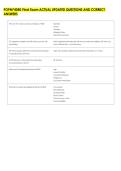
POPM*4040 Final Exam ACTUAL UPDATED QUESTIONS AND CORRECT
ANSWERS
What are the 5 major causative pathogens of FBD? Bacteria
Viruses
Parasites
Biological Toxins
Elements/Chemicals
T/F: Organisms multiply in the GIT when you have a FB False. Organisms enter the body with food or water and multiply in GIT when you
intoxication have a FB infection - not intoxication.
T/F: The incubation period for a food borne intoxication False. The incubation period for a food borne intoxication is < 4 hours.
is typically around 24 hours
Is it FB infection or intoxication that typically is FB infection
accompanied by a fever?
What are 5 host-related risk factors for FBD? Age
Level of Nutrition
Concurrent Diseases
Pregnancy
Concurrent medication
What are 5 environment-related risk factors for FBD? Occupation
Race/Ethnicity
Social Activities
Recent Travel
Socio-economic status
Food availability
, An _______ disease is one that is always present in the endemic
population at a predictable level of occurrence.
An ________ disease is one with an unpredictably high epidemic
occurrance in a population - more than normal.
A _____________ disease is an global _______ _. d) pandemic, epidemic
a) pandemic, endemic
b) epidemic, endemic
c) pandemic, sporadic
d) pandemic, epidemic
e) endemic, sporadic
The attack rate of a disease is proportion of ____________ a) exposed, immunity
individuals who develop _______ _. b) not exposed, immunity
c) not exposed, clinical disease
d) exposed, clinical disease
e) exposed, diarrhea
The attack rate for the mayo given the following AR = [D+| E+]/ [(D+)+(D-)/ E+]
information is: AR = 48/ 100
AR = 0.48 = 48%
Total people who ate mayo which tested (+) for listeria =
100
People ate mayo and developed vomiting or diarrhea =
48
People ate mayo and did not develop disease = 52
The ______ is the proportion of cases in the population at a) prevalence
a specific point in time.
a) prevalence
b) incidence
c) occurrence
d) count
e) attack rate
The ______________ is the proportion of ________ cases in a e) incidence, new
defined population during a specific time period.
a) prevalence, pre-existing
b) incidence, pre-existing
c) attack rate, pre-existing
d) prevalence, new
e) incidence, new
ANSWERS
What are the 5 major causative pathogens of FBD? Bacteria
Viruses
Parasites
Biological Toxins
Elements/Chemicals
T/F: Organisms multiply in the GIT when you have a FB False. Organisms enter the body with food or water and multiply in GIT when you
intoxication have a FB infection - not intoxication.
T/F: The incubation period for a food borne intoxication False. The incubation period for a food borne intoxication is < 4 hours.
is typically around 24 hours
Is it FB infection or intoxication that typically is FB infection
accompanied by a fever?
What are 5 host-related risk factors for FBD? Age
Level of Nutrition
Concurrent Diseases
Pregnancy
Concurrent medication
What are 5 environment-related risk factors for FBD? Occupation
Race/Ethnicity
Social Activities
Recent Travel
Socio-economic status
Food availability
, An _______ disease is one that is always present in the endemic
population at a predictable level of occurrence.
An ________ disease is one with an unpredictably high epidemic
occurrance in a population - more than normal.
A _____________ disease is an global _______ _. d) pandemic, epidemic
a) pandemic, endemic
b) epidemic, endemic
c) pandemic, sporadic
d) pandemic, epidemic
e) endemic, sporadic
The attack rate of a disease is proportion of ____________ a) exposed, immunity
individuals who develop _______ _. b) not exposed, immunity
c) not exposed, clinical disease
d) exposed, clinical disease
e) exposed, diarrhea
The attack rate for the mayo given the following AR = [D+| E+]/ [(D+)+(D-)/ E+]
information is: AR = 48/ 100
AR = 0.48 = 48%
Total people who ate mayo which tested (+) for listeria =
100
People ate mayo and developed vomiting or diarrhea =
48
People ate mayo and did not develop disease = 52
The ______ is the proportion of cases in the population at a) prevalence
a specific point in time.
a) prevalence
b) incidence
c) occurrence
d) count
e) attack rate
The ______________ is the proportion of ________ cases in a e) incidence, new
defined population during a specific time period.
a) prevalence, pre-existing
b) incidence, pre-existing
c) attack rate, pre-existing
d) prevalence, new
e) incidence, new


