

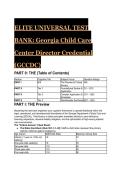
ELITE UNIVERSAL TEST
BANK: Georgia Child Care
Center Director Credential
(GCCDC)
PART 0: THE (Table of Contents)
Section Cognitive Tier Subject Focus Question Range
PART I N/A The Preview & Critical N/A
Axioms
PART II Tier 1 Foundational Syntax & Q1 – Q10
Application
PART II Tier 2 Complex Application & Q11 – Q20
Simulation
PART II Tier 3 Grandmaster Synthesis Q21 – Q30
PART I: THE Preview
Mastering this test bank engineers your cognitive framework to operate flawlessly within the
legal, operational, and developmental boundaries of the Georgia Department of Early Care and
Learning (DECAL). Total fluency in these principles translates directly to zero-deficiency
licensing inspections, absolute liability mitigation, and the optimization of high-acuity pediatric
care environments.
The "Critical Axioms" Cheat Sheet:
● The Ratio Hard-Deck (Rule 591-1-1-.32): Staff-to-child ratios represent the primary
statutory defense against negligence.
Age Cohort Staff:Child Ratio Maximum Group Size
Infants (<1 year or <18m not 1:6 12
walking)
One-year-olds (walking) 1:8 16
Two-year-olds 1:10 20
Three-year-olds 1:15 30
Four-year-olds 1:18 36
,Age Cohort Staff:Child Ratio Maximum Group Size
Five-year-olds 1:20 40
● The Spatial Metric (Rule 591-1-1-.25/.26): Indoor capacity is strictly calculated at 35
square feet of usable space per child, excluding bathrooms and fixed adult furniture.
Outdoor playgrounds require 100 square feet per child, computed against one-third (1/3)
of the facility's total licensed capacity.
● The Mandated Reporting Absolute (O.C.G.A. § 19-7-5): Suspected abuse or neglect
must be reported to the Department of Family and Children Services (DFCS) or law
enforcement immediately, but no later than 24 hours. There is no internal
chain-of-command exemption; the duty rests on the individual reporter.
● The Safety Perimeter (Rule 591-1-1-.30 /.13): Safe sleep mandates back-only
positioning with zero soft objects in cribs, and mechanical restrictions like swaddling are
prohibited without a physician's directive. Field trips prohibit lanyard name tags to avert
strangulation hazards.
PART II: THE ELITE TEST BANK
Tier 1 - Foundational Syntax & Application
Q1: A newly enrolled infant is 10 months old and not yet walking. Based on the principles of
Rule 591-1-1-.32 Staff:Child Ratios and Supervision, which action/conclusion regarding ratio
and group size is the MOST ACCURATE? A) The required ratio is 1:8 with a maximum group
size of 16. B) The required ratio is 1:6 with a maximum group size of 12. C) The required ratio is
1:10 with a maximum group size of 20. D) The required ratio is 1:6 with a maximum group size
of 14.
● The Answer: B (The required ratio is 1:6 with a maximum group size of 12.)
● Distractor Analysis:
○ A is incorrect: This parameter is strictly reserved for one-year-olds who have
already achieved the developmental milestone of walking. Applying this ratio to a
non-ambulatory infant compromises emergency evacuation protocols.
○ C is incorrect: This represents the statutory maximum for two-year-old cohorts,
which possess significantly higher autonomy and hazard-avoidance capabilities
than infants.
○ D is incorrect: While the 1:6 caregiver-to-child ratio is mathematically correct,
DECAL regulations explicitly cap the maximum group size in a single physical infant
space at 12 to mitigate infectious disease transmission and acoustic stress.
The Mentor's Analysis: Regulatory compliance begins with infant vulnerability parameters.
DECAL categorizes any child under 12 months, or under 18 months and not walking, as an
infant requiring maximum supervisory saturation. By utilizing the Strict Cohort Ratio Matrix, you
bypass the common trap of over-enrolling infant rooms based on physical square footage rather
than staffing caps. Professional/Academic Intuition: Infant capacity is dictated by staff
availability (1:6) and group caps (12) before physical square footage is ever calculated.
Q2: During a facility expansion, the Director is mapping out a new classroom. Based on the
principles of Rule 591-1-1-.25 Physical Plant, which action/conclusion is the MOST ACCURATE
for determining licensed capacity? A) Divide the total wall-to-wall square footage by 25 square
feet, excluding only the bathrooms. B) Divide the total square footage by 35 square feet,
including built-in cabinets to maximize the legal occupancy load. C) Divide usable space by 35
, square feet, explicitly excluding bathrooms, halls, and space occupied by adult-size furniture. D)
Divide total square footage by 100 square feet to calculate safe indoor capacity during a public
health emergency.
● The Answer: C (Divide usable space by 35 square feet, explicitly excluding bathrooms,
halls, and space occupied by adult-size furniture.)
● Distractor Analysis:
○ A is incorrect: The Georgia standard for indoor spatial allowances is strictly 35
square feet per child; calculating at 25 square feet artificially inflates capacity and
constitutes a severe licensing violation.
○ B is incorrect: Built-in cabinets, administrative desks, and adult-sized furniture must
be mathematically deducted from the gross square footage because they represent
dead space inaccessible to the child.
○ D is incorrect: The 100 square feet metric is the specific regulatory multiplier utilized
exclusively for calculating outdoor playground capacity, not indoor physical plant
capacity.
The Mentor's Analysis: Indoor capacity is an operational hard-stop based entirely on the
child's unencumbered, usable footprint. When facing expansion planning, the immediate priority
is accurate spatial accounting that strips away all architectural dead zones. By utilizing Usable
Space Deductions, you bypass the common trap of counting administrative floor space toward
legal pediatric capacity. Professional/Academic Intuition: Capacity is derived exclusively
from unencumbered, child-accessible floor space, not the gross dimensions of the real
estate.
Q3: A parent requests that her 9-month-old be placed to sleep on his stomach to alleviate
symptoms of severe gastroesophageal reflux. Based on the principles of Rule 591-1-1-.30 Safe
Sleeping and Resting Requirements, which action/conclusion is the MOST ACCURATE? A)
Accommodate the parent's verbal request to provide optimal customer service and prevent
infant distress. B) Place the infant on his back, as stomach sleeping is globally prohibited in
licensed centers regardless of medical status. C) Place the infant on his stomach ONLY if the
parent provides a physician's written statement authorizing the position and dictating a specific
time frame. D) Place the child in a mechanical swing to keep the head elevated during the
scheduled nap time.
● The Answer: C (Place the infant on his stomach ONLY if the parent provides a
physician's written statement authorizing the position and dictating a specific time frame.)
● Distractor Analysis:
○ A is incorrect: Verbal authorization from a custodial parent is legally invalid for
altering statutory safe sleep protocols designed to prevent Sudden Infant Death
Syndrome (SIDS).
○ B is incorrect: DECAL regulations do permit deviations from supine (back) sleeping,
but they strictly mandate a physician's written directive to shift the liability shield
from the center to the medical provider.
○ D is incorrect: Infants are explicitly prohibited from sleeping in equipment other than
safety-approved cribs; mechanical swings, car seats, and bouncy seats pose
extreme positional asphyxiation hazards.
The Mentor's Analysis: Sleep environment engineering is a non-negotiable liability shield
against infant mortality. When facing parental requests that contradict safety baselines, the
immediate priority is securing formal medical documentation. By utilizing Physician-Authorized
Deviations, you bypass the common trap of accepting parental preference over regulatory
statute. Professional/Academic Intuition: Never override a baseline physiological safety
BANK: Georgia Child Care
Center Director Credential
(GCCDC)
PART 0: THE (Table of Contents)
Section Cognitive Tier Subject Focus Question Range
PART I N/A The Preview & Critical N/A
Axioms
PART II Tier 1 Foundational Syntax & Q1 – Q10
Application
PART II Tier 2 Complex Application & Q11 – Q20
Simulation
PART II Tier 3 Grandmaster Synthesis Q21 – Q30
PART I: THE Preview
Mastering this test bank engineers your cognitive framework to operate flawlessly within the
legal, operational, and developmental boundaries of the Georgia Department of Early Care and
Learning (DECAL). Total fluency in these principles translates directly to zero-deficiency
licensing inspections, absolute liability mitigation, and the optimization of high-acuity pediatric
care environments.
The "Critical Axioms" Cheat Sheet:
● The Ratio Hard-Deck (Rule 591-1-1-.32): Staff-to-child ratios represent the primary
statutory defense against negligence.
Age Cohort Staff:Child Ratio Maximum Group Size
Infants (<1 year or <18m not 1:6 12
walking)
One-year-olds (walking) 1:8 16
Two-year-olds 1:10 20
Three-year-olds 1:15 30
Four-year-olds 1:18 36
,Age Cohort Staff:Child Ratio Maximum Group Size
Five-year-olds 1:20 40
● The Spatial Metric (Rule 591-1-1-.25/.26): Indoor capacity is strictly calculated at 35
square feet of usable space per child, excluding bathrooms and fixed adult furniture.
Outdoor playgrounds require 100 square feet per child, computed against one-third (1/3)
of the facility's total licensed capacity.
● The Mandated Reporting Absolute (O.C.G.A. § 19-7-5): Suspected abuse or neglect
must be reported to the Department of Family and Children Services (DFCS) or law
enforcement immediately, but no later than 24 hours. There is no internal
chain-of-command exemption; the duty rests on the individual reporter.
● The Safety Perimeter (Rule 591-1-1-.30 /.13): Safe sleep mandates back-only
positioning with zero soft objects in cribs, and mechanical restrictions like swaddling are
prohibited without a physician's directive. Field trips prohibit lanyard name tags to avert
strangulation hazards.
PART II: THE ELITE TEST BANK
Tier 1 - Foundational Syntax & Application
Q1: A newly enrolled infant is 10 months old and not yet walking. Based on the principles of
Rule 591-1-1-.32 Staff:Child Ratios and Supervision, which action/conclusion regarding ratio
and group size is the MOST ACCURATE? A) The required ratio is 1:8 with a maximum group
size of 16. B) The required ratio is 1:6 with a maximum group size of 12. C) The required ratio is
1:10 with a maximum group size of 20. D) The required ratio is 1:6 with a maximum group size
of 14.
● The Answer: B (The required ratio is 1:6 with a maximum group size of 12.)
● Distractor Analysis:
○ A is incorrect: This parameter is strictly reserved for one-year-olds who have
already achieved the developmental milestone of walking. Applying this ratio to a
non-ambulatory infant compromises emergency evacuation protocols.
○ C is incorrect: This represents the statutory maximum for two-year-old cohorts,
which possess significantly higher autonomy and hazard-avoidance capabilities
than infants.
○ D is incorrect: While the 1:6 caregiver-to-child ratio is mathematically correct,
DECAL regulations explicitly cap the maximum group size in a single physical infant
space at 12 to mitigate infectious disease transmission and acoustic stress.
The Mentor's Analysis: Regulatory compliance begins with infant vulnerability parameters.
DECAL categorizes any child under 12 months, or under 18 months and not walking, as an
infant requiring maximum supervisory saturation. By utilizing the Strict Cohort Ratio Matrix, you
bypass the common trap of over-enrolling infant rooms based on physical square footage rather
than staffing caps. Professional/Academic Intuition: Infant capacity is dictated by staff
availability (1:6) and group caps (12) before physical square footage is ever calculated.
Q2: During a facility expansion, the Director is mapping out a new classroom. Based on the
principles of Rule 591-1-1-.25 Physical Plant, which action/conclusion is the MOST ACCURATE
for determining licensed capacity? A) Divide the total wall-to-wall square footage by 25 square
feet, excluding only the bathrooms. B) Divide the total square footage by 35 square feet,
including built-in cabinets to maximize the legal occupancy load. C) Divide usable space by 35
, square feet, explicitly excluding bathrooms, halls, and space occupied by adult-size furniture. D)
Divide total square footage by 100 square feet to calculate safe indoor capacity during a public
health emergency.
● The Answer: C (Divide usable space by 35 square feet, explicitly excluding bathrooms,
halls, and space occupied by adult-size furniture.)
● Distractor Analysis:
○ A is incorrect: The Georgia standard for indoor spatial allowances is strictly 35
square feet per child; calculating at 25 square feet artificially inflates capacity and
constitutes a severe licensing violation.
○ B is incorrect: Built-in cabinets, administrative desks, and adult-sized furniture must
be mathematically deducted from the gross square footage because they represent
dead space inaccessible to the child.
○ D is incorrect: The 100 square feet metric is the specific regulatory multiplier utilized
exclusively for calculating outdoor playground capacity, not indoor physical plant
capacity.
The Mentor's Analysis: Indoor capacity is an operational hard-stop based entirely on the
child's unencumbered, usable footprint. When facing expansion planning, the immediate priority
is accurate spatial accounting that strips away all architectural dead zones. By utilizing Usable
Space Deductions, you bypass the common trap of counting administrative floor space toward
legal pediatric capacity. Professional/Academic Intuition: Capacity is derived exclusively
from unencumbered, child-accessible floor space, not the gross dimensions of the real
estate.
Q3: A parent requests that her 9-month-old be placed to sleep on his stomach to alleviate
symptoms of severe gastroesophageal reflux. Based on the principles of Rule 591-1-1-.30 Safe
Sleeping and Resting Requirements, which action/conclusion is the MOST ACCURATE? A)
Accommodate the parent's verbal request to provide optimal customer service and prevent
infant distress. B) Place the infant on his back, as stomach sleeping is globally prohibited in
licensed centers regardless of medical status. C) Place the infant on his stomach ONLY if the
parent provides a physician's written statement authorizing the position and dictating a specific
time frame. D) Place the child in a mechanical swing to keep the head elevated during the
scheduled nap time.
● The Answer: C (Place the infant on his stomach ONLY if the parent provides a
physician's written statement authorizing the position and dictating a specific time frame.)
● Distractor Analysis:
○ A is incorrect: Verbal authorization from a custodial parent is legally invalid for
altering statutory safe sleep protocols designed to prevent Sudden Infant Death
Syndrome (SIDS).
○ B is incorrect: DECAL regulations do permit deviations from supine (back) sleeping,
but they strictly mandate a physician's written directive to shift the liability shield
from the center to the medical provider.
○ D is incorrect: Infants are explicitly prohibited from sleeping in equipment other than
safety-approved cribs; mechanical swings, car seats, and bouncy seats pose
extreme positional asphyxiation hazards.
The Mentor's Analysis: Sleep environment engineering is a non-negotiable liability shield
against infant mortality. When facing parental requests that contradict safety baselines, the
immediate priority is securing formal medical documentation. By utilizing Physician-Authorized
Deviations, you bypass the common trap of accepting parental preference over regulatory
statute. Professional/Academic Intuition: Never override a baseline physiological safety


