

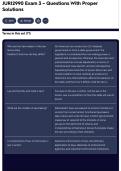
JURI2990 Exam 3 – Questions With Proper
Solutions
Save Groups
Terms in this set (71)
Who are the 'law‐makers' in the law All American law comes from U.S. (federal)
and society government or from a state government. The
tradition? And how do they differ? legislature is considered the rule-making power, is
general and prospective. Whereas, the executive and
judicial branches include adjudication in terms of
individual and case specific, and are retrospective.
Separating these branches of power allows law and
society tradition to look carefully at evidence to
determine how that institution affects the behavior of
the state, and thus how it affects what the law is.
Law and Society and what is law? Focuses on the law in action, not the law in the
books. Law is a prediction of how the state will use its
power.
What are the models of lawmaking? Rationalistic (laws are passed to protect members of
society from social harms), functional (lawmakers
take culture and write into law), conflict (government
makes law to respond to the interests of some
groups to the detriment of others), and
moral/political entrepreneur (powerful people shape
the law according to their interests).
4 Components of law on the books v. Selective enforcement of laws, discretionary
law in action application of laws, dilemmas of enforcement
agencies, and important enforcement institutions
,What is the "externalist account" and Might not have been the Court Packing Plan, but
the "internalist account"? What are FDR's election was decided around this same time.
some arguments and Outside political factors can affect the decisions of
counterarguments on both sides? the Court. Justices may have been more likely to vote
for cases in which FDR and public opinion agree
upon.
What is the significance of the Roberts argument was that her was never asked to
"Nebbia" case? overrule certain cases, and if he had, the switch
would have happened much sooner than it actually
did.
Externalist Account Views the legal system from an outsider's
perspective—such as a sociologist, economist, or
citizen—focusing on behavior, social consequences,
and empirical facts rather than the internal logic of
legal rules.
Internalist Account Prioritizes the perspectives of officials using law as a
guide to obligation.
Who are the 'law‐makers' in the law The 'law-makers' are the three branches of
and society government, primarily distinguished by the scope
tradition? And how do they differ? and timing of their authority. The legislature holds the
rule-making power, creating laws that are general in
nature and prospective, meaning they apply to future
conduct. In contrast, the executive and judicial
branches engage in adjudication, which is case-
specific and retrospective, dealing with individual
actions that have already occurred. Separating these
powers allows the law and society tradition to use
evidence to determine how specific institutions affect
the behavior of the state, thereby defining what 'the
law' actually becomes in practice
, How is law seen in terms of law & Law is viewed not as a static set of rules, but as a
society tradition? measurable product of the society that created it.
This perspective is strictly positivistic and evidence-
based, treating law as an exercise of power by
society that can be observed and analyzed through
data. By shifting the focus from abstract legal logic to
societal output, this tradition allows scholars to
evaluate how social forces shape the legal system's
development and function.
What are the different theories of There are two primary theories: the rationalistic
legislation in the model and the functionalist model. The rationalistic
Law and Society tradition? model views legislation as a logical sequence of
investigation, information gathering, and interest
aggregation designed to create a specific remedy.
The functionalist model argues that law-making is a
functional response to societal needs, creating
structures that define society and ensure individuals
follow through on their social promises. Both theories
relate to the course goal of understanding whether
the Rule of Law is a planned rational system or a
reactive social tool.
What does law and society Scholarship suggests that the legislative process is
scholarship on the often less about a 'rational' search for the common
legislative process suggest about the good and more about the aggregation of powerful
ROL in the U.S., interests. This implies that the Rule of Law in the U.S.
particularly the state of democratic may be compromised by 'capture,' where specific
decision‐making? groups influence the 'law-making' power to favor
their own needs rather than neutral, democratic
consensus. From this view, democratic decision-
making is seen as a messy competition for influence
that determines the actual content of the law.
Solutions
Save Groups
Terms in this set (71)
Who are the 'law‐makers' in the law All American law comes from U.S. (federal)
and society government or from a state government. The
tradition? And how do they differ? legislature is considered the rule-making power, is
general and prospective. Whereas, the executive and
judicial branches include adjudication in terms of
individual and case specific, and are retrospective.
Separating these branches of power allows law and
society tradition to look carefully at evidence to
determine how that institution affects the behavior of
the state, and thus how it affects what the law is.
Law and Society and what is law? Focuses on the law in action, not the law in the
books. Law is a prediction of how the state will use its
power.
What are the models of lawmaking? Rationalistic (laws are passed to protect members of
society from social harms), functional (lawmakers
take culture and write into law), conflict (government
makes law to respond to the interests of some
groups to the detriment of others), and
moral/political entrepreneur (powerful people shape
the law according to their interests).
4 Components of law on the books v. Selective enforcement of laws, discretionary
law in action application of laws, dilemmas of enforcement
agencies, and important enforcement institutions
,What is the "externalist account" and Might not have been the Court Packing Plan, but
the "internalist account"? What are FDR's election was decided around this same time.
some arguments and Outside political factors can affect the decisions of
counterarguments on both sides? the Court. Justices may have been more likely to vote
for cases in which FDR and public opinion agree
upon.
What is the significance of the Roberts argument was that her was never asked to
"Nebbia" case? overrule certain cases, and if he had, the switch
would have happened much sooner than it actually
did.
Externalist Account Views the legal system from an outsider's
perspective—such as a sociologist, economist, or
citizen—focusing on behavior, social consequences,
and empirical facts rather than the internal logic of
legal rules.
Internalist Account Prioritizes the perspectives of officials using law as a
guide to obligation.
Who are the 'law‐makers' in the law The 'law-makers' are the three branches of
and society government, primarily distinguished by the scope
tradition? And how do they differ? and timing of their authority. The legislature holds the
rule-making power, creating laws that are general in
nature and prospective, meaning they apply to future
conduct. In contrast, the executive and judicial
branches engage in adjudication, which is case-
specific and retrospective, dealing with individual
actions that have already occurred. Separating these
powers allows the law and society tradition to use
evidence to determine how specific institutions affect
the behavior of the state, thereby defining what 'the
law' actually becomes in practice
, How is law seen in terms of law & Law is viewed not as a static set of rules, but as a
society tradition? measurable product of the society that created it.
This perspective is strictly positivistic and evidence-
based, treating law as an exercise of power by
society that can be observed and analyzed through
data. By shifting the focus from abstract legal logic to
societal output, this tradition allows scholars to
evaluate how social forces shape the legal system's
development and function.
What are the different theories of There are two primary theories: the rationalistic
legislation in the model and the functionalist model. The rationalistic
Law and Society tradition? model views legislation as a logical sequence of
investigation, information gathering, and interest
aggregation designed to create a specific remedy.
The functionalist model argues that law-making is a
functional response to societal needs, creating
structures that define society and ensure individuals
follow through on their social promises. Both theories
relate to the course goal of understanding whether
the Rule of Law is a planned rational system or a
reactive social tool.
What does law and society Scholarship suggests that the legislative process is
scholarship on the often less about a 'rational' search for the common
legislative process suggest about the good and more about the aggregation of powerful
ROL in the U.S., interests. This implies that the Rule of Law in the U.S.
particularly the state of democratic may be compromised by 'capture,' where specific
decision‐making? groups influence the 'law-making' power to favor
their own needs rather than neutral, democratic
consensus. From this view, democratic decision-
making is seen as a messy competition for influence
that determines the actual content of the law.


