

JURI 2990 FINAL EXAM – Accurate Solutions For
Every Question
Save Groups
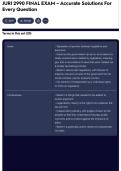
Terms in this set (20)
locke - Separation of powers between legislative and
executive
- Useful as the government can act in accordance to
dually enacted laws created by legislature, meaning
gov acts in accordance to laws that were created via
a proper lawmaking process
- Belief in democratic legislature, with themes of
majority rule and consent of the governed from his
social contract, esp for property owners
- No mention of independent jury, individual rights,
or limits on legislature
Montesquieu - Belief in 2 things that needed to be added to
locke's argument
- Legal liberty: liberty is the right to do whatever the
law permits
- Independent judiciary, with judges chosen by the
people so that they understand everyday public
concerns and to protect against the influence of
elites
- Belief in a politically active citizenry to perpetuate
rol ideas
, Dicey - 3 interconnected parts:
- Courts safeguard individual rights. They have
reason which allows them to decide what the law is,
as they possess merit which allows them to be free
from individual passion
- Everyone is equal in the laws eyes
- Individuals can be punished only if they breech a
preexsitng law
- Concerned about the growing power of
administrative state, would be against chevron, as it
meant courts gave deference to adminstrative
agencies whenever there was ambigous law
- Supported marbury v madison and the idea of
judicial review constraining governmental power
Criticism: courts sometimes produce vague and
indeterminate law, and he places excessive power at
the hands of the courts.
Hayek - Laws must be general, equal, and certain, so that
individuals can anticipate how the government will
exercise its sometimes frightening power
- General: not aimed at particular people
- Equal: apply uniformly to all
- Against administrative agencies as they apply
discretionary policy driven decision making rather
than neutral rules
- Freedom is not in unlimited choices, but being able
to choose without pressure/judgement from others
- Criticism: his hostility towards substantive aims may
be impractical in a modern regulatory state, and may
undermine the governments role of acknowledging
inequalities in society.
Every Question
Save Groups
Terms in this set (20)
locke - Separation of powers between legislative and
executive
- Useful as the government can act in accordance to
dually enacted laws created by legislature, meaning
gov acts in accordance to laws that were created via
a proper lawmaking process
- Belief in democratic legislature, with themes of
majority rule and consent of the governed from his
social contract, esp for property owners
- No mention of independent jury, individual rights,
or limits on legislature
Montesquieu - Belief in 2 things that needed to be added to
locke's argument
- Legal liberty: liberty is the right to do whatever the
law permits
- Independent judiciary, with judges chosen by the
people so that they understand everyday public
concerns and to protect against the influence of
elites
- Belief in a politically active citizenry to perpetuate
rol ideas
, Dicey - 3 interconnected parts:
- Courts safeguard individual rights. They have
reason which allows them to decide what the law is,
as they possess merit which allows them to be free
from individual passion
- Everyone is equal in the laws eyes
- Individuals can be punished only if they breech a
preexsitng law
- Concerned about the growing power of
administrative state, would be against chevron, as it
meant courts gave deference to adminstrative
agencies whenever there was ambigous law
- Supported marbury v madison and the idea of
judicial review constraining governmental power
Criticism: courts sometimes produce vague and
indeterminate law, and he places excessive power at
the hands of the courts.
Hayek - Laws must be general, equal, and certain, so that
individuals can anticipate how the government will
exercise its sometimes frightening power
- General: not aimed at particular people
- Equal: apply uniformly to all
- Against administrative agencies as they apply
discretionary policy driven decision making rather
than neutral rules
- Freedom is not in unlimited choices, but being able
to choose without pressure/judgement from others
- Criticism: his hostility towards substantive aims may
be impractical in a modern regulatory state, and may
undermine the governments role of acknowledging
inequalities in society.


